Skip to main content
Anatomy & Physiology
나의 코스
배우기
시험 준비
AI 튜터
학습 가이드
교과서적 해결책
플래시카드
탐험해 보세요
앱을 사용해 보세요
나의 코스
배우기
시험 준비
AI 튜터
학습 가이드
교과서적 해결책
플래시카드
탐험해 보세요
앱을 사용해 보세요
뒤로
Axial Skeleton Anatomy & Physiology
카드를 뒤집기 위해 탭할 수 있습니다.
Axial skeleton
카드를 뒤집기 위해 탭할 수 있습니다.
👆
Axial skeleton
The part of the skeleton forming the long axis of the body, including the skull, vertebral column, and rib cage.
진행 상황 추적
컨트롤 버튼이 '내비게이션' 모드로 변경되었습니다.
1/23
추천 영상
4:50
Skeletal System
15666
views
531
rank
이 집합의 용어 (23)
하이드의 정의
Axial skeleton
The part of the skeleton forming the long axis of the body, including the skull, vertebral column, and rib cage.
Appendicular skeleton
The part of the skeleton consisting of the limbs and girdles that attach them to the axial skeleton.
Bones of the axial skeleton
Includes the skull bones, vertebrae of the vertebral column, ribs, and sternum.
Cranial bones
Bones that form the protective case around the brain.
Facial bones
Bones that form the framework of the face.
Major sutures of the skull
Includes the coronal, sagittal, lambdoid, and squamous sutures.
Paranasal sinuses
Air-filled cavities in certain skull bones that lighten the skull and enhance voice resonance.
Vertebral column functions
Supports the head and trunk, protects the spinal cord, and provides attachment points for ribs and muscles.
Spinal curvatures
Curves in the vertebral column that increase strength, flexibility, and shock absorption.
Intervertebral discs
Pads of fibrocartilage between vertebrae that act as shock absorbers and allow movement.
Typical vertebra anatomy
Consists of a vertebral body, vertebral arch, and several processes for muscle attachment and articulation.
Cervical vertebrae characteristics
Small body, large vertebral foramen, transverse foramina, and bifid spinous processes.
Thoracic vertebrae characteristics
Medium-sized body, long spinous process, and facets for rib articulation.
Lumbar vertebrae characteristics
Large body, short and thick spinous process, designed to bear more weight.
Intervertebral foramina
Openings between vertebrae through which spinal nerves exit.
Vertebral canal
The central passage formed by vertebral foramina that houses the spinal cord.
Bony thorax components
Includes the sternum, ribs, and thoracic vertebrae.
Rib anatomy
Consists of a head, neck, tubercle, and shaft.
True ribs
Ribs 1-7 that attach directly to the sternum via costal cartilage.
False ribs
Ribs 8-12 that do not attach directly to the sternum; ribs 8-10 attach via cartilage of rib 7.
Floating ribs
Ribs 11-12 that have no anterior attachment to the sternum.
Fetal skull fontanels
Soft spots on a baby's skull where bones have not yet fused, allowing brain growth and easier birth.
Advantages of fontanels
Permit skull flexibility during birth and allow rapid brain growth during infancy.
 뒤로뒤로
뒤로뒤로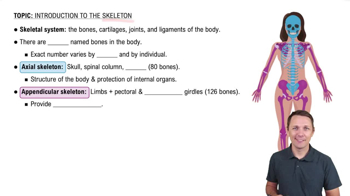
 4:50
4:50