Skip to main content
Anatomy & Physiology
나의 코스
배우기
시험 준비
AI 튜터
학습 가이드
교과서적 해결책
플래시카드
탐험해 보세요
앱을 사용해 보세요
나의 코스
배우기
시험 준비
AI 튜터
학습 가이드
교과서적 해결책
플래시카드
탐험해 보세요
앱을 사용해 보세요
뒤로
Axial Skeleton Anatomy & Physiology
카드를 뒤집기 위해 탭할 수 있습니다.
What are the two main divisions of the human skeleton?
카드를 뒤집기 위해 탭할 수 있습니다.
👆
What are the two main divisions of the human skeleton?
The skeleton is divided into the
axial skeleton
and the
appendicular skeleton
.
진행 상황 추적
컨트롤 버튼이 '내비게이션' 모드로 변경되었습니다.
1/21
추천 영상
VideoThumbView.guidedCourse
4:50
Skeletal System
16681
views
573
rank
1
comments
이 집합의 용어 (21)
하이드의 정의
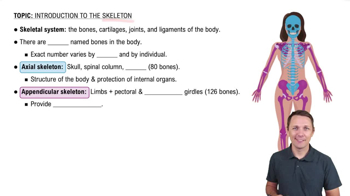
What are the two main divisions of the human skeleton?
The skeleton is divided into the
axial skeleton
and the
appendicular skeleton
.
Which bones make up the axial skeleton?
The axial skeleton includes the
skull
,
auditory ossicles
,
hyoid bone
,
vertebral column
, and
thoracic cage
.
Name the major bones of the skull.
Major skull bones include the
frontal
,
parietal
,
temporal
,
occipital
,
sphenoid
, and
ethmoid
bones.
What are the cranial bones?
The cranial bones are the
occipital
,
parietal
,
frontal
,
temporal
,
sphenoid
, and
ethmoid
bones.
What bones form the facial skeleton?
The facial bones include the
maxillae
,
zygomatic
,
nasal
,
lacrimal
,
palatine
,
inferior nasal conchae
,
vomer
, and
mandible
.
What is the function of the auditory ossicles?
The auditory ossicles (
malleus
,
incus
,
stapes
) transmit sound vibrations from the eardrum to the inner ear.
Where is the hyoid bone located and what is its function?
The
hyoid bone
is located in the neck and supports the tongue and serves as an attachment for muscles of swallowing.
What are the major parts of the vertebral column?
The vertebral column consists of
cervical
,
thoracic
,
lumbar
,
sacrum
, and
coccyx
regions.
How many vertebrae are in each region of the vertebral column?
There are 7 cervical, 12 thoracic, 5 lumbar vertebrae, plus the sacrum and coccyx.
What are the three types of ribs in the thoracic cage?
The ribs are classified as
true ribs
(vertebrosternal),
false ribs
(vertebrochondral), and
floating ribs
(vertebral).
What are the main parts of the sternum?
The sternum consists of the
manubrium
,
body
, and
xiphoid process
.
What is the significance of the foramen magnum?
The
foramen magnum
is the large opening in the occipital bone through which the spinal cord passes.
What sutures connect the cranial bones?
Major cranial sutures include the
sagittal
,
coronal
,
lambdoid
, and
squamous
sutures.
What is the function of the nasal conchae?
The
nasal conchae
increase the surface area of the nasal cavity to warm and humidify inhaled air.
What is the role of the sacrum in the vertebral column?
The
sacrum
is a fused bone that connects the vertebral column to the pelvic girdle.
Describe the unique features of cervical vertebrae.
Cervical vertebrae have a
bifid spinous process
and
transverse foramina
for vertebral arteries.
What distinguishes thoracic vertebrae from other vertebrae?
Thoracic vertebrae have
costal facets
for rib articulation.
What are the key features of lumbar vertebrae?
Lumbar vertebrae have large, thick bodies and short, blunt spinous processes for weight support.
What is the function of the sacral foramina?
The
sacral foramina
allow passage of nerves and blood vessels through the sacrum.
What is the anatomical significance of the mandibular foramen?
The
mandibular foramen
allows passage of the inferior alveolar nerve and vessels to the lower jaw.
What bones contribute to the orbit of the eye?
The orbit is formed by the
frontal
,
maxilla
,
zygomatic
,
lacrimal
,
ethmoid
,
sphenoid
, and
palatine
bones.
 뒤로뒤로
 4:50
