뒤로

Axial Skeleton Anatomy & Physiology

컨트롤 버튼이 '내비게이션' 모드로 변경되었습니다.
1/23
  • What are the main divisions of the skeleton?

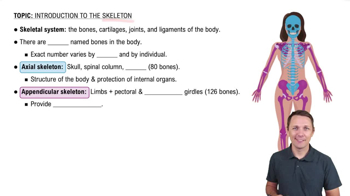
    Axial skeleton (bones of head and trunk) and appendicular skeleton (bones supporting limbs).
  • How many bones are in the axial skeleton and what are its major components?

    80 bones including the skull (8 cranial, 14 facial), 6 auditory ossicles, hyoid bone, thoracic cage (sternum and 24 ribs), and vertebral column (24 vertebrae, sacrum, coccyx).
  • What are the primary functions of the axial skeleton?

    Supports and protects organs in body cavities, provides muscle attachment points for head, neck, trunk movement, breathing, and stabilizes appendicular skeleton.
  • How many cranial and facial bones form the skull?

    22 bones total: 8 cranial bones form the cranium and 14 facial bones.
  • What are sutures in the skull and name the four major sutures?

    Immovable joints between skull bones. Major sutures: Lambdoid, Coronal, Sagittal, and Squamous.
  • What is the function of the paranasal sinuses?

    Air-filled chambers that decrease skull weight, produce mucus to moisten air, and serve as resonating chambers for speech.
  • Name the eight cranial bones.

    Occipital, parietal (2), frontal, temporal (2), sphenoid, and ethmoid bones.
  • What is the significance of the occipital bone?

    Forms much of the posterior and inferior cranium, articulates with parietal, temporal, sphenoid bones, and the first cervical vertebra (atlas).
  • What are the auditory ossicles and their function?

    Three tiny bones in the middle ear that transfer sound vibrations from the eardrum to the internal ear.
  • Describe the sphenoid bone and its key features.

    Forms part of the cranial floor, unites cranial and facial bones, contains sphenoidal sinuses, and has the sella turcica which holds the pituitary gland.
  • What bones form the orbital complex (eye socket)?

    Frontal (roof), maxilla (floor), maxilla, lacrimal, ethmoid (medial wall), sphenoid, palatine, and zygomatic (lateral wall).
  • What are the five vertebral regions and their vertebrae counts?

    Cervical (7), thoracic (12), lumbar (5), sacral (5 fused), and coccygeal (3-5 fused).
  • What are the primary and secondary spinal curves?

    Primary curves: thoracic and sacral (present at birth). Secondary curves: cervical and lumbar (develop after birth for upright posture).
  • Describe the characteristics of cervical vertebrae.

    Small bodies, large vertebral foramina, concave superior surfaces, and support only the head.
  • What distinguishes thoracic vertebrae from other vertebrae?

    Heart-shaped bodies, costal facets for rib articulation, long slender spinous processes.
  • Describe lumbar vertebrae features.

    Largest vertebrae with thick oval bodies, no costal facets, triangular vertebral foramen, and massive spinous processes for muscle attachment.
  • What is the sacrum and its function?

    Five fused vertebrae forming a curved bone that protects pelvic organs and connects axial skeleton to pelvic girdle.
  • What is the coccyx and its anatomical significance?

    3-5 fused vertebrae forming the tailbone, attaching ligaments and muscles of the anus.
  • What bones make up the thoracic cage?

    Thoracic vertebrae, ribs (12 pairs), costal cartilages, and sternum.
  • Differentiate between true ribs, false ribs, and floating ribs.

    True ribs (1-7) attach directly to sternum; false ribs (8-12) attach indirectly or not at all; floating ribs (11-12) have no anterior attachment.
  • What are the three parts of the sternum?

    Manubrium (superior), body (middle), and xiphoid process (inferior).
  • What is the function of the manubrium?

    Articulates with clavicles and first rib pair; contains jugular notch.
  • What is the xiphoid process and its clinical significance?

    Smallest sternum part, attaches diaphragm and abdominal muscles, and is easily broken.