 뒤로
Axial Skeleton and Bone Landmarks
 4:50

이 집합의 용어 (20)
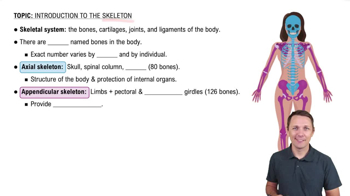
The axial skeleton includes the skull, vertebral column, rib cage, and sternum.
It provides support and protection for the brain, spinal cord, and thoracic organs.
The manubrium, body, and xiphoid process.
It is composed of 33 vertebrae divided into cervical, thoracic, lumbar, sacral, and coccygeal regions.
The mastoid process is a prominent landmark of the temporal bone.
The rib cage protects the heart and lungs and supports the upper body.
Cervical vertebrae have transverse foramina for vertebral artery passage.
They articulate with the first cervical vertebra, allowing head movement.
True ribs attach directly to the sternum; false ribs attach indirectly or not at all.
The acromion process is a key muscle attachment site on the scapula.
It forms the vertebral canal that houses the spinal cord.
The frontal bone forms the forehead.
The sternal angle is the junction between the manubrium and body; it is a landmark for rib 2.
Thoracic vertebrae have facets for rib articulation.
The hyoid bone supports the tongue and is an attachment site for neck muscles.
The coronoid process is a muscle attachment site on the mandible.
The nasal bones form the bridge of the nose.
It serves as a muscle and ligament attachment point.
The atlas (C1) supports the skull; the axis (C2) has the dens for head rotation.
The mandible forms the lower jaw.