 뒤로
Basic Chemistry Concepts for Anatomy & Physiology
 02:13

이 집합의 용어 (22)
Matter is anything that has mass and occupies space. The three basic forms are solid, liquid, and gas.
Energy is the capacity to do work. Kinetic energy is energy of motion (e.g., muscle contraction). Potential energy is stored energy (e.g., chemical energy in ATP).
An atom is the smallest unit of matter that retains properties of an element. An element is a substance made of only one type of atom.
The main elements are oxygen (O), carbon (C), hydrogen (H), nitrogen (N), calcium (Ca), and phosphorus (P).
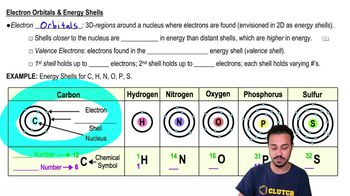
Protons and neutrons form the nucleus; electrons orbit in shells. Number of protons = atomic number; electrons balance protons; neutrons add mass.
Molecules are two or more atoms bonded together. Compounds are molecules with at least two different elements.
The solvent is the substance that dissolves another (usually water). The solute is the substance dissolved in the solvent.
Solutions are homogeneous mixtures with solutes dissolved at the molecular level. Suspensions have larger particles that may settle out over time.
Elements with full outer electron shells are inert. Those with incomplete shells are reactive and seek stability by bonding.
Reactive elements gain, lose, or share electrons to fill their outer shells, forming chemical bonds to achieve stability.
Ionic bonds transfer electrons; covalent bonds share electrons; hydrogen bonds are weak attractions between polar molecules.
Single bonds share one pair of electrons; double bonds share two pairs; polar covalent bonds share electrons unequally.
Synthesis: A + B → AB; Decomposition: AB → A + B; Exchange: AB + CD → AD + CB; Reversible: A + B ⇌ AB.
Factors include temperature, concentration, particle size, and catalysts. Reaction rates affect metabolism and homeostasis.
Organic compounds contain carbon and hydrogen (e.g., carbohydrates). Inorganic compounds generally lack carbon (e.g., water, salts).
Carbohydrates, lipids, proteins, nucleic acids, and ATP. Each has unique structure, building blocks, and functions.
Structural proteins provide support (e.g., collagen). Active proteins perform functions like enzymes and hormones.
Enzymes bind specific substrates at active sites, lowering activation energy and speeding reactions without being consumed.
Water is a solvent, temperature buffer, lubricant, and reactant in metabolism. It has high heat capacity and polarity.
Acids release H+; bases release OH-; salts are products of acid-base reactions.
Buffers maintain pH by neutralizing acids or bases. A buffer pair includes a weak acid and its conjugate base.
pH measures hydrogen ion concentration. Strong acids: pH 0-3; weak acids: pH 4-6; neutral: pH 7; weak bases: pH 8-10; strong bases: pH 11-14.