Skip to main content
Anatomy & Physiology
나의 코스
배우기
시험 준비
AI 튜터
학습 가이드
교과서적 해결책
플래시카드
탐험해 보세요
앱을 사용해 보세요
나의 코스
배우기
시험 준비
AI 튜터
학습 가이드
교과서적 해결책
플래시카드
탐험해 보세요
앱을 사용해 보세요
뒤로
Biomolecules in Anatomy & Physiology
카드를 뒤집기 위해 탭할 수 있습니다.
What are the four important classes of biological molecules?
카드를 뒤집기 위해 탭할 수 있습니다.
👆
What are the four important classes of biological molecules?
Carbohydrates, proteins, nucleic acids, and lipids
.
진행 상황 추적
컨트롤 버튼이 '내비게이션' 모드로 변경되었습니다.
1/20
추천 영상
VideoThumbView.guidedCourse
03:35
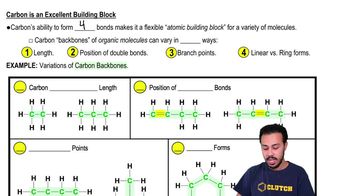
Carbon is an Excellent Building Block
23170
views
916
rank
VideoThumbView.guidedCourse
04:19
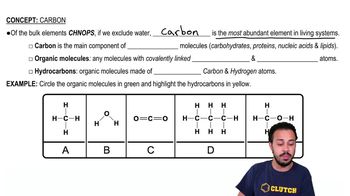
Carbon
30483
views
719
rank
1
comments
이 집합의 용어 (20)
하이드의 정의
What are the four important classes of biological molecules?
Carbohydrates, proteins, nucleic acids, and lipids
.
What is the structural basis of biological molecules?
Carbon forms the skeletons of biological molecules by bonding with hydrogen, oxygen, nitrogen, and other atoms.
How do carbon skeletons vary?
They vary in
length, branching, double bond position, and presence of rings
.
What are hydrocarbons?
Organic molecules consisting only of
carbon and hydrogen
, often found in fats and can release large energy.
What is dehydration synthesis?
A reaction where two monomers bond by
removal of a water molecule
.
What is hydrolysis?
The breakdown of polymers into monomers by
adding a water molecule
.
What are carbohydrates composed of?
They contain
carbon, hydrogen, and oxygen
with hydrogen and oxygen in a 2:1 ratio.
What are the three classes of carbohydrates?
Monosaccharides (single sugars), disaccharides (two sugars), and polysaccharides (many sugars)
.
What is the general formula for monosaccharides?
CH2O (n)
, where n is the number of carbon atoms.
Name important monosaccharides.
Ribose, deoxyribose (pentose sugars), and glucose (hexose sugar)
.
What are disaccharides?
Double sugars formed by
dehydration synthesis of two monosaccharides
, e.g., sucrose, maltose, lactose.
What are polysaccharides?
Polymers of monosaccharides formed by
dehydration synthesis
, e.g., starch (plants) and glycogen (animals).
What are lipids?
Hydrophobic molecules mostly made of hydrocarbons, including
fats, phospholipids, and steroids
.
What are triglycerides composed of?
Three fatty acids bonded to a glycerol molecule by
dehydration synthesis
.
Difference between saturated and unsaturated fatty acids?
Saturated have
single bonds
and pack tightly (solid at room temp); unsaturated have
double bonds
causing kinks (liquid at room temp).
What are phospholipids?
Modified triglycerides with two fatty acids and a phosphorus-containing group; have
hydrophilic heads and hydrophobic tails
.
Why are phospholipids important?
They form the
bilayer structure of cell membranes
.
What is the structure of steroids?
Consist of
four interlocking hydrocarbon rings
.
What is the most important steroid?
Cholesterol
, which is a precursor for vitamin D, steroid hormones, and bile salts.
How do dehydration synthesis and hydrolysis relate?
Dehydration synthesis
builds polymers
by removing water; hydrolysis
breaks polymers
by adding water.
 뒤로뒤로
 03:35