What are the main functions of the circulatory system?
Transport of nutrients, gases, and wastes; Protection through immune responses; and Regulation of body temperature and pH.
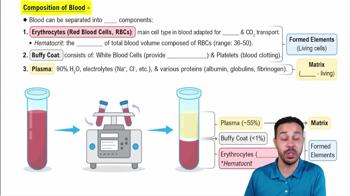
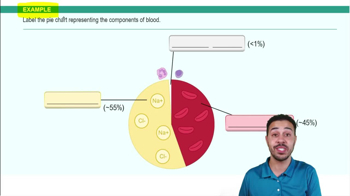
What are the two main components of blood?
Plasma (liquid portion) and formed elements (cells and cell fragments).
What percentage of blood is plasma and what does it contain?
About 55% of blood is plasma, composed of 92% water, 7% proteins, and 1% other solutes like nutrients, wastes, hormones, and gases.
What are the three major plasma proteins and their roles?
Albumin (transports solutes, buffers pH, affects viscosity), Globulins (immune defense and transport), and Fibrinogen (clotting).
What is hematopoiesis?
The continuous production of formed elements in blood, including red blood cells, white blood cells, and platelets.
What are erythrocytes and their main functions?
Red blood cells that transport oxygen from lungs to tissues and carbon dioxide from tissues to lungs.
Describe the structure of erythrocytes.
Bi-concave discs with no nucleus or organelles, allowing more space for hemoglobin and efficient gas exchange.
What is hemoglobin and its function?
An iron-containing protein in RBCs that binds oxygen; each iron atom binds one oxygen molecule.
Why do erythrocytes rely on anaerobic fermentation for ATP?
Because they lack mitochondria, preventing them from using oxygen for energy, which preserves oxygen for transport.
What is the typical lifespan of an erythrocyte?
About 120 days, after which they are broken down and recycled.
What is sickle-cell anemia?
A genetic disorder where abnormal hemoglobin causes RBCs to become crescent-shaped, leading to impaired oxygen transport.
What are leukocytes and their primary role?
White blood cells that defend the body against infection and remove debris.
Name the two main categories of leukocytes.
Granulocytes (neutrophils, eosinophils, basophils) and Agranulocytes (monocytes, lymphocytes).
What is leukopoiesis?
The production of white blood cells from hematopoietic stem cells.
What are platelets and their function?
Small cell fragments from megakaryocytes that play a key role in blood clotting.
What are the three stages of hemostasis?
Vascular spasm, platelet plug formation, and coagulation (blood clotting).
How does coagulation differ from agglutination?
Coagulation involves fibrin forming a mesh to trap cells; agglutination is RBCs clumping due to antibody-antigen binding.
What determines human blood types?
The presence or absence of specific antigens on RBC surfaces and corresponding antibodies in plasma.
Describe the ABO blood group system.
Type A has A antigens and anti-B antibodies; Type B has B antigens and anti-A antibodies; Type AB has both antigens and no antibodies; Type O has no antigens and both antibodies.
What is the universal donor and universal recipient blood type?
Universal donor: Type O (no antigens); Universal recipient: Type AB (no antibodies).
What is the Rh factor in blood typing?
An antigen that is either present (+) or absent (-); Rh-negative individuals produce antibodies only if exposed to Rh-positive blood.
 뒤로
 2:36