Skip to main content
Anatomy & Physiology
나의 코스
배우기
시험 준비
AI 튜터
학습 가이드
교과서적 해결책
플래시카드
탐험해 보세요
앱을 사용해 보세요
나의 코스
배우기
시험 준비
AI 튜터
학습 가이드
교과서적 해결책
플래시카드
탐험해 보세요
앱을 사용해 보세요
뒤로
Blood Composition and Blood Typing in Anatomy & Physiology
카드를 뒤집기 위해 탭할 수 있습니다.
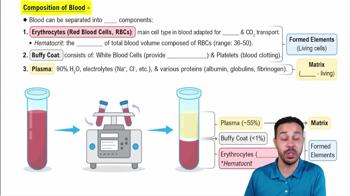
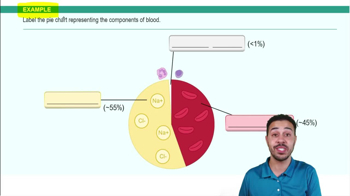
What are the main components of whole blood?
카드를 뒤집기 위해 탭할 수 있습니다.
👆
What are the main components of whole blood?
Plasma
(46–63%) and
formed elements
(37–54%), which include red blood cells, white blood cells, and platelets.
진행 상황 추적
컨트롤 버튼이 '내비게이션' 모드로 변경되었습니다.
1/20
추천 영상
VideoThumbView.guidedCourse
2:36
Introduction to Blood Example 1
11366
views
334
rank
VideoThumbView.guidedCourse
7:49
Composition of Blood
11911
views
337
rank
VideoThumbView.guidedCourse
1:55
Introduction to Blood Example 2
9383
views
225
rank
이 집합의 용어 (20)
하이드의 정의
What are the main components of whole blood?
Plasma
(46–63%) and
formed elements
(37–54%), which include red blood cells, white blood cells, and platelets.
What is the composition of plasma?
Plasma is about 92% water, 7% plasma proteins, and 1% other solutes.
What percentage of whole blood do red blood cells (RBCs) make up?
Red blood cells make up approximately 99.9% of the formed elements in blood.
Describe the shape and size of a mature red blood cell.
RBCs are biconcave discs about 7.2–8.4 µm in diameter, 2.31–2.85 µm wide, and 0.45–1.16 µm thick.
Why do RBCs appear two-dimensional in a blood smear?
Because they are flattened against the surface of the slide, making them appear as thin, two-dimensional objects.
Name the five types of white blood cells (WBCs).
Neutrophils, eosinophils, basophils, monocytes, and lymphocytes.
Which WBCs are classified as granular leukocytes?
Neutrophils, eosinophils, and basophils.
Which WBCs are classified as agranular leukocytes?
Monocytes and lymphocytes.
What is the typical percentage range of neutrophils in blood?
Neutrophils typically make up 50–70% of white blood cells.
What is the function of platelets in blood?
Platelets are involved in blood clotting and help prevent bleeding.
What determines a person's blood type?
The presence or absence of surface antigens (agglutinogens) A and B on red blood cells.
What antibodies are present in the plasma of Type A blood?
Anti-B antibodies, which attack Type B surface antigens.
What antibodies are present in the plasma of Type B blood?
Anti-A antibodies, which attack Type A surface antigens.
What antibodies are present in the plasma of Type AB blood?
Neither anti-A nor anti-B antibodies are present.
What antibodies are present in the plasma of Type O blood?
Both anti-A and anti-B antibodies are present.
What is the Rh factor in blood typing?
A surface antigen (D antigen) that can be either present (+) or absent (–), affecting blood compatibility.
How is hemoglobin concentration in blood measured?
Using a hemoglobinometer, which compares color density of a hemolyzed blood sample to a standard scale.
What is the significance of blood typing and cross-reactions?
To ensure compatibility for blood transfusions and prevent immune reactions against foreign antigens.
What is the typical size range of platelets?
Platelets are less than 0.1% of formed elements and are much smaller than red blood cells, typically 2–4 µm in diameter.
What is the role of white blood cells in blood?
White blood cells defend the body against infection and remove debris.
 뒤로뒤로
 2:36