 뒤로
Bone Structure and Skeletal System Basics
 3:56

이 집합의 용어 (20)
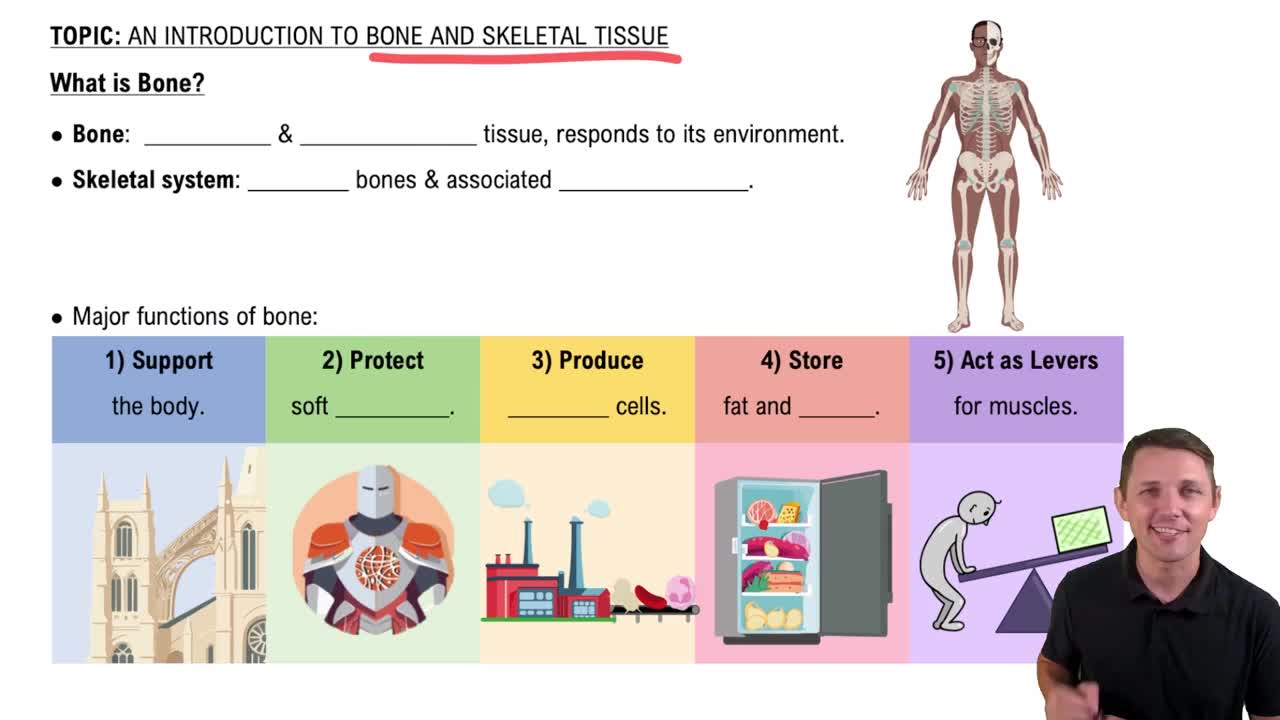
The skeletal system provides support, protection, movement, mineral storage, blood cell production, and energy storage.
Compact bone is dense and forms the outer layer; spongy bone is porous and found inside bones.
A long bone has a diaphysis (shaft), epiphyses (ends), and a medullary cavity containing marrow.
Osteocytes are mature bone cells that maintain bone tissue.
Osteoblasts synthesize new bone matrix and initiate mineralization.
Osteoclasts resorb bone by breaking down the mineral matrix.
The periosteum is a dense connective tissue layer covering the outer surface of bones, containing nerves and blood vessels.
The medullary cavity houses bone marrow, which produces blood cells and stores fat.
Red marrow produces blood cells; yellow marrow stores fat.
The axial skeleton includes the skull, vertebral column, and rib cage; the appendicular skeleton includes limbs and girdles.
Cartilage provides flexible support and reduces friction at joints.
The epiphyseal plate is a growth plate of cartilage where bone lengthening occurs in children.
Calcium phosphate is the main mineral stored, providing hardness to bone.
Bone remodeling is the continuous process of bone resorption and formation to maintain bone strength and mineral balance.
The Haversian system is the structural unit of compact bone, consisting of concentric lamellae around a central canal.
The central canal contains blood vessels and nerves supplying the osteon.
Lacunae are small spaces housing osteocytes within the bone matrix.
Canaliculi are tiny channels connecting lacunae, allowing nutrient and waste exchange between osteocytes.
Intramembranous ossification is bone formation directly from mesenchymal tissue, mainly in flat bones.
Endochondral ossification is bone formation by replacing cartilage, typical in long bones.