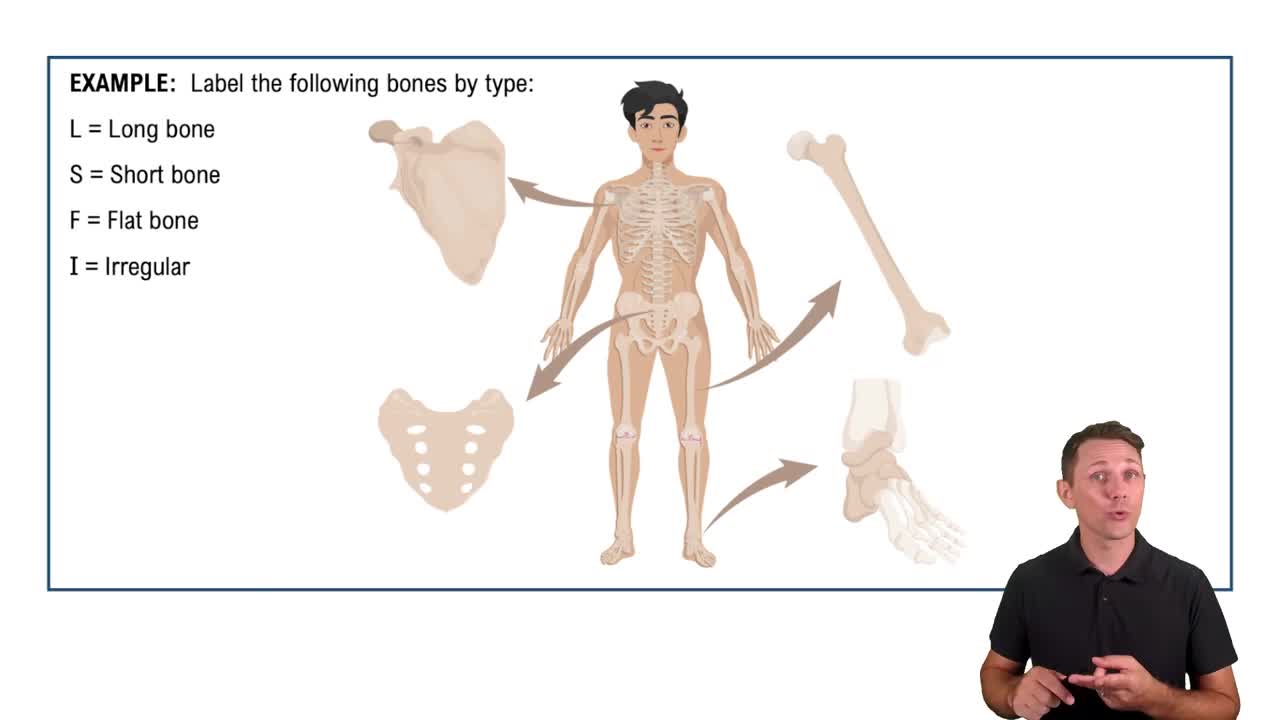
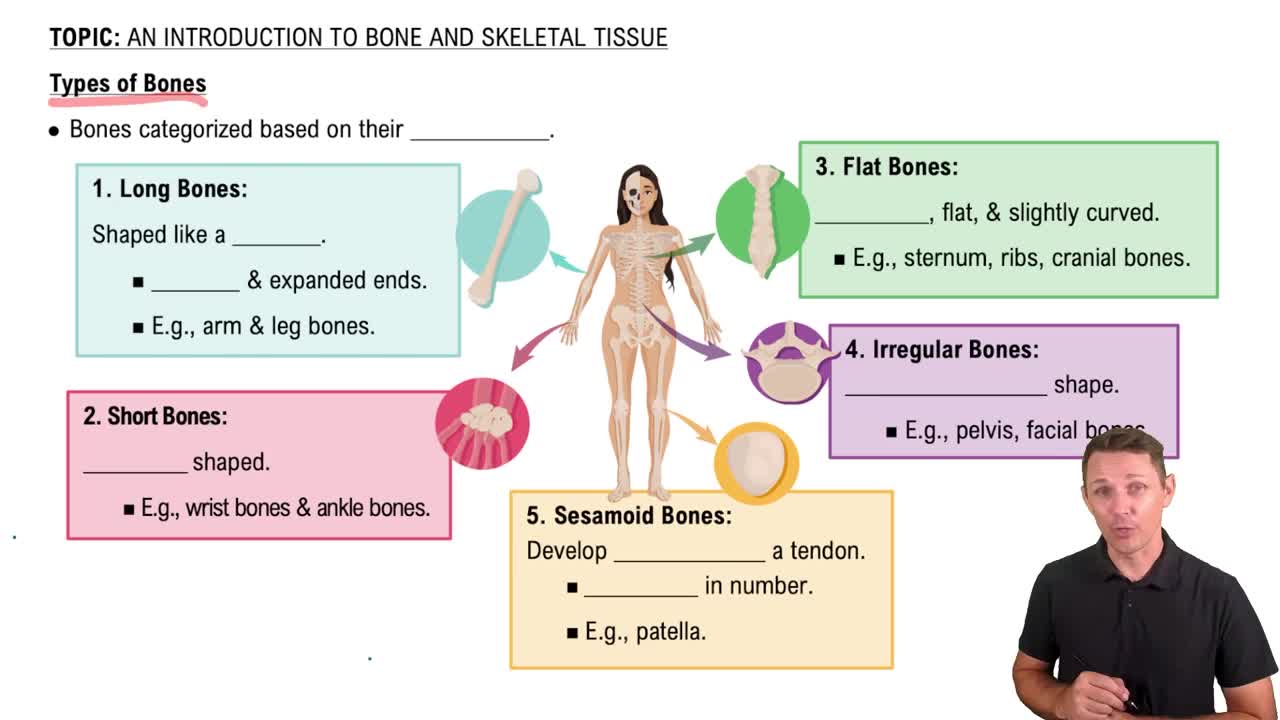
Bone is made up of several tissues including bone, cartilage, dense connective tissue, adipose, and nervous tissue working together.
What are the main functions of the skeletal system?
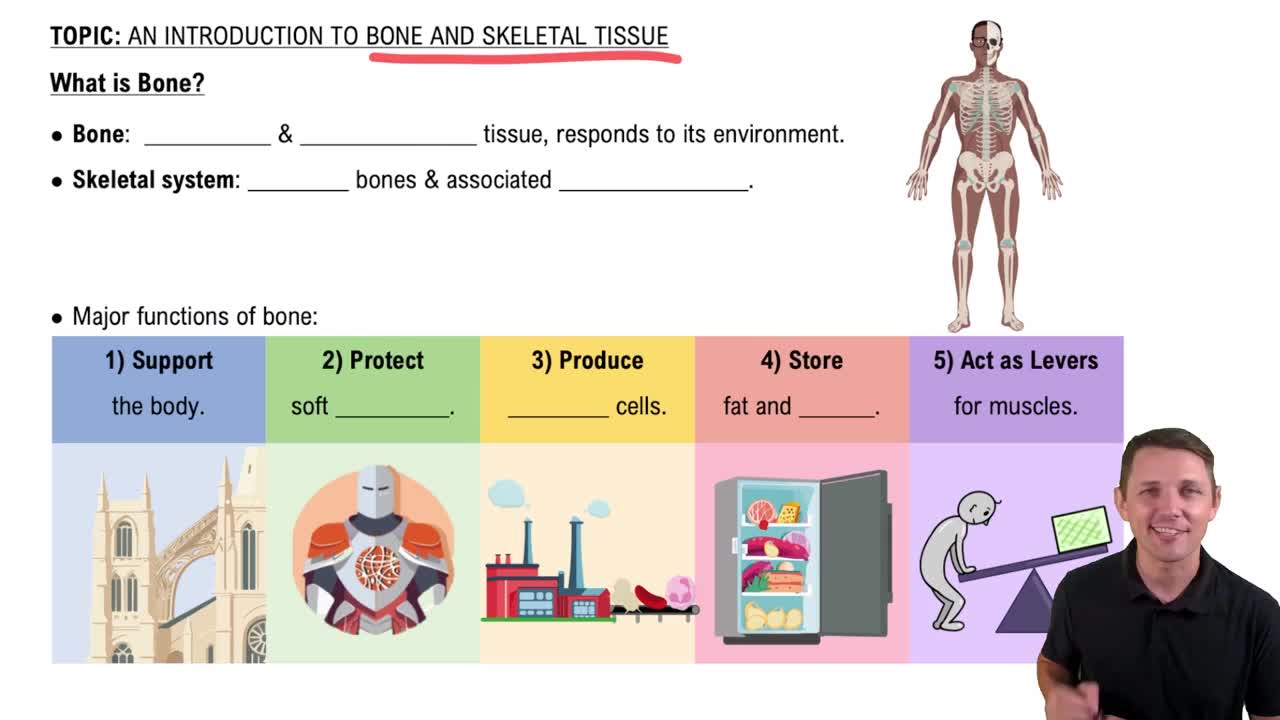
Support, protection of organs, assistance in movement, mineral homeostasis, blood cell production, and triglyceride storage.
Name the main parts of a long bone.
Diaphysis (shaft), 2 epiphyses (ends), 2 metaphyses (between diaphysis and epiphysis), articular cartilage, periosteum, medullary cavity, and endosteum.
What is the composition of the bone extracellular matrix?
About 15% water, 30% collagen fibers, and 55% crystallized mineral salts mainly hydroxyapatite.
What mineral salts form hydroxyapatite in bone?
Calcium phosphate and calcium hydroxide combine to form hydroxyapatite crystals.
List the four types of bone cells and their functions.
Osteoprogenitor cells: stem cells; Osteoblasts: build bone and secrete matrix; Osteocytes: mature bone cells; Osteoclasts: resorb bone and release calcium.
What are the differences between compact and spongy bone?
Compact bone is dense and strong for protection and support; spongy bone is lightweight, provides tissue support, and contains trabeculae.
How do periosteal arteries enter the bone?
Periosteal arteries enter the diaphysis through Volkmann’s canals accompanied by nerves and veins.
What is ossification (osteogenesis)?
The process of bone formation occurring during embryonic development, growth, remodeling, and fracture repair.
Name the two types of ossification.
Intramembranous ossification and endochondral ossification.
Where does intramembranous ossification occur?
In flat bones, where connective tissue membranes are replaced by bone.
What happens during endochondral ossification?
Cartilage is replaced by bone, occurring in the embryo and at epiphyseal plates for bone lengthening.
How do bones grow in thickness?
Osteoblasts deposit bone on the outer surface while osteoclasts widen the medullary cavity from within.
Which minerals are essential for bone growth and remodeling?
Calcium, phosphorus, magnesium, fluoride, and manganese.
Which vitamins affect bone growth?
Vitamins A, C, D, K, and B12 are important for bone health.
What hormones influence bone growth?
IGFs (stimulated by GH), thyroid hormones (T3 and T4), estrogen, and testosterone.
What are the phases of fracture healing?
1. Reactive (inflammatory) phase, 2. Reparative phase (fibrocartilaginous then bony callus), 3. Bone remodeling phase.
How does bone participate in calcium homeostasis?
Bones store 99% of body calcium; PTH stimulates osteoclasts to release calcium and increases intestinal absorption via calcitriol.
What changes occur in bone tissue with aging?
Bone mass decreases as resorption outpaces formation, especially in post-menopausal women.
What is osteoporosis?
A disorder where bone resorption exceeds formation, leading to fragile bones; affects mostly women.
What causes rickets and osteomalacia?
Inadequate calcification of bone matrix; rickets affects children causing deformities, osteomalacia affects adults causing bone pain and fractures.
 뒤로
 3:56