 뒤로
Bones and Bone Tissue - Anatomy & Physiology
 3:56

이 집합의 용어 (32)
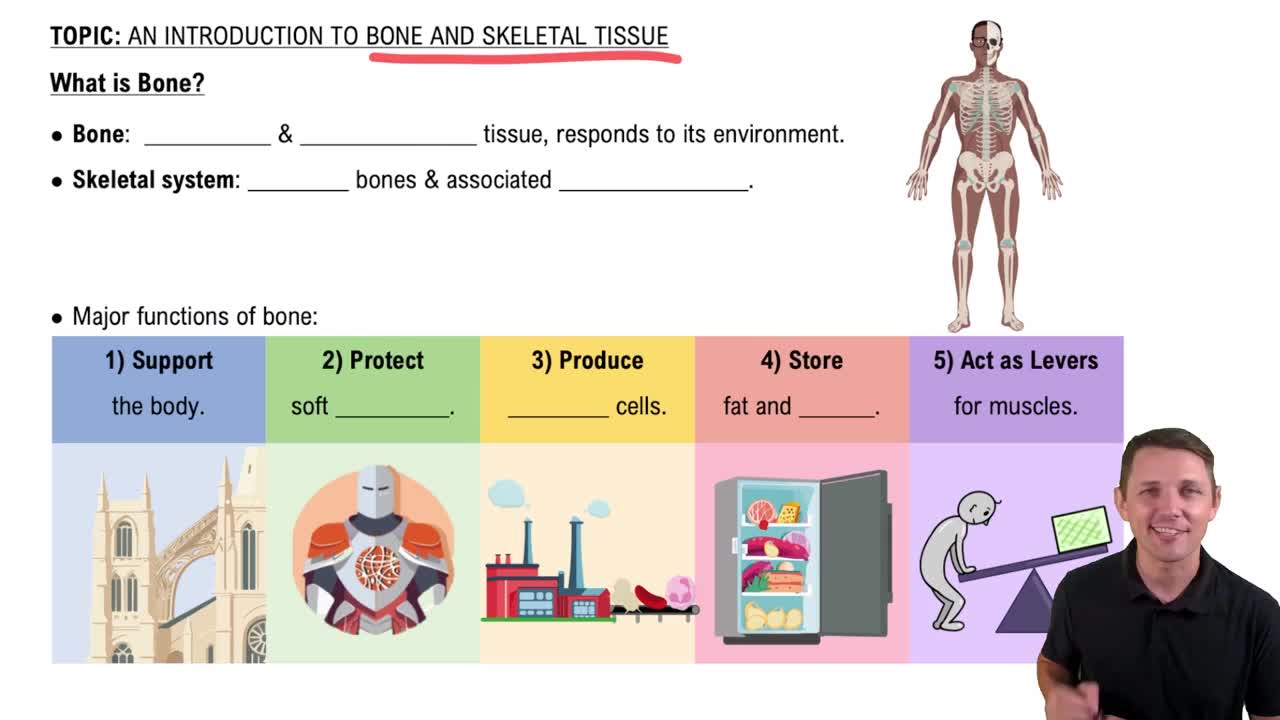
Support, protection, movement, mineral storage, blood cell production, and energy storage.
Compact bone and spongy (cancellous) bone.
Dense bone tissue made of osteons with central canals containing blood vessels and nerves.
The structural unit of compact bone, consisting of concentric lamellae around a central canal.
Concentric rings of mineralized matrix in an osteon.
Osteoblasts synthesize and secrete bone matrix.
Osteoclasts resorb bone by breaking down matrix.
Mature bone cells that maintain bone matrix and communicate with other bone cells.
A dense connective tissue membrane covering the outer surface of bones, containing nerves and blood vessels.
A thin membrane lining the medullary cavity and trabeculae of spongy bone.
Porous bone made of trabeculae with spaces filled by bone marrow.
The central cavity inside long bones that contains yellow bone marrow.
Red marrow produces blood cells; yellow marrow stores fat.
Calcium and phosphorus.
The process of bone tissue formation.
Intramembranous and endochondral ossification.
Flat bones of the skull and clavicles.
Most bones of the skeleton, especially long bones.
A cartilage plate in long bones where growth in length occurs.
Cartilage cells divide and ossify, lengthening the bone.
The continuous process of bone resorption and formation to maintain bone strength and mineral homeostasis.
Increases osteoclast activity to raise blood calcium levels.
Inhibits osteoclasts to lower blood calcium levels.
Collagen fibers and ground substance (osteoid).
Hydroxyapatite crystals made of calcium phosphate.
Provides tensile strength and flexibility.
Provides hardness and resistance to compression.
A break in the continuity of a bone.
Hematoma formation, fibrocartilaginous callus formation, bony callus formation, and bone remodeling.
Stem cells that differentiate into osteoblasts.
The central canal in an osteon containing blood vessels and nerves.
Channels that connect Haversian canals and carry blood vessels between osteons.