 뒤로
Bones and Bone Tissues - Anatomy & Physiology
 3:56

이 집합의 용어 (20)
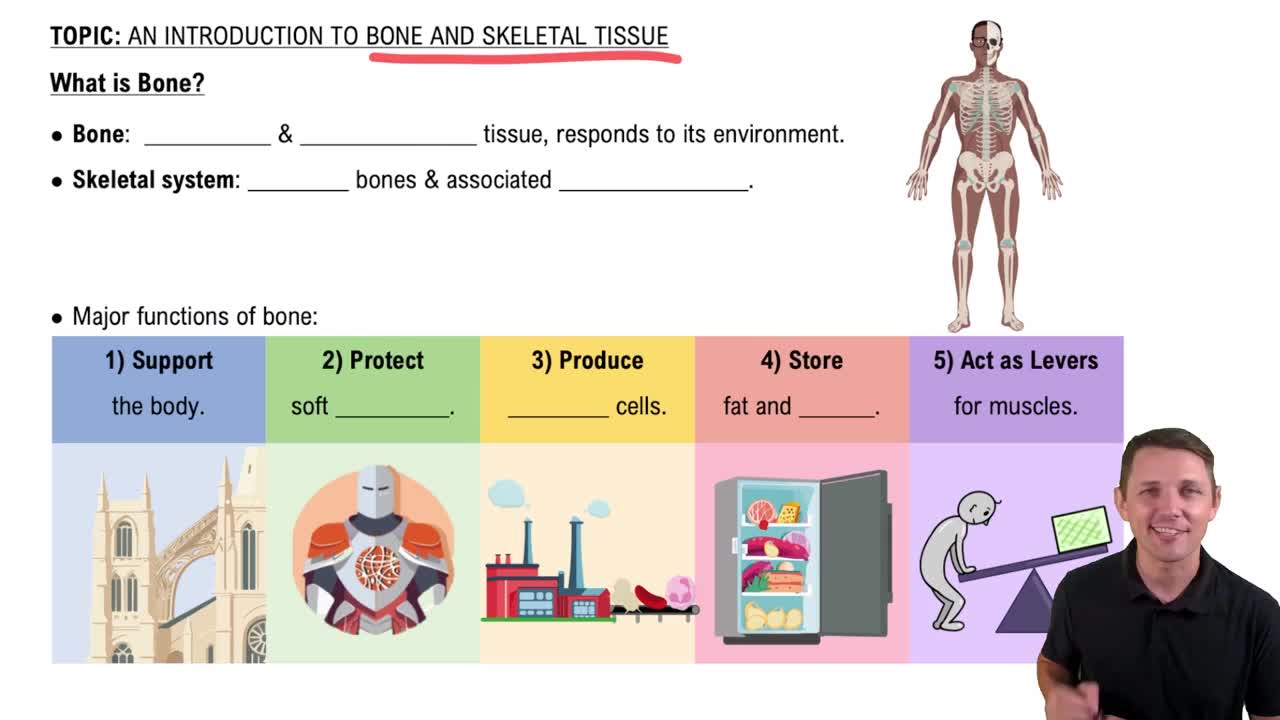
Support, protection, movement, mineral storage, blood cell production, and energy storage.
Compact bone and spongy (cancellous) bone.
Dense and solid with osteons (Haversian systems) as the structural unit.
The basic structural unit of compact bone, consisting of concentric lamellae surrounding a central canal.
Osteoblasts synthesize and secrete bone matrix.
Osteoclasts resorb bone by breaking down the matrix.
Mature bone cells that maintain the bone matrix and communicate with other bone cells.
Osteoid, mainly composed of collagen fibers.
Hydroxyapatite, a calcium phosphate mineral.
Inside bones, especially at the ends of long bones and inside flat bones.
Provides structural support and houses red bone marrow for blood cell production.
A dense connective tissue membrane covering the outer surface of bones, containing nerves and blood vessels.
A thin membrane lining the inner surface of bone cavities.
Compact bone is dense with osteons; spongy bone has a porous, trabecular structure without osteons.
The continuous process of bone resorption and formation to maintain bone strength and mineral homeostasis.
It contains blood vessels and nerves supplying the bone.
Small spaces housing osteocytes within the bone matrix.
Microscopic channels connecting lacunae, allowing nutrient and waste exchange between osteocytes.
Osteoclasts.
Collagen fibers in the osteoid.