뒤로

Bones and Skeletal Tissues - Anatomy & Physiology

컨트롤 버튼이 '내비게이션' 모드로 변경되었습니다.
1/26
  • What is skeletal cartilage and its key characteristics?

    Skeletal cartilage is made of highly resilient cartilage tissue, primarily water, containing no blood vessels or nerves, and is surrounded by a dense connective tissue layer called the perichondrium.
  • Name the three types of cartilage and a key feature of each.

    Hyaline cartilage: most abundant, provides support and flexibility.
    Elastic cartilage: contains elastic fibers, found in external ear and epiglottis.
    Fibrocartilage: thick collagen fibers, great tensile strength, found in menisci and intervertebral discs.
  • How does cartilage grow?

    Cartilage grows by appositional growth (new matrix on surface) and interstitial growth (new matrix within cartilage). Growth ends during adolescence.
  • List the seven functions of bones.

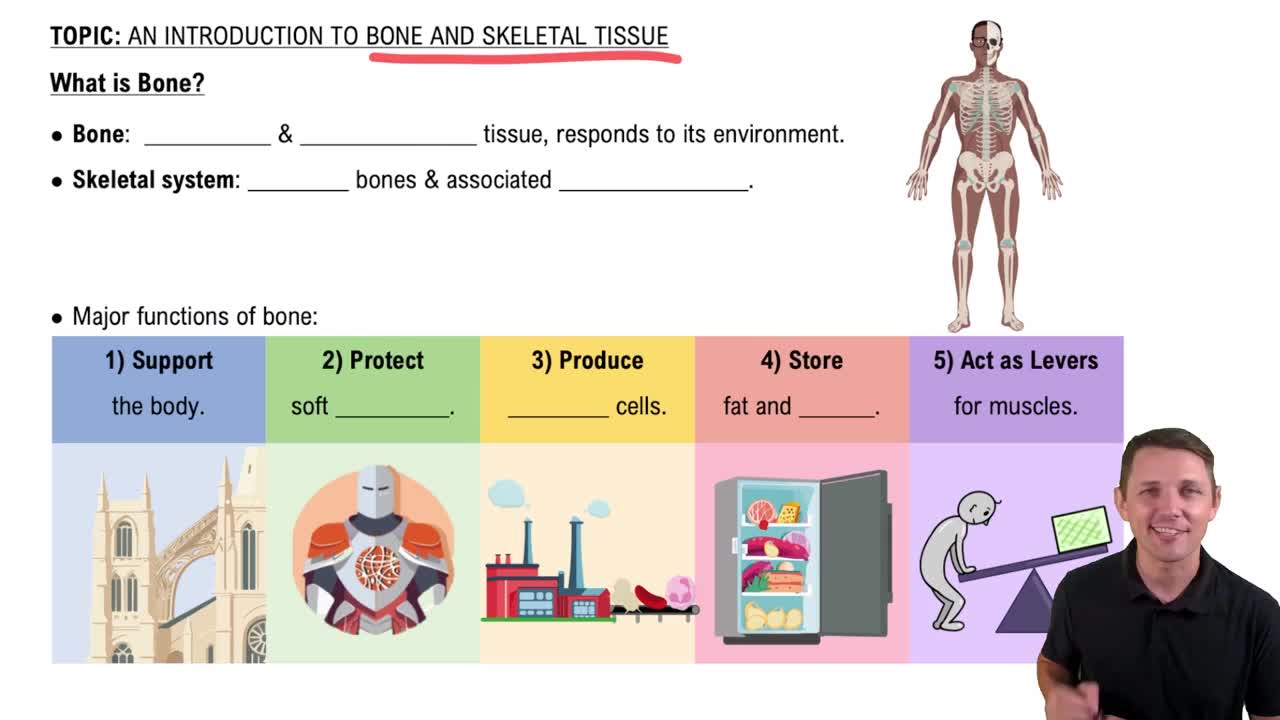
    Support, protection, anchorage for muscles, mineral storage, blood cell formation (hematopoiesis), triglyceride storage, and hormone production (osteocalcin).
  • What are the two main groups of bones based on location?

    Axial skeleton: skull, vertebral column, rib cage.
    Appendicular skeleton: limbs and girdles attaching limbs to axial skeleton.
  • Classify bones by shape and give an example of each.

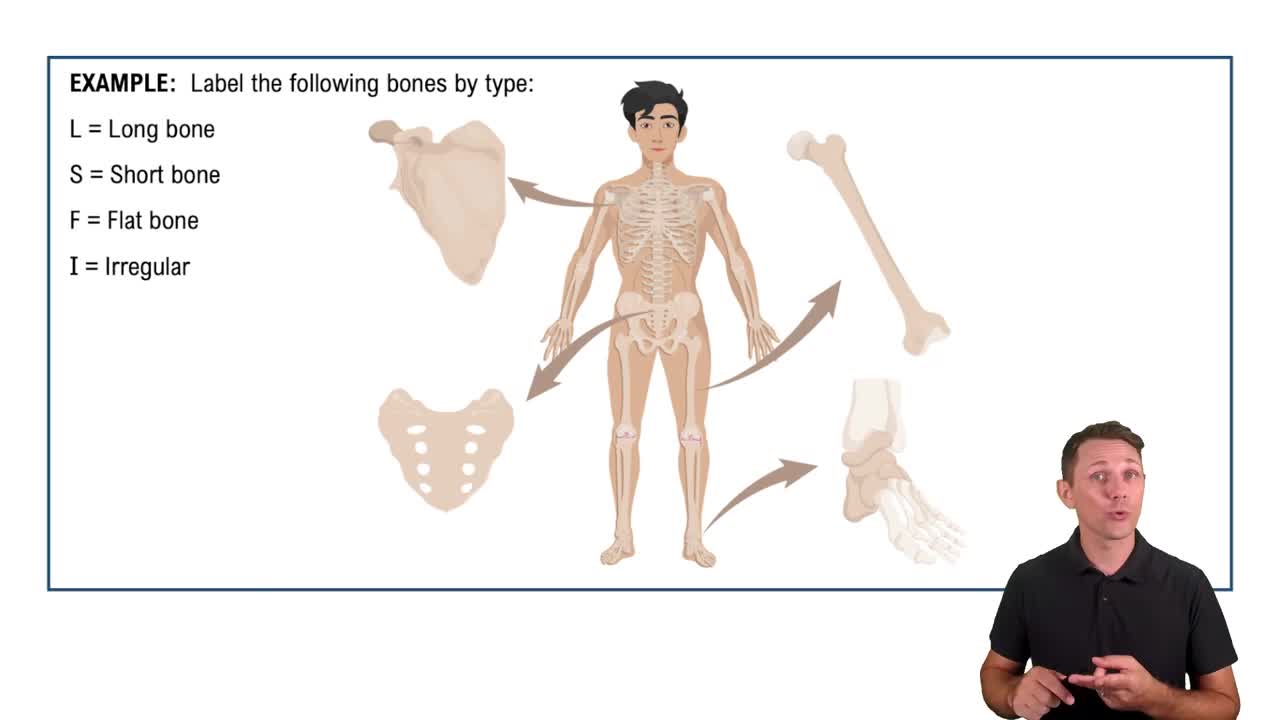
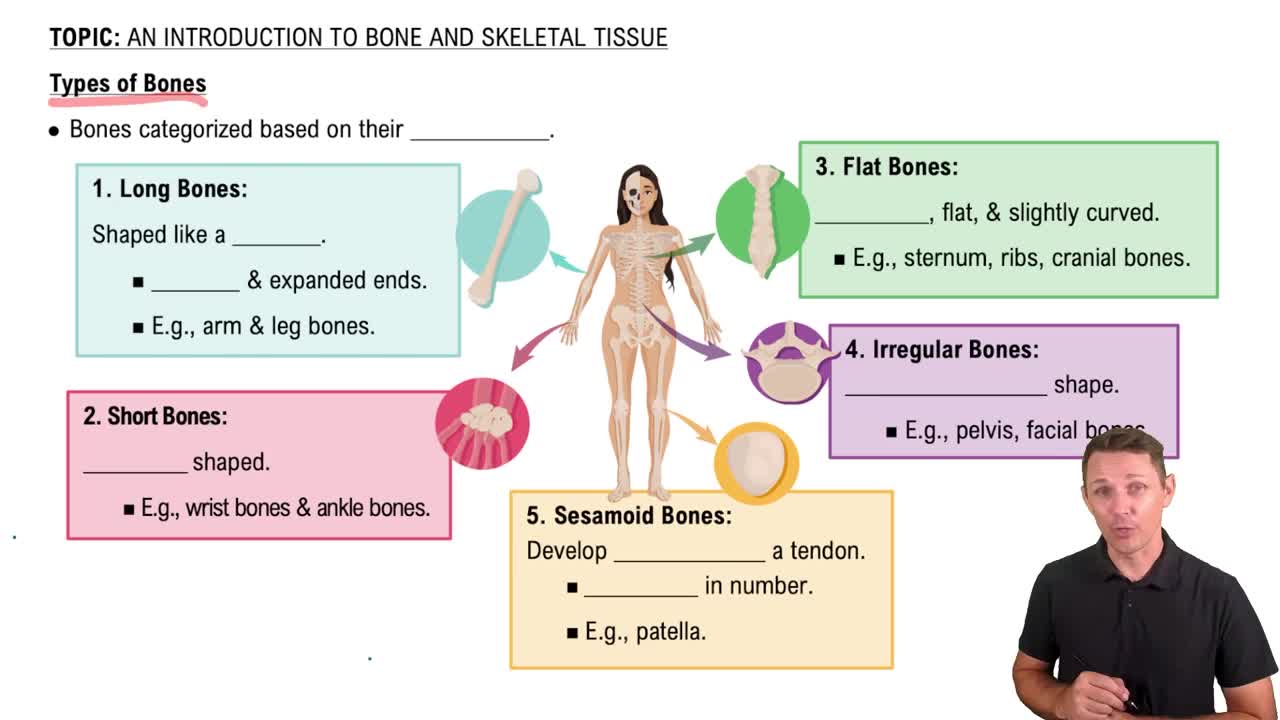
    Long bones (femur), short bones (wrist bones), flat bones (sternum), irregular bones (vertebrae).
  • What tissues make up bones as organs?

    Bone tissue, nervous tissue, cartilage, dense connective tissue, muscle cells, and epithelial cells in blood vessels.
  • Describe the difference between compact and spongy bone.

    Compact bone is dense and smooth forming the outer layer; spongy bone has a honeycomb structure of trabeculae filled with marrow.
  • What are the membranes associated with long bones and their functions?

    Periosteum covers external surfaces (fibrous and osteogenic layers); endosteum lines internal surfaces and contains osteogenic cells.
  • Where is red bone marrow found and what is its function?

    Red bone marrow is in trabecular cavities of spongy bone and flat bones; it is the site of hematopoiesis (blood cell formation).
  • What are bone markings and their categories?

    Bone markings are sites for muscle, ligament, tendon attachment, joint formation, or blood vessel/nerve passage. Categories: projections, surfaces, depressions/openings.
  • Name the five major types of bone cells and their primary roles.

    Osteoprogenitor (stem cells), osteoblasts (bone-forming), osteocytes (mature bone cells maintaining matrix), bone-lining cells (maintain matrix), osteoclasts (bone resorption).
  • What is an osteon and its components?

    Osteon is the structural unit of compact bone, consisting of concentric lamellae, central (Haversian) canal, lacunae with osteocytes, and canaliculi.
  • Explain the role of canaliculi in bone.

    Canaliculi are tiny canals connecting lacunae, allowing osteocytes to communicate and exchange nutrients and wastes.
  • What are the organic and inorganic components of bone matrix?

    Organic: osteoid (collagen and proteins) providing tensile strength and flexibility.
    Inorganic: hydroxyapatites (calcium phosphate crystals) providing hardness and resistance to compression.
  • Differentiate between endochondral and intramembranous ossification.

    Endochondral ossification replaces hyaline cartilage to form most bones; intramembranous ossification forms bone directly from fibrous membranes, e.g., skull bones.
  • Describe the zones of the epiphyseal plate involved in bone length growth.

    Resting zone, proliferation zone (cell division), hypertrophic zone (cell enlargement), calcification zone, ossification zone (new bone formation).
  • What hormones regulate bone growth and how?

    Growth hormone stimulates epiphyseal plate activity; thyroid hormone modulates growth hormone; sex hormones (testosterone, estrogen) promote growth spurts and epiphyseal plate closure.
  • What is bone remodeling and which cells are involved?

    Bone remodeling replaces old bone with new, involving osteoblasts (deposit bone) and osteoclasts (resorb bone).
  • How does parathyroid hormone (PTH) regulate blood calcium levels?

    PTH is released when blood calcium is low, stimulating osteoclasts to resorb bone and release calcium into blood, restoring homeostasis.
  • What is Wolff's law regarding bone remodeling?

    Bones grow or remodel in response to mechanical stress, becoming thicker and stronger where stressed.
  • List the four stages of bone fracture repair.

    Hematoma formation, fibrocartilaginous callus formation, bony callus formation, bone remodeling.
  • What is osteoporosis and its risk factors?

    Osteoporosis is a disease where bone resorption exceeds deposit, leading to decreased bone mass. Risk factors include age, postmenopausal status, insufficient exercise, poor diet, smoking, and genetics.
  • What causes rickets and osteomalacia?

    Both caused by vitamin D deficiency or insufficient calcium, leading to poorly mineralized, soft, and weak bones.
  • Describe Paget's disease of bone.

    A disorder with excessive and disorganized bone remodeling, resulting in enlarged, weak bones with high spongy to compact bone ratio.
  • How does bone mass change with age?

    Bone formation exceeds resorption in youth; balanced in young adults; resorption exceeds formation in older adults, leading to bone loss.