뒤로

Bones and Skeletal Tissues - Anatomy & Physiology

컨트롤 버튼이 '내비게이션' 모드로 변경되었습니다.
1/28
  • What is skeletal cartilage and its key characteristics?

    Skeletal cartilage is made of highly resilient cartilage tissue, primarily water, with no blood vessels or nerves. It is surrounded by perichondrium, a dense connective tissue layer that provides nutrients and resists outward expansion.
  • Name the three types of cartilage and their locations.

    Hyaline cartilage: support and flexibility, found in articular joints, ribs, larynx, nose tip.
    Elastic cartilage: contains elastic fibers, found in external ear and epiglottis.
    Fibrocartilage: thick collagen fibers, great tensile strength, found in knee menisci and vertebral discs.
  • How does cartilage grow?

    Cartilage grows by appositional growth (matrix secreted on cartilage surface by cells in perichondrium) and interstitial growth (chondrocytes divide and secrete matrix from within lacunae).
  • List the seven functions of bones.

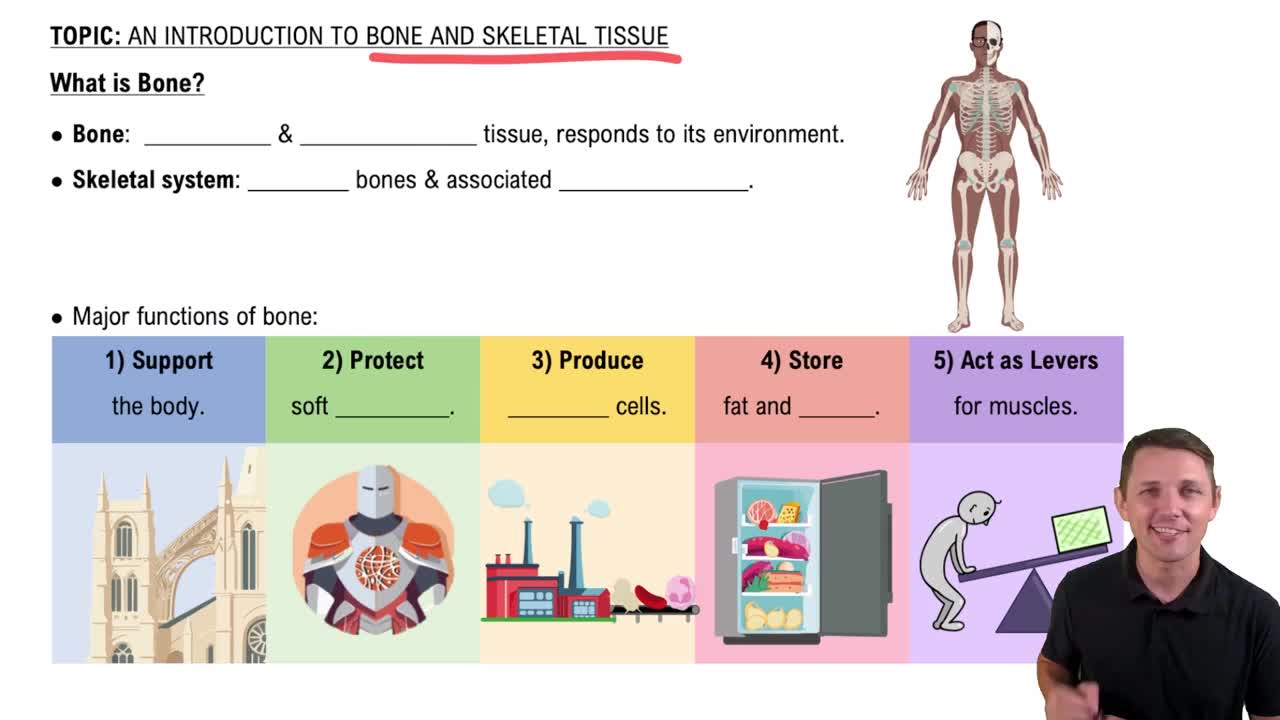
    Support for body and organs, protection of brain and vital organs, movement as levers for muscles, mineral and growth factor storage, blood cell formation (hematopoiesis), triglyceride (fat) storage, and hormone production (osteocalcin).
  • What are the two main divisions of the human skeleton?

    Axial skeleton: skull, vertebral column, rib cage.
    Appendicular skeleton: bones of limbs and girdles attaching limbs to axial skeleton.
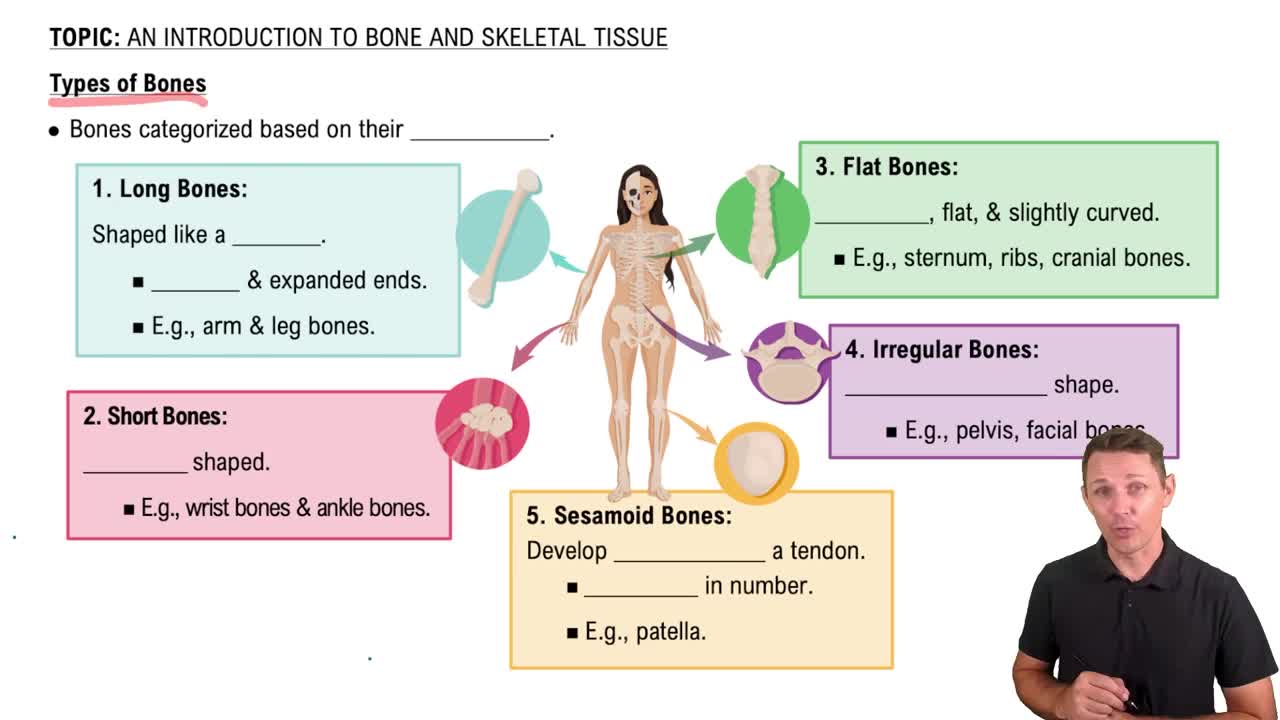
  • Classify bones by shape with examples.

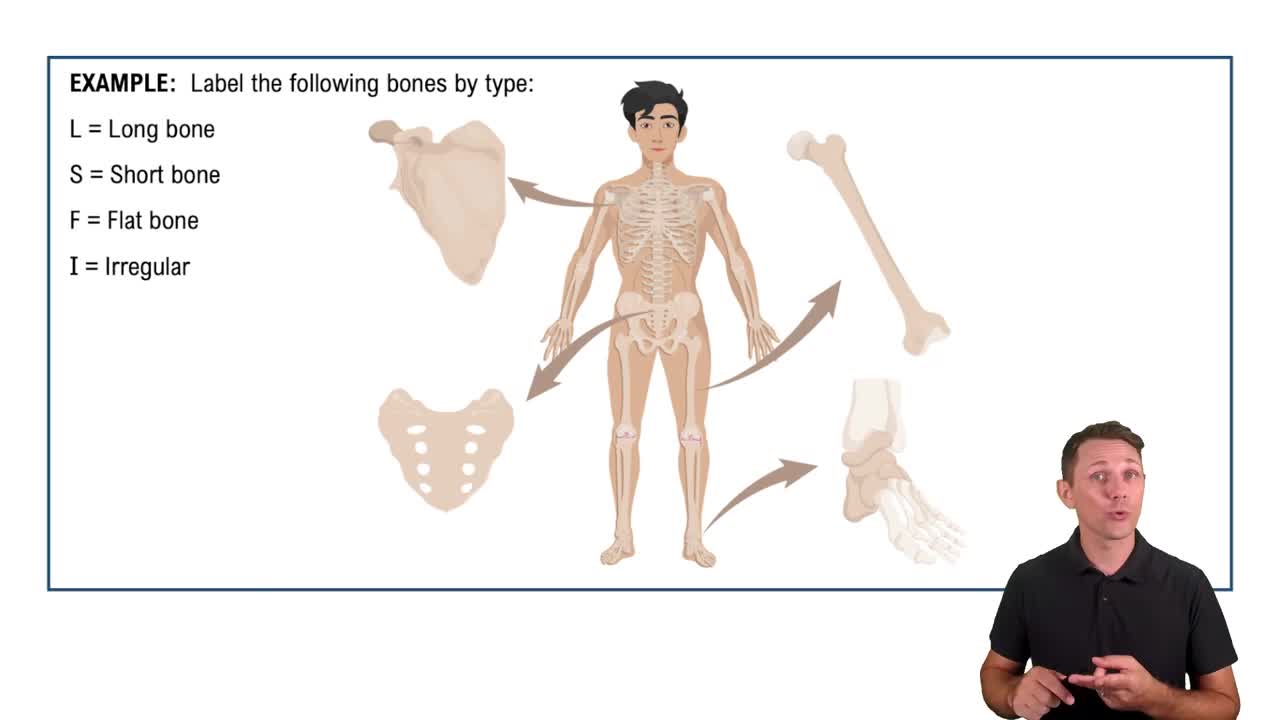
    Long bones: longer than wide, e.g., femur.
    Short bones: cube-shaped, e.g., wrist bones.
    Flat bones: thin and flat, e.g., sternum.
    Irregular bones: complex shapes, e.g., vertebrae.
  • What tissues make up bones besides osseous tissue?

    Bones contain nervous tissue, cartilage, fibrous connective tissue, muscle cells, and epithelial cells in blood vessels, making them organs.
  • Describe the gross anatomy of a long bone.

    Long bones have a diaphysis (shaft) of compact bone with a medullary cavity containing yellow marrow, epiphyses (ends) with compact bone outside and spongy bone inside, articular cartilage on joint surfaces, and membranes periosteum (outside) and endosteum (inside).
  • What are the periosteum and endosteum?

    Periosteum is a double-layered membrane covering external bone surfaces with nerve fibers and blood vessels; endosteum is a delicate membrane lining internal bone surfaces and canals, both containing osteogenic cells.
  • Name and describe the three types of bone markings.

    Projections: outward bulges for muscle/ligament attachment or joints.
    Depressions: grooves or cavities for vessels, nerves, or joints.
    Openings: holes or canals for blood vessels and nerves.
  • Where is red bone marrow found and what is its function?

    Red marrow is in trabecular cavities of spongy bone and diploë of flat bones; it is hematopoietic tissue responsible for blood cell formation.
  • List the five major types of bone cells and their functions.

    Osteogenic cells: stem cells that become osteoblasts.
    Osteoblasts: bone-forming cells secreting osteoid.
    Osteocytes: mature cells maintaining bone matrix.
    Bone-lining cells: maintain matrix on bone surfaces.
    Osteoclasts: multinucleate cells that resorb bone.
  • What is an osteon and its components?

    An osteon is the structural unit of compact bone, consisting of concentric lamellae around a central (Haversian) canal containing blood vessels and nerves, with lacunae housing osteocytes connected by canaliculi.
  • Explain the role of canaliculi in bone.

    Canaliculi are tiny canals connecting lacunae and the central canal, allowing osteocytes to communicate and exchange nutrients and wastes.
  • What are the organic and inorganic components of bone matrix?

    Organic: osteoid made of collagen and ground substance providing tensile strength and flexibility.
    Inorganic: hydroxyapatites (calcium phosphate crystals) providing hardness and resistance to compression.
  • Describe intramembranous ossification.

    Bone develops from mesenchymal fibrous membranes; mesenchymal cells become osteoblasts, secrete osteoid, form woven bone, then lamellar bone, producing membrane bones like skull and clavicle.
  • Describe endochondral ossification.

    Bone forms by replacing hyaline cartilage; involves bone collar formation, cartilage calcification, periosteal bud invasion, spongy bone formation, and secondary ossification centers in epiphyses.
  • How do long bones grow in length?

    By interstitial growth at the epiphyseal plate, which has five zones: resting, proliferation, hypertrophic, calcification, and ossification, balancing cartilage growth and bone replacement.
  • How do bones grow in width?

    Through appositional growth where osteoblasts beneath periosteum add bone matrix externally and osteoclasts remove bone internally, thickening bones in response to stress.
  • What hormones regulate bone growth?

    Growth hormone stimulates epiphyseal plate activity; thyroid hormone modulates growth hormone; testosterone and estrogens promote growth spurts and induce epiphyseal plate closure.
  • What is bone remodeling and which cells are involved?

    Bone remodeling is the ongoing replacement of old bone by new bone involving osteoclasts (resorption) and osteoblasts (deposition) coordinated in remodeling units.
  • How do osteoclasts resorb bone?

    Osteoclasts secrete lysosomal enzymes and protons to digest bone matrix, convert calcium salts to soluble forms, phagocytize debris, and then undergo apoptosis after resorption.
  • How is bone deposition carried out?

    Osteoblasts secrete osteoid, which calcifies as calcium and phosphate ions crystallize, forming hydroxyapatite that mineralizes the new bone matrix.
  • How is calcium homeostasis maintained hormonally?

    Parathyroid hormone (PTH) raises blood calcium by stimulating osteoclasts; calcitonin lowers blood calcium at high doses but has minor physiological effect.
  • What is Wolff's law regarding bone?

    Bones grow and remodel in response to mechanical stress, becoming thicker and stronger where stresses are greatest, with trabeculae aligning along stress lines.
  • Describe the stages of bone fracture repair.

    1. Hematoma formation
    2. Fibrocartilaginous callus formation
    3. Bony callus formation
    4. Bone remodeling to restore original structure.
  • What is osteoporosis and its risk factors?

    Osteoporosis is a disease where bone resorption exceeds deposition, leading to fragile bones. Risk factors include aging, postmenopausal women, low estrogen, poor diet, smoking, and lack of exercise.
  • What is Paget's disease of bone?

    A disorder with excessive and disorganized bone remodeling causing enlarged, weak bones with high spongy to compact bone ratio, often affecting spine, pelvis, femur, and skull.