 뒤로
Cardiovascular Physiology Key Concepts
 6:13

이 집합의 용어 (20)
Preload is the degree of stretch of the ventricular walls at the end of diastole, related to the volume of blood returning to the heart (end-diastolic volume).
Afterload is the pressure the ventricles must overcome to eject blood during systole, mainly determined by arterial blood pressure and systemic resistance.
Contractility is the intrinsic strength of cardiac muscle contraction, independent of preload and afterload, reflecting how forcefully the heart contracts at a given fiber length.
Inotropic refers to the force of muscle contraction; an inotropic effect changes the strength of the heart's contraction.
The Frank-Starling Law states that increased stretch of the heart muscle during filling (greater preload) leads to a stronger contraction and increased stroke volume, matching output to venous return.
The skeletal muscle pump compresses veins during muscle contraction, pushing blood toward the heart; venous valves prevent backflow.
During inhalation, decreased thoracic pressure and increased abdominal pressure draw blood into thoracic veins toward the right atrium, aiding venous return.
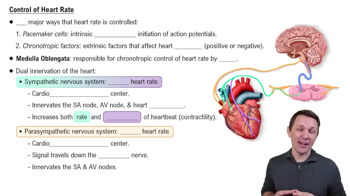
It increases contractility by releasing norepinephrine, which binds to β1-adrenergic receptors, increasing calcium entry into cardiac muscle cells.
The parasympathetic system mainly decreases heart rate and has little direct effect on contractility.
Hormones like epinephrine increase contractility by enhancing calcium availability in cardiac cells; thyroid hormone can also increase contractile strength over time.
A positive inotropic effect increases the strength of cardiac muscle contraction.
They increase contractility by raising intracellular calcium in cardiac muscle cells, strengthening each contraction.
Norepinephrine and epinephrine bind to β1-adrenergic receptors, increasing depolarization rate and calcium entry, thus increasing heart rate and contractility.
Acetylcholine binds muscarinic receptors, increasing potassium efflux and decreasing calcium influx, slowing pacemaker cell depolarization.
Na+, K+, and Ca2+ channels are modulated to alter depolarization rates and contractility.
Preload is stretch before contraction, afterload is resistance to ejection, and contractility is the strength of contraction.
They assist venous return by mechanically pushing blood toward the heart during muscle contraction and breathing.
By releasing norepinephrine that binds β1 receptors on pacemaker cells, increasing the rate of depolarization.
It decreases heart rate by slowing pacemaker cell depolarization, with little effect on contractility.
By increasing intracellular calcium, Digitalis strengthens cardiac contractions, improving cardiac output.