 뒤로
Cardiovascular System - Anatomy & Physiology
 6:13

이 집합의 용어 (20)
The heart, blood vessels, and blood are the main components of the cardiovascular system.
To transport oxygen, nutrients, hormones, and waste products throughout the body.
The heart has four chambers: two atria (upper) and two ventricles (lower), separated by valves.
The atria receive blood returning to the heart and pump it into the ventricles.
The ventricles pump blood out of the heart to the lungs and the rest of the body.
The tricuspid valve (right atrium to right ventricle), pulmonary valve (right ventricle to pulmonary artery), mitral valve (left atrium to left ventricle), and aortic valve (left ventricle to aorta).
To prevent backflow of blood and ensure one-way flow through the heart.
Blood enters the right atrium, moves to the right ventricle, is pumped to the lungs, returns to the left atrium, moves to the left ventricle, and is pumped to the body.
Pulmonary circulation moves blood between the heart and lungs; systemic circulation moves blood between the heart and the rest of the body.
Arteries, veins, and capillaries.
To carry blood away from the heart, usually oxygen-rich blood.
To carry blood toward the heart, usually oxygen-poor blood.
To facilitate exchange of oxygen, nutrients, and waste between blood and tissues.
The volume of blood the heart pumps per minute; calculated as \(\text{Cardiac Output} = \text{Heart Rate} \times \text{Stroke Volume}\).
The amount of blood pumped by one ventricle with each heartbeat.
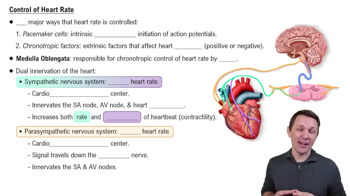
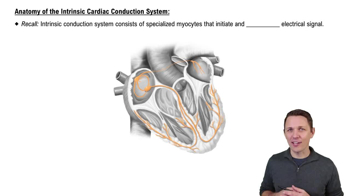
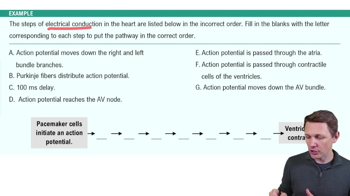
The heart's natural pacemaker that initiates electrical impulses causing heartbeats.
It delays the electrical impulse before it passes to the ventricles, allowing atria to contract first.
They supply oxygen-rich blood to the heart muscle itself.
The force exerted by circulating blood on the walls of blood vessels.
Systolic pressure is the pressure during heart contraction; diastolic pressure is the pressure during heart relaxation.