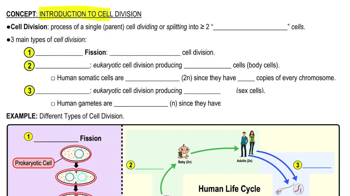
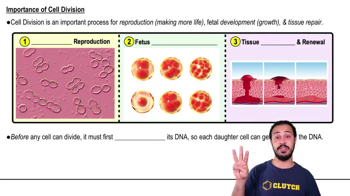
Mitosis is somatic cell division used for tissue growth and repair, producing diploid daughter cells.
Where does meiosis occur and what does it produce?
Meiosis occurs in gonads and produces haploid daughter cells for reproduction.
List the four main steps of mitosis.
The steps are Prophase, Metaphase, Anaphase, and Telophase.
What happens during prophase?
Chromosomes become visible, chromatids attach at centromeres, centrioles move to poles, spindle fibers extend, and the nuclear membrane and nucleolus vanish.
Describe the metaphase stage of mitosis.
Chromosomes line up at the metaphase plate and spindle fibers attach to centromeres.
What occurs during anaphase?
Centromeres split, spindle fibers retract, and sister chromatids are pulled to opposite poles.
What are the key events in telophase?
Chromosomes revert to chromatin, nuclear membrane and nucleolus reappear, and cytokinesis usually occurs.
What are the main stages of the cell life cycle?
The stages include Interphase, Cell division, and Differentiation.
What is cell differentiation?
Process where a cell becomes specialized by repressing some DNA and promoting other DNA.
How is the cell cycle controlled?
Three checkpoints (G1, G2, M) regulate progression through the cell cycle.
What is the significance of the G1 checkpoint?
Determines if the cell will divide; some cells enter a resting phase called G0 if they do not pass.
What does the G2 checkpoint check for?
Ensures the cell is ready to enter mitosis.
What is the role of the M checkpoint?
Determines if the cell can exit mitosis and complete division.
Define cancer in terms of cell cycle control.
Cancer is uncontrolled cell growth due to failure in cell cycle regulation.
What is the difference between benign and malignant tumors?
Benign tumors are encapsulated by normal cells; malignant tumors are not and can invade other tissues.
What is metastasis?
The spread of cancerous cells to different locations in the body.
What causes cancer at the genetic level?
Damaged genes fail to control the cell cycle, involving mutations in proto-oncogenes and tumor suppressor genes.
What are proto-oncogenes?
Genes that stimulate cell division; mutations can convert them into oncogenes causing uncontrolled growth.
What is the function of tumor suppressor genes?
They turn off cell division in healthy cells; mutations lead to uncontrolled cell division.
What is the role of the p53 gene?
A tumor suppressor gene acting at the G1 checkpoint to prevent division of cells with damaged DNA.
 뒤로
 04:44