Skip to main content
Anatomy & Physiology
나의 코스
배우기
시험 준비
AI 튜터
학습 가이드
교과서적 해결책
플래시카드
탐험해 보세요
앱을 사용해 보세요
나의 코스
배우기
시험 준비
AI 튜터
학습 가이드
교과서적 해결책
플래시카드
탐험해 보세요
앱을 사용해 보세요
뒤로
Cell Cycle, Mitosis, and Protein Synthesis in Anatomy & Physiology
카드를 뒤집기 위해 탭할 수 있습니다.
What are the two major periods of the cell cycle?
카드를 뒤집기 위해 탭할 수 있습니다.
👆
What are the two major periods of the cell cycle?
Interphase
(cell growth and usual activities) and
Mitotic phase
(cell division).
진행 상황 추적
컨트롤 버튼이 '내비게이션' 모드로 변경되었습니다.
1/20
추천 영상
VideoThumbView.guidedCourse
04:44
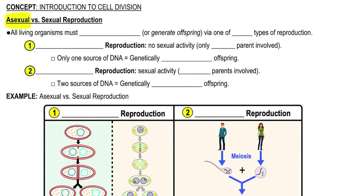
Asexual vs. Sexual Reproduction
18555
views
391
rank
VideoThumbView.guidedCourse
09:40
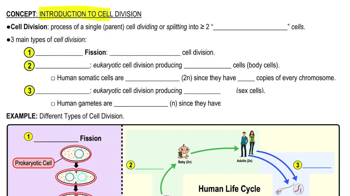
Introduction to Cell Division
28188
views
637
rank
1
comments
VideoThumbView.guidedCourse
03:18
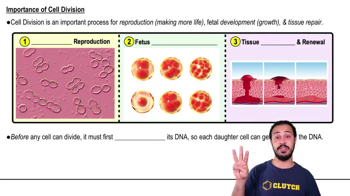
Importance of Cell Division
17765
views
573
rank
이 집합의 용어 (20)
하이드의 정의
What are the two major periods of the cell cycle?
Interphase
(cell growth and usual activities) and
Mitotic phase
(cell division).
What are the subphases of Interphase?
G1
(growth and metabolism),
S
(DNA replication), and
G2
(preparation for division).
What are the two distinct events of the Mitotic (M) phase?
Mitosis
(division of the nucleus) and
Cytokinesis
(division of the cytoplasm).
What happens during early prophase of mitosis?
Chromatin condenses into visible chromosomes; sister chromatids held by centromere; centrosomes synthesize microtubules forming the mitotic spindle.
What occurs during late prophase?
Nuclear envelope breaks down; microtubules attach to kinetochores on centromeres; nonkinetochore microtubules push poles apart.
Describe the metaphase stage of mitosis.
Chromosome centromeres align precisely at the cell's equator on the metaphase plate.
What key events happen in anaphase?
Centromeres split; sister chromatids pulled to opposite poles by kinetochore motor proteins; nonkinetochore microtubules push poles apart.
What occurs during telophase?
Chromosomes uncoil into chromatin; new nuclear membranes form; nucleoli reappear; spindle disappears.
What is cytokinesis and when does it occur?
Division of cytoplasm by actin microfilament ring forming cleavage furrow; begins in late anaphase and completes after mitosis.
What is the role of DNA in protein synthesis?
DNA holds the master code for protein synthesis, directing amino acid order in polypeptides via genes.
What is a gene and what does its code consist of?
A gene is a DNA segment coding for one polypeptide; code consists of three-base sequences (triplet code) specifying amino acids.
What are the three types of RNA involved in protein synthesis?
Messenger RNA (mRNA)
,
Ribosomal RNA (rRNA)
, and
Transfer RNA (tRNA)
.
What is the function of mRNA?
Copies DNA code in nucleus (transcription) and carries it to ribosomes in cytoplasm, maintaining the triplet codon code.
What are the three phases of transcription?
Initiation
(RNA polymerase binds promoter),
Elongation
(RNA polymerase adds nucleotides),
Termination
(RNA polymerase stops at termination signal).
How is pre-mRNA processed before translation?
Introns are removed by spliceosomes, leaving only exon coding regions in mature mRNA.
What is the role of rRNA?
Structural component of ribosomes; helps translate mRNA message into polypeptides.
What is the function of tRNA?
Carries specific amino acids; anticodon pairs with mRNA codon at ribosome to add amino acids during translation.
How many possible codons exist and what do they represent?
64 codons (4 bases, 3 positions); 61 code for amino acids, 3 are stop codons.
What are the three phases of translation?
Initiation
(ribosome assembles at start codon),
Elongation
(amino acids added to chain),
Termination
(stop codon ends translation).
What role does the rough ER play in protein synthesis?
Ribosomes dock on rough ER via ER signal sequence; proteins enter ER for folding, modification, and packaging into vesicles for Golgi.
 뒤로뒤로
 04:44