 뒤로
Cell Membrane and Transport Mechanisms in Anatomy & Physiology
 02:21

이 집합의 용어 (22)
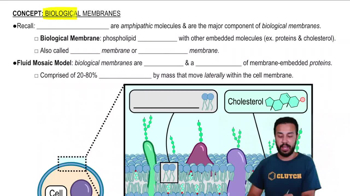
The cell membrane acts as a boundary, provides selective permeability, maintains the electrochemical gradient, and sustains the resting membrane potential.
Selective permeability controls the entry and exit of substances, allowing essential nutrients in and waste out, maintaining cellular homeostasis.
Membrane proteins facilitate transportation of molecules across the membrane via channels, carriers, and pumps.
Membrane proteins serve as cell identity markers, enabling recognition by other cells and the immune system.
Membrane proteins act as extracellular receptors to detect and respond to chemical signals like hormones.
Some membrane proteins have enzymatic activity, catalyzing reactions at the cell surface.
Membrane proteins form cellular junctions that link cells together for communication and structural support.
The primary structure is the linear sequence of amino acids in a protein chain.
The secondary structure includes alpha helices and beta sheets formed by hydrogen bonding.
The tertiary structure is the 3D folding of a protein due to interactions among side chains.
The quaternary structure is the assembly of multiple protein subunits into a functional complex.
Proteins are sensitive to changes in pH, temperature, and ion concentrations, which can affect their structure and function.
Diffusion is the passive movement of molecules from high to low concentration until equilibrium is reached.
Facilitated diffusion uses membrane proteins to help molecules cross the membrane down their concentration gradient.
Osmosis is the diffusion of water across a selectively permeable membrane toward higher solute concentration.
Filtration is the movement of water and solutes through a membrane by hydrostatic pressure.
Dynamic equilibrium occurs when molecules continue moving but concentrations remain equal on both sides of the membrane.
Primary active transport uses ATP to move molecules against their concentration gradient via pumps.
Secondary active transport uses the energy from one molecule moving down its gradient to transport another molecule against its gradient.
Bulk transport includes phagocytosis (cell eating), pinocytosis (cell drinking), and exocytosis (secretion).
Intracellular fluid is inside cells, rich in potassium and proteins; extracellular fluid is outside cells, rich in sodium and chloride.
In isotonic solutions, cells maintain shape; in hypotonic, cells swell; in hypertonic, cells shrink due to water movement.