Skip to main content
Anatomy & Physiology
나의 코스
배우기
시험 준비
AI 튜터
학습 가이드
교과서적 해결책
플래시카드
탐험해 보세요
앱을 사용해 보세요
나의 코스
배우기
시험 준비
AI 튜터
학습 가이드
교과서적 해결책
플래시카드
탐험해 보세요
앱을 사용해 보세요
뒤로
Cell Structure, Membrane Transport, and Cell Division in Anatomy & Physiology
카드를 뒤집기 위해 탭할 수 있습니다.
Inclusions
카드를 뒤집기 위해 탭할 수 있습니다.
👆
Inclusions
Nonliving materials stored in the cytoplasm, such as pigments, nutrients, or waste products.
진행 상황 추적
컨트롤 버튼이 '내비게이션' 모드로 변경되었습니다.
1/34
추천 영상
VideoThumbView.guidedCourse
05:33
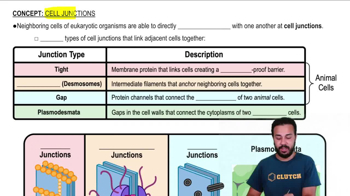
Cell Junctions
24080
views
304
rank
이 집합의 용어 (34)
하이드의 정의
Inclusions
Nonliving materials stored in the cytoplasm, such as pigments, nutrients, or waste products.
Interstitial fluid
Extracellular fluid that surrounds and bathes the body's cells.
Glycocalyx
A carbohydrate-rich coating on the outside of the plasma membrane that helps with cell protection and recognition.
Glycoprotein
A protein with carbohydrate chains attached; involved in cell recognition and communication.
Tight junctions
Connections between cells that prevent substances from passing between them.
Desmosome
A strong cell-to-cell attachment that helps tissues resist stretching and pulling.
Gap junction
A connection between cells that allows ions and small molecules to pass directly between them.
Passive process
Movement across a membrane that does not require cellular energy (ATP).
Diffusion
Movement of particles from an area of higher concentration to lower concentration.
Simple diffusion
Movement of small or lipid-soluble substances directly through the membrane.
Facilitated diffusion
Movement of substances down their concentration gradient through membrane proteins.
Osmosis
Diffusion of water across a selectively permeable membrane.
Isotonic solution
A solution with the same effective solute concentration as the cell, causing no net water movement.
Hypertonic solution
A solution with a higher effective solute concentration than the cell, causing water to leave the cell.
Hypotonic solution
A solution with a lower effective solute concentration than the cell, causing water to enter the cell.
Filtration
Movement of water and small solutes through a membrane due to pressure.
Microvilli
Tiny membrane projections that increase a cell's surface area for absorption.
Active transport
Movement of substances across a membrane using cellular energy (ATP), usually against a concentration gradient.
Sodium-potassium pump
A membrane protein that uses ATP to move 3 Na⁺ out of a cell and 2 K⁺ into a cell.
Vesicular transport
Movement of substances into or out of cells using membrane-bound vesicles.
Exocytosis
Process in which a vesicle fuses with the plasma membrane and releases its contents outside the cell.
Endocytosis
Process in which the plasma membrane surrounds and brings substances into the cell.
Phagocytosis
"Cell eating"; endocytosis of large particles or cells.
Pinocytosis
"Cell drinking"; endocytosis of extracellular fluid and dissolved substances.
Receptor-mediated endocytosis
Selective endocytosis where specific molecules bind to membrane receptors before being brought into the cell.
Transcription
Process of using DNA as a template to make mRNA.
Translation
Process of using mRNA instructions to assemble a protein at a ribosome.
Interphase
Period when a cell grows, performs normal functions, and replicates its DNA before division.
Mitosis
Division of the nucleus that produces two genetically identical nuclei.
Prophase
Stage of mitosis when chromosomes condense, the nuclear envelope breaks down, and the spindle begins to form.
Metaphase
Stage of mitosis when chromosomes line up in the middle of the cell.
Anaphase
Stage of mitosis when sister chromatids separate and move toward opposite ends of the cell.
Telophase
Stage of mitosis when chromosomes reach opposite ends and new nuclear envelopes form.
Cytokinesis
Division of the cytoplasm that separates one cell into two daughter cells.
 뒤로뒤로
 05:33
