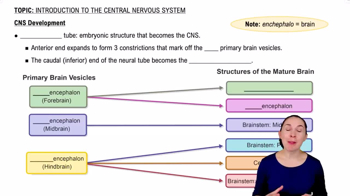
What are the four main regions of the adult brain?
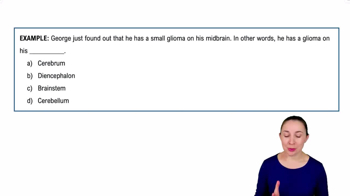
Cerebral hemispheres, diencephalon, brain stem (midbrain, pons, medulla), and cerebellum.
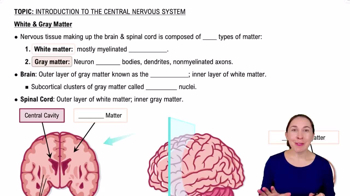
What is the basic pattern of gray and white matter distribution in the CNS?
Central cavity surrounded by gray matter, with white matter external to gray matter. This pattern changes ascending into the brain stem.
What are ventricles in the brain and what do they contain?
Fluid-filled chambers continuous with each other and the spinal cord's central canal, filled with cerebrospinal fluid (CSF) and lined by ependymal cells.
Name the five lobes of the cerebral hemispheres.
Frontal, parietal, temporal, occipital, and insula lobes. The insula is buried under parts of the other lobes.
What are gyri, sulci, and fissures in the brain?
Gyri are ridges, sulci are shallow grooves, and fissures are deep grooves on the brain's surface.
What is the cerebral cortex and its main functions?
Thin outer layer of gray matter responsible for conscious mind, sensory perception, voluntary movement, communication, memory, and understanding.
What are the three types of functional areas in the cerebral cortex?
Motor areas (voluntary movement), sensory areas (conscious sensation), and association areas (integrate information).
Where is the primary motor cortex located and what is its role?
Located in the precentral gyrus of the frontal lobe; controls precise, skilled voluntary skeletal muscle movements.
What is the function of the premotor cortex?
Helps plan movements, controls learned motor skills, coordinates simultaneous or sequential actions, and uses sensory feedback.
What is Broca's area responsible for?
Motor speech area that directs muscles for speech production, usually in the left hemisphere.
What happens if the primary motor cortex is damaged?
Paralysis of muscles controlled by that area on the opposite side of the body, but muscle strength may remain.
Where is the primary somatosensory cortex and what does it do?
Located in the postcentral gyrus of the parietal lobe; receives sensory input from skin and proprioceptors for spatial discrimination.
What is the role of the somatosensory association cortex?
Integrates sensory input to understand object size, texture, and spatial relationships.
Where is the primary visual cortex located and what is its function?
Located in the occipital lobe; receives visual information from the retinas.
What is the function of the auditory areas in the cerebral cortex?
Primary auditory cortex interprets pitch, loudness, and location; auditory association area stores sound memories.
What is the vestibular cortex responsible for?
Conscious awareness of balance and head position in space, located in the posterior insula and adjacent parietal cortex.
What is the olfactory cortex and its role?
Primary olfactory cortex in the medial temporal lobe; involved in conscious awareness of odors.
What is the function of the gustatory cortex?
Located in the insula; involved in perception of taste.
What are the multimodal association areas and their importance?
Receive inputs from multiple sensory areas and integrate information for meaning, memory, and decision-making.
What is the anterior association area (prefrontal cortex) involved in?
Intellect, cognition, recall, personality, working memory, judgment, reasoning, and planning.
What functions are associated with the posterior association area?
Pattern and face recognition, spatial localization, and understanding written and spoken language (Wernicke's area).
What role does the limbic association area play?
Provides emotional impact to experiences and helps establish memories; part of the limbic system.
What is lateralization of cortical function?
Division of labor between hemispheres; left hemisphere controls language and logic, right controls visual-spatial and artistic skills.
What are the three types of cerebral white matter fibers?
Association fibers connect areas within the same hemisphere, commissural fibers connect hemispheres, projection fibers connect cortex with lower CNS.
What are basal nuclei and their functions?
Clusters of gray matter deep in cerebrum involved in muscle movement regulation, cognition, emotion, and filtering inappropriate responses.
What are the main functions of the cerebellum?
Coordinates precise skeletal muscle movements, processes input from cortex and sensory receptors, and maintains balance.
What are the cerebellar peduncles and their connections?
Three paired fiber tracts connecting cerebellum to brain stem: superior (midbrain), middle (pons), and inferior (medulla).
How does the cerebellum fine-tune motor activity?
Receives motor intent from cortex and sensory feedback, calculates smooth coordination, and sends movement plans to motor cortex and brain stem.
 뒤로
 0:50