뒤로

Ch.12 Part 2

컨트롤 버튼이 '내비게이션' 모드로 변경되었습니다.
1/24
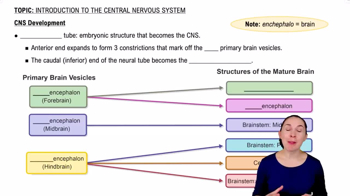
  • What are the three paired gray-matter structures of the diencephalon?

    Thalamus, Hypothalamus, and Epithalamus.
  • What is the main function of the thalamus?

    Acts as a relay station for information coming into the cortex, sorting, editing, and relaying ascending inputs.
  • Name two types of impulses the thalamus relays.

    Impulses from the hypothalamus for emotion and visceral function, and impulses from the cerebellum and basal nuclei to motor cortices.
  • Where is the hypothalamus located and what is its main role?

    Located below the thalamus; it is the main visceral control and regulating center vital to homeostasis.
  • List three chief homeostasis controls of the hypothalamus.

    Controls autonomic nervous system, initiates physical responses to emotions, and regulates body temperature.
  • What endocrine functions does the hypothalamus control?

    Controls secretions of the anterior pituitary gland and production of posterior pituitary hormones.
  • What is the epithalamus and its key function?

    Most dorsal portion of diencephalon; contains the pineal gland which secretes melatonin to regulate sleep-wake cycles.
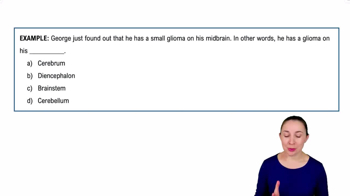
  • What are the three regions of the brainstem?

    Midbrain, Pons, and Medulla oblongata.
  • What is the cerebral aqueduct and where is it located?

    A channel running through the midbrain connecting the third and fourth ventricles.
  • Name the paired dorsal protrusions of the midbrain and their functions.

    Corpora quadrigemina: Superior colliculi for visual reflexes and Inferior colliculi for auditory relay.
  • What is the substantia nigra and its clinical significance?

    A midbrain nucleus linked to basal nuclei; degeneration causes Parkinson's disease.
  • What is the role of the pons in the brainstem?

    Contains conduction tracts connecting brain and spinal cord; origin of cranial nerves; helps maintain breathing rhythm.
  • Describe the location and function of the medulla oblongata.

    Blends into spinal cord at foramen magnum; autonomic reflex center controlling cardiovascular and respiratory functions.
  • What is the decussation of the pyramids?

    The point in the medulla where pyramidal motor tracts cross to the opposite side of the body.
  • What are the three main functions of the spinal cord?

    Two-way communication between brain and body, major reflex center, and integration of sensory and motor information.
  • What protects the spinal cord?

    Bone (vertebral column), meninges (dura mater, arachnoid mater, pia mater), and cerebrospinal fluid (CSF).
  • What is the conus medullaris?

    The cone-shaped terminal end of the spinal cord.
  • What are denticulate ligaments?

    Extensions of pia mater that secure the spinal cord to the dura mater.
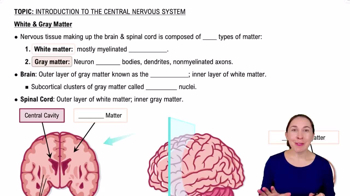
  • What is the gray matter organization in the spinal cord?

    Butterfly-shaped with dorsal horns (sensory), ventral horns (motor), and lateral horns (sympathetic neurons in thoracic/lumbar regions).
  • What are the three directions of white matter fibers in the spinal cord?

    Ascending (sensory), descending (motor), and transverse (commissural fibers).
  • What is the difference between flaccid and spastic paralysis?

    Flaccid paralysis results from ventral root damage causing muscle atrophy; spastic paralysis results from upper motor neuron damage causing involuntary muscle contractions.
  • What are the three layers of meninges and their key features?

    Dura mater: tough outer layer; Arachnoid mater: middle layer with CSF-filled subarachnoid space; Pia mater: delicate inner layer clinging to brain.
  • What is the function of arachnoid granulations?

    Protrude into dural venous sinuses to allow reabsorption of cerebrospinal fluid into venous blood.
  • What is meningitis?

    Inflammation of the meninges, which can spread to the brain causing encephalitis.