Skip to main content
Anatomy & Physiology
나의 코스
배우기
시험 준비
AI 튜터
학습 가이드
교과서적 해결책
플래시카드
탐험해 보세요
앱을 사용해 보세요
나의 코스
배우기
시험 준비
AI 튜터
학습 가이드
교과서적 해결책
플래시카드
탐험해 보세요
앱을 사용해 보세요
뒤로
ch5Anatomy & Physiology: Integumentary System
카드를 뒤집기 위해 탭할 수 있습니다.
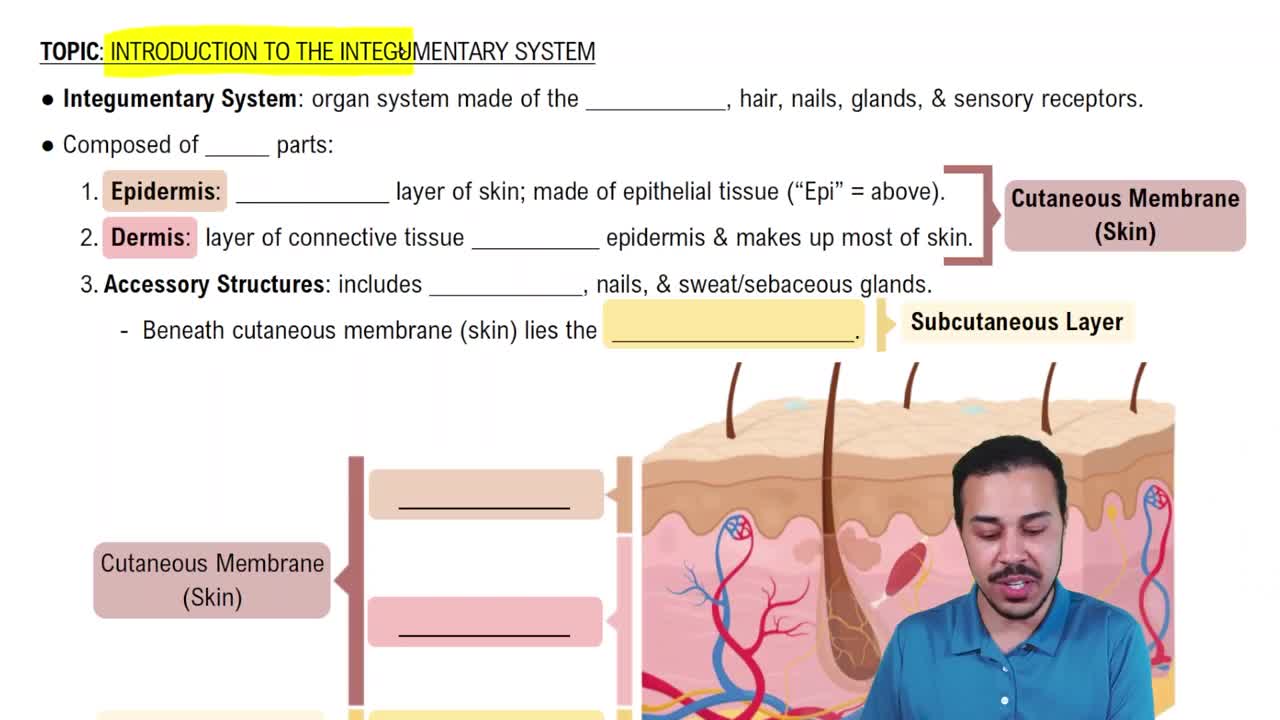
What are the two main regions of the skin?
카드를 뒤집기 위해 탭할 수 있습니다.
👆
What are the two main regions of the skin?
Epidermis
(superficial, epithelial, avascular) and
Dermis
(underlying, fibrous connective tissue, vascular).
진행 상황 추적
컨트롤 버튼이 '내비게이션' 모드로 변경되었습니다.
1/28
추천 영상
VideoThumbView.guidedCourse
06:54
Introduction to the Integumentary System
24092
views
820
rank
3
comments
VideoThumbView.guidedCourse
03:40
Integumentary System Functions
15646
views
395
rank
1
comments
VideoThumbView.guidedCourse
02:47
Map of the Lesson on Integumentary System
13789
views
649
rank
6
comments
이 집합의 용어 (28)
하이드의 정의
What are the two main regions of the skin?
Epidermis
(superficial, epithelial, avascular) and
Dermis
(underlying, fibrous connective tissue, vascular).
What is the hypodermis and its function?
A subcutaneous layer deep to the skin, mostly adipose tissue that absorbs shock, insulates, and anchors skin to underlying structures.
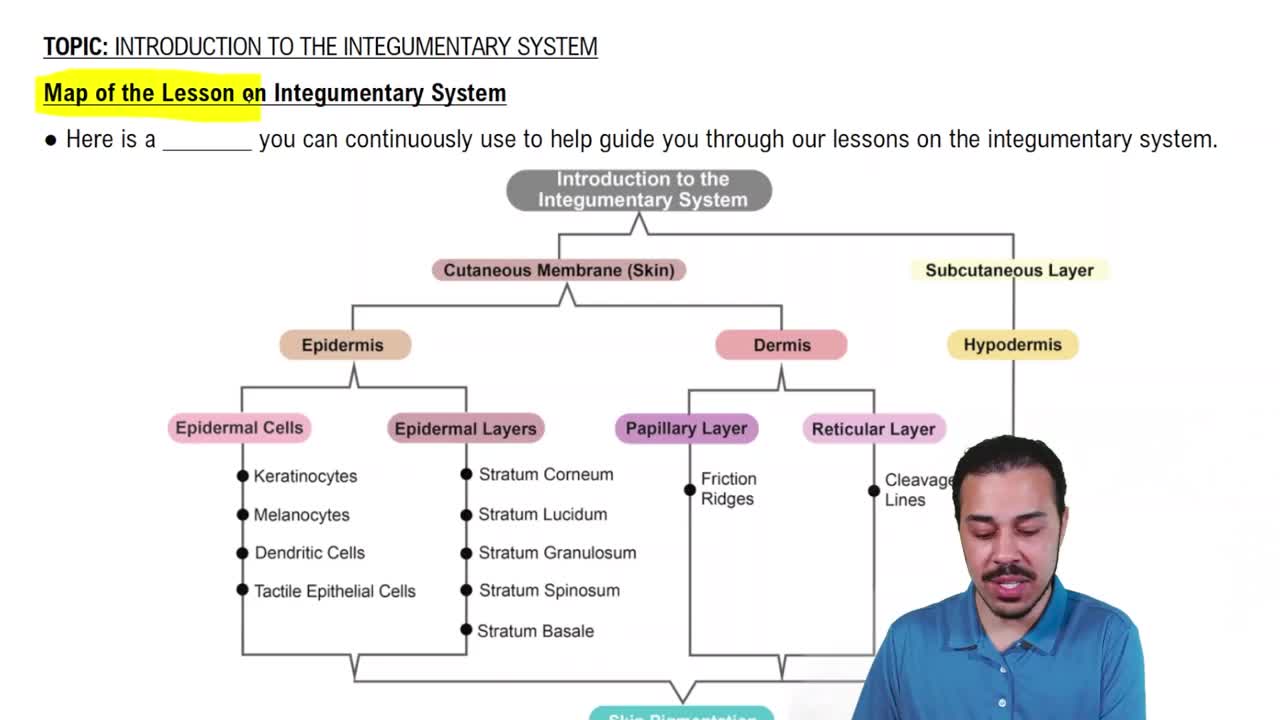
Name the four main cell types in the epidermis.
Keratinocytes
,
Melanocytes
,
Dendritic cells
, and
Tactile (Merkel) cells
.
What is the function of keratinocytes?
Produce fibrous keratin, providing skin its protective properties; major epidermal cells connected by desmosomes.
What role do melanocytes play in the skin?
Produce melanin pigment, which protects keratinocyte nuclei from UV damage by transferring melanosomes.
List the five layers (strata) of the epidermis in thick skin.
Stratum basale, stratum spinosum, stratum granulosum, stratum lucidum, and stratum corneum.
What is the stratum basale?
Deepest epidermal layer with mitotically active stem cells; also contains melanocytes and tactile cells.
Describe the stratum spinosum.
Several layers thick with spiny keratinocytes, abundant melanosomes, and dendritic cells.
What happens in the stratum granulosum?
Cells flatten, organelles disintegrate, keratinization begins, and glycolipid granules form a water-resistant barrier.
Where is the stratum lucidum found and what is its characteristic?
Only in thick skin; a thin, translucent layer of dead keratinocytes above the stratum granulosum.
What is the stratum corneum and its function?
Outermost layer of 20–30 rows of dead, keratinized cells that protect deeper layers and prevent water loss.
What are the two layers of the dermis?
Papillary layer (areolar connective tissue) and reticular layer (dense irregular connective tissue).
What are dermal papillae?
Fingerlike projections of the papillary dermis that contain capillaries and sensory receptors.
What are cleavage lines and why are they important?
Lines in the reticular dermis formed by collagen fiber orientation; important for surgical incisions to heal better.
Name the three pigments that contribute to skin color.
Melanin
,
Carotene
, and
Hemoglobin
.
What is the function of melanin in the skin?
Protects skin cells from UV radiation by absorbing harmful rays.
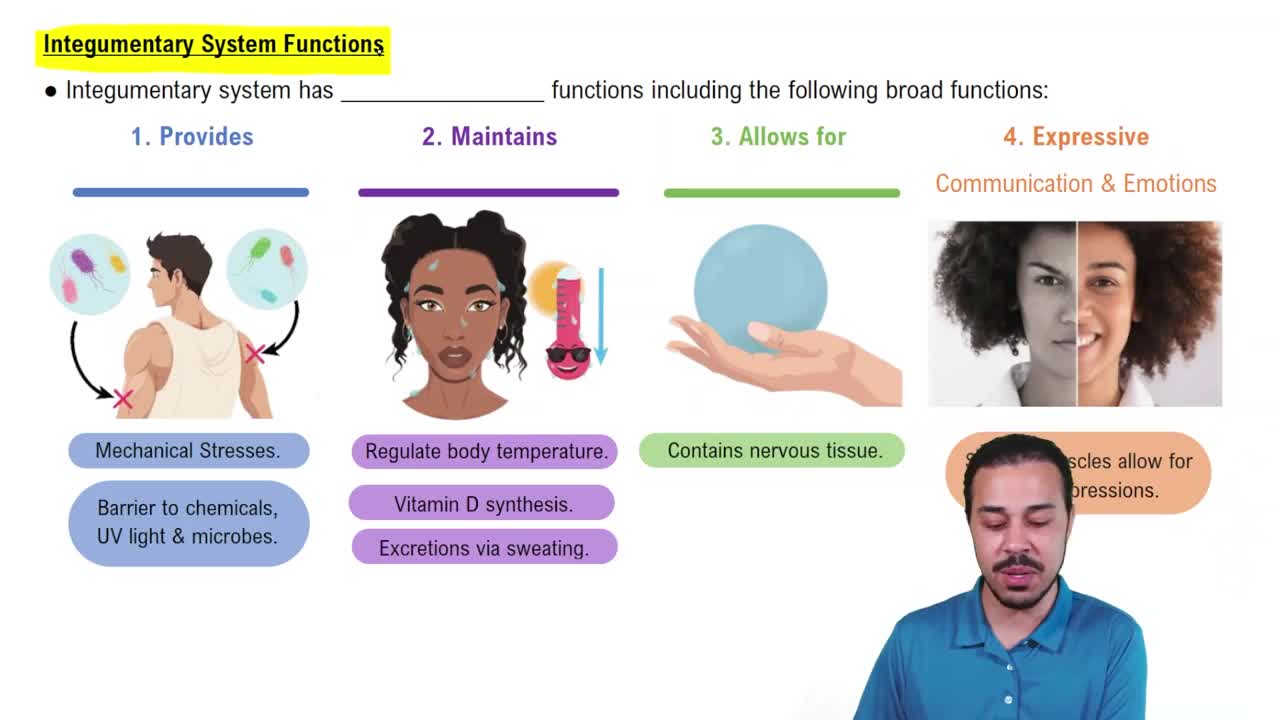
What are the main functions of the integumentary system?
Protection, temperature regulation, cutaneous sensation, metabolic functions, blood reservoir, excretion, and hormone synthesis.
Describe the chemical barrier function of the skin.
Skin secretions like low pH, sebum, defensins, and melanin protect against bacteria and UV damage.
What are eccrine sweat glands and their function?
Most numerous sweat glands that regulate body temperature by producing watery sweat.
What distinguishes apocrine sweat glands?
Located in axillary and anogenital areas; secrete milky sweat with proteins and fatty substances, causing body odor.
What is the role of sebaceous glands?
Secrete oily sebum that lubricates skin and hair and has bactericidal properties.
What is the ABCD rule for melanoma detection?
A: Asymmetry, B: Border irregularity, C: Color variation, D: Diameter > 6 mm.
What are the three degrees of burns?
First-degree: epidermal damage; second-degree: epidermal and upper dermal damage with blisters; third-degree: full-thickness skin damage.
Why are third-degree burns not painful?
Nerve endings are destroyed in full-thickness skin damage.
What is the rule of nines?
A method to estimate the extent of burns by dividing the body into regions representing 9% or multiples thereof.
What is the function of the arrector pili muscle?
Small smooth muscle attached to hair follicles that causes 'goose bumps' when contracted.
What is the difference between vellus and terminal hair?
Vellus hair is fine and pale; terminal hair is coarse, long, and pigmented.
What is alopecia?
Hair thinning or baldness, often age-related or genetically influenced.
 뒤로뒤로
 06:54