Skip to main content
Anatomy & Physiology
나의 코스
배우기
시험 준비
AI 튜터
학습 가이드
교과서적 해결책
플래시카드
탐험해 보세요
앱을 사용해 보세요
나의 코스
배우기
시험 준비
AI 튜터
학습 가이드
교과서적 해결책
플래시카드
탐험해 보세요
앱을 사용해 보세요
뒤로
Ch.8 Joints
카드를 뒤집기 위해 탭할 수 있습니다.
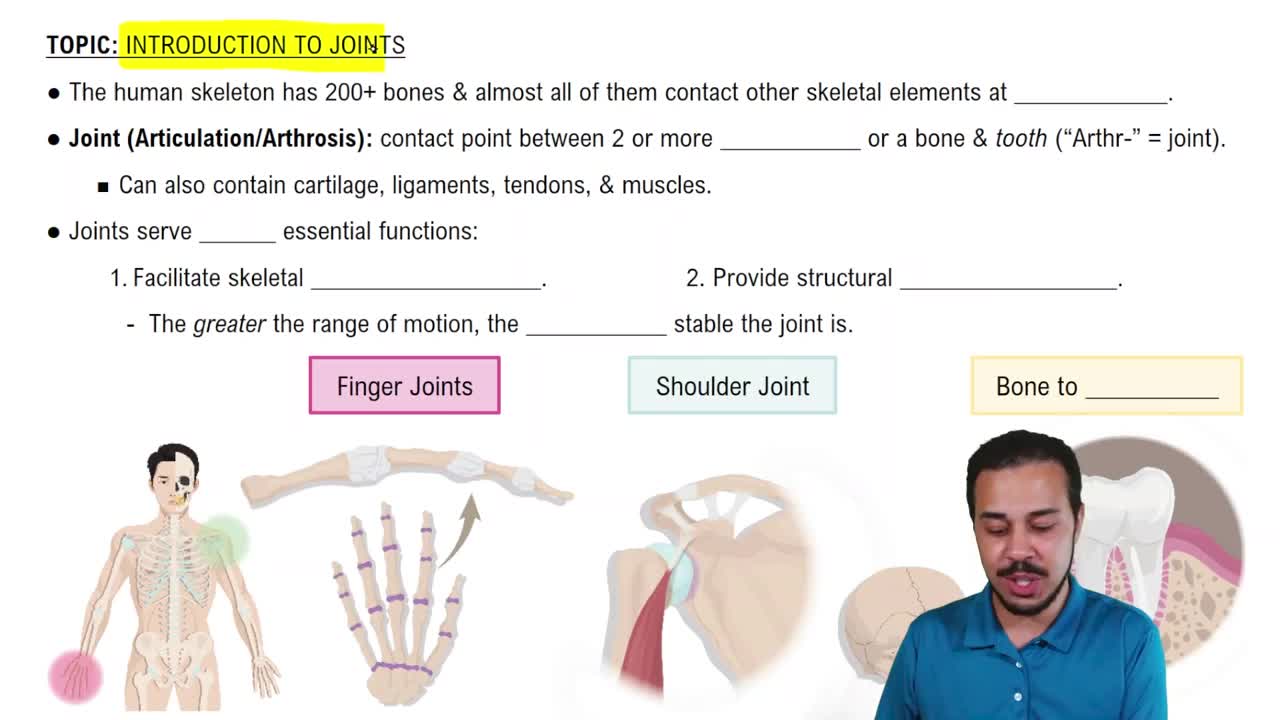
What are joints (articulations)?
카드를 뒤집기 위해 탭할 수 있습니다.
👆
What are joints (articulations)?
Sites where two or more bones meet, providing skeleton mobility and holding it together.
진행 상황 추적
컨트롤 버튼이 '내비게이션' 모드로 변경되었습니다.
1/30
추천 영상
VideoThumbView.guidedCourse
04:06
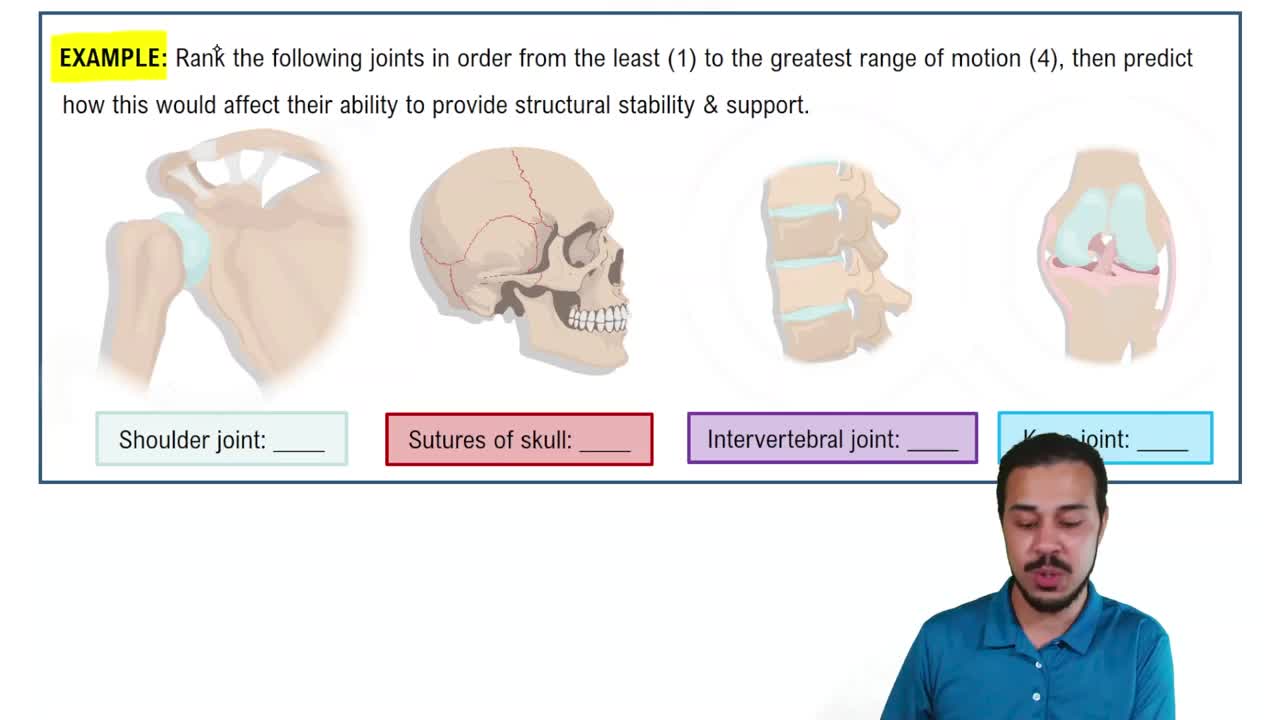
Introduction to Joints Example 1
11995
views
269
rank
VideoThumbView.guidedCourse
05:29
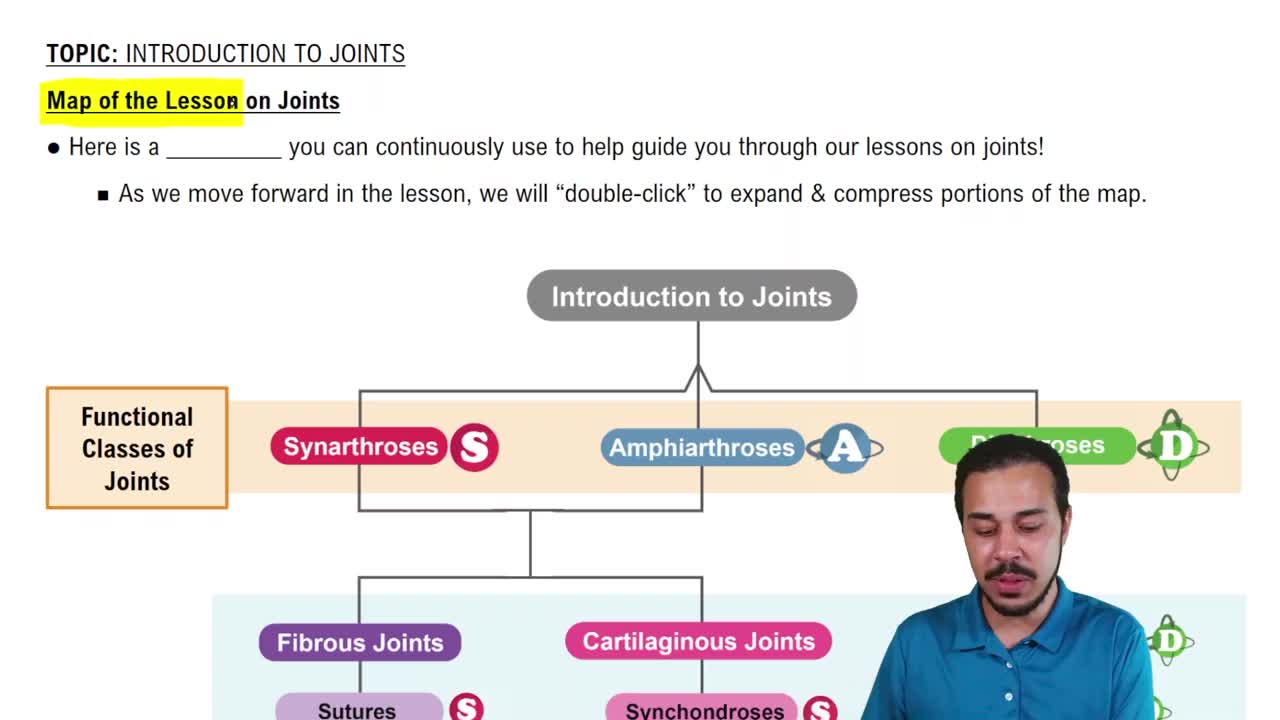
Map of the Lesson on Joints
12527
views
265
rank
1
comments
VideoThumbView.guidedCourse
05:39
Introduction to Joints
16802
views
431
rank
이 집합의 용어 (30)
하이드의 정의
What are joints (articulations)?
Sites where two or more bones meet, providing skeleton mobility and holding it together.
What are the two main classifications of joints?
Structural (fibrous, cartilaginous, synovial) and functional (synarthroses, amphiarthroses, diarthroses).
Describe fibrous joints.
Bones joined by dense fibrous connective tissue, no joint cavity, mostly immovable.
What are sutures?
Rigid, interlocking fibrous joints of the skull that allow growth during youth and ossify in middle age.
What are syndesmoses?
Bones connected by ligaments with variable fiber length, allowing variable movement.
What are gomphoses?
Peg-in-socket fibrous joints; teeth held in alveolar sockets by periodontal ligament.
Describe cartilaginous joints.
Bones united by cartilage, no joint cavity, not highly movable; includes synchondroses and symphyses.
What are synchondroses?
Bones united by hyaline cartilage, mostly immovable, e.g., epiphyseal plates and 1st rib-sternum joint.
What are symphyses?
Bones united by fibrocartilage, slightly movable, e.g., intervertebral discs and pubic symphysis.
What defines synovial joints?
Bones separated by fluid-filled joint cavity, all diarthrotic (freely movable), mostly limb joints.
Name the six general features of synovial joints.
Articular cartilage, joint cavity, articular capsule, synovial fluid, reinforcing ligaments, nerves and blood vessels.
What is the function of synovial fluid?
Lubricates and nourishes articular cartilage and contains phagocytic cells to remove debris.
What are bursae and tendon sheaths?
Fluid-filled sacs reducing friction; bursae cushion ligaments and tendons, tendon sheaths wrap tendons.
What factors influence synovial joint stability?
Shape of articular surface, number/location of ligaments, and muscle tone (most important).
What are the three functional classifications of joints by movement?
Synarthroses (immovable), amphiarthroses (slightly movable), diarthroses (freely movable).
Define gliding movement in synovial joints.
One flat bone surface slips over another, e.g., intercarpal and intertarsal joints.
What are angular movements?
Movements that increase or decrease the angle between bones, including flexion, extension, hyperextension, abduction, adduction, and circumduction.
Describe rotation movement.
Turning of a bone around its own long axis, either medially (toward midline) or laterally (away from midline).
What are special movements of synovial joints?
Supination/pronation, dorsiflexion/plantar flexion, inversion/eversion, protraction/retraction, elevation/depression, and opposition.
List the six types of synovial joints.
Plane, hinge, pivot, condylar, saddle, and ball-and-socket joints.
What is the temporomandibular joint (TMJ)?
A modified hinge joint between mandibular condyle and temporal bone allowing hinge and gliding movements; most easily dislocated joint.
Describe the shoulder (glenohumeral) joint.
A ball-and-socket joint with great mobility but less stability, reinforced by rotator cuff tendons and ligaments.
What stabilizes the elbow joint?
Hinge joint with anular ligament around radius and ulnar and radial collateral ligaments restricting side-to-side movement.
Describe the hip (coxal) joint.
Ball-and-socket joint with deep acetabulum and strong ligaments providing stability and good range of motion.
What are the main features of the knee joint?
Largest joint, includes femoropatellar and tibiofemoral joints, stabilized by ligaments and menisci, allows flexion, extension, and some rotation.
What are common joint injuries?
Cartilage tears, sprains, dislocations, often requiring surgery or immobilization.
What is osteoarthritis?
Degenerative arthritis caused by cartilage breakdown, common with aging, causing joint stiffness and pain.
What is rheumatoid arthritis?
Chronic autoimmune inflammatory disease causing joint pain, swelling, and tissue destruction.
What is gouty arthritis?
Inflammation caused by uric acid crystal deposits in joints, often affecting the big toe.
What is Lyme disease in relation to joints?
Bacterial infection from tick bites causing joint pain and arthritis if untreated.
 뒤로뒤로
 04:06