Skip to main content
Anatomy & Physiology
나의 코스
배우기
시험 준비
AI 튜터
학습 가이드
교과서적 해결책
플래시카드
탐험해 보세요
앱을 사용해 보세요
나의 코스
배우기
시험 준비
AI 튜터
학습 가이드
교과서적 해결책
플래시카드
탐험해 보세요
앱을 사용해 보세요
뒤로
Chapter 13 Muscles - Anatomy & Physiology
카드를 뒤집기 위해 탭할 수 있습니다.
What is the sarcoplasm?
카드를 뒤집기 위해 탭할 수 있습니다.
👆
What is the sarcoplasm?
The
sarcoplasm
is the cytoplasm of a muscle fiber, containing organelles and myofibrils.
진행 상황 추적
컨트롤 버튼이 '내비게이션' 모드로 변경되었습니다.
1/35
추천 영상
VideoThumbView.guidedCourse
6:31
Types of Muscle Tissue
18703
views
494
rank
1
comments
VideoThumbView.guidedCourse
2:00
Introduction to Muscles and Muscle Tissue Example 1
16631
views
323
rank
VideoThumbView.guidedCourse
4:36
Properties of Muscle Tissue
25594
views
741
rank
2
comments
이 집합의 용어 (35)
하이드의 정의
What is the sarcoplasm?
The
sarcoplasm
is the cytoplasm of a muscle fiber, containing organelles and myofibrils.
What is the sarcolemma?
The
sarcolemma
is the plasma membrane of a muscle fiber that surrounds the sarcoplasm.
What are Transverse Tubules (T-tubules)?
T-tubules are invaginations of the sarcolemma that penetrate into the muscle fiber and contain voltage-gated ion channels.
Order muscle fibers, myofibrils, and myofilaments from largest to smallest.
Muscle fibers
>
Myofibrils
>
Myofilaments
.
What is the sarcoplasmic reticulum and its function?
The
sarcoplasmic reticulum
is a specialized smooth ER that stores and releases calcium ions for muscle contraction.
What are Terminal Cisternae?
Terminal cisternae are enlarged areas of the sarcoplasmic reticulum that flank T-tubules and release calcium during contraction.
What is a Triad in muscle fibers?
A triad consists of a T-tubule flanked by two terminal cisternae of the sarcoplasmic reticulum.
What types of pumps are in the sarcoplasmic reticulum?
The sarcoplasmic reticulum contains
calcium pumps
that actively transport calcium ions back into the SR.
What are myofilaments?
Myofilaments are the contractile proteins within myofibrils, including thick filaments (myosin) and thin filaments (actin).
Which proteins are found on thick and thin filaments?
Thick filaments contain
myosin
. Thin filaments contain
actin
,
tropomyosin
, and
troponin
.
Which myofilament proteins are regulatory?
Tropomyosin
and
troponin
are regulatory proteins on thin filaments controlling contraction.
What is a sarcomere?
A sarcomere is the functional contractile unit of a muscle fiber, defined by Z-disks at each end.
What are Z-disks?
Z-disks are protein structures that define the boundaries of a sarcomere and anchor thin filaments.
Define A-bands and I-bands in a sarcomere.
The
A-band
contains thick filaments and overlapping thin filaments; the
I-band
contains only thin filaments.
Which band shortens during muscle contraction?
The
I-band
shortens during contraction as thin filaments slide over thick filaments.
Where is the H-zone located?
The
H-zone
is the central region of the A-band with only thick filaments and no overlap.
What is the M-line?
The M-line is the center of the sarcomere where thick filaments are anchored.
What are titin and nebulin?
Titin
stabilizes thick filaments and provides elasticity;
nebulin
helps align thin filaments.
What are the three parts of the neuromuscular junction?
The synaptic knob, motor end plate, and synaptic cleft.
What is the synaptic knob and its contents?
The synaptic knob is the axon terminal containing synaptic vesicles filled with acetylcholine (ACh).
What is the function of calcium pumps at the synaptic knob?
Calcium pumps maintain low intracellular calcium until an action potential triggers calcium entry.
What happens when voltage-gated calcium channels open at the synaptic knob?
Calcium enters the synaptic knob, triggering ACh release into the synaptic cleft.
Where is the motor end plate and its function?
The motor end plate is the specialized region of the muscle fiber membrane with ACh receptors.
What is the synaptic cleft?
The synaptic cleft is the space separating the synaptic knob and motor end plate.
What establishes the resting membrane potential (RMP) of muscle cells?
The RMP (~ -90 mV) is established by ion gradients and selective permeability, mainly potassium leak channels.
What triggers calcium entry at the synaptic knob during muscle contraction?
An action potential arriving at the synaptic knob opens voltage-gated calcium channels.
What is an end plate potential (EPP)?
An EPP is a local depolarization caused by ACh binding, allowing sodium influx at the motor end plate.
Describe depolarization and repolarization in muscle action potentials.
Depolarization is sodium influx raising membrane potential; repolarization is potassium efflux restoring RMP.
What is the refractory period?
The refractory period is the time after an action potential when the muscle fiber cannot be re-excited.
Where does the action potential travel to stimulate calcium release?
It travels along the sarcolemma and down T-tubules to the sarcoplasmic reticulum.
What does calcium bind to in the sarcoplasm to initiate contraction?
Calcium binds to
troponin
on thin filaments, causing tropomyosin to move and expose myosin-binding sites.
What are the four steps of cross-bridge cycling?
1. Cross-bridge formation, 2. Power stroke, 3. Cross-bridge detachment, 4. Reactivation of myosin head.
What happens to the H-zone and I-band during cross-bridge cycling?
Both the H-zone and I-band shorten as thin filaments slide over thick filaments.
What causes central and peripheral muscle fatigue?
Central fatigue is due to CNS factors; peripheral fatigue results from changes within the muscle like ion imbalance.
Basic differences between smooth and skeletal muscle?
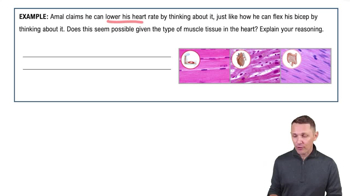
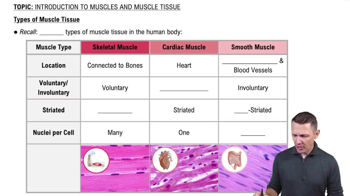
Smooth muscle is involuntary, non-striated, and has single nuclei; skeletal muscle is voluntary, striated, and multinucleated.
 뒤로뒤로
 6:31