 뒤로
Chapter 16: The Blood
 2:36

이 집합의 용어 (55)
What are the 3 basic functions of blood?
Transportation
Regulation
Protection
What is transported in the blood?
Hormones, waste/nutrients, O2/CO2, Proteins, Cholesterol
What is regulated by blood?
Body temperature and pH
What are the different ways of protection through blood?
Clotting, Immune cells, Immunoglobulins
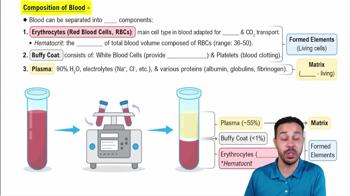
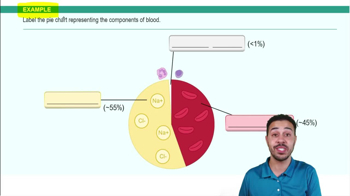
What are the two major compositions of whole blood?
Plasma
Formed elements
What are the formed elements in whole blood?
Erythrocyte
Leukocyte
Thrombocyte (Platelet)
What % of erythrocyte is in whole blood?
45%
What % of leukocytes is in whole blood?
less than 1%
What % of thrombocytes is in whole blood?
less than 1%
What % of plasma is in whole blood?
55%
What is the most dense component in whole blood when spun in a centrifuge?
Erythrocytes
What is the middle dense component in whole blood when spun in a centrifuge?
Buffy Coat
What does the buffy coat contain?
Leukocytes and thrombocytes (platelets)
What is the least dense component in whole blood when spun in a centrifuge?
Plasma
What % of water is in plasma?
about 90%
What are the different solutes that plasma has?
Electrolytes
Plasma proteins
Nutrients
Waste
Hormones
Dissolved gasses
What are the different types of plasma proteins?
Albumins
Globulins
Fibrinogen
Albumins make up what _% of the total of plasma proteins?
about 60%
Globulins make up what _% of the total of plasma proteins?
about 36%
Fibrinogen make up what _% of the total of plasma proteins?
about 4%
Define albumins.
Major contributor to osmotic pressure
Define globulins
Transport proteins and antibodies
What are antibodies also know as?
Immunoglobulins
Define fibrinogen.
Are inactive. Becomes fibrin threads of blood clots
What is the function of red blood cells?
carrying oxygen; hematocrit
What is the function of leukocytes?
Immunity
What is the function of thrombocytes?
Clotting
Define hematocrit.
The percentage of RBC in your blood
What is the structure of erythrocytes?
Small, flexible, biconcave discs
Lack nuclei
Lack mitochondria
Filled with hemoglobin
How does erythrocytes create energy?
Glycolysis
Does erythrocytes use oxygen to create ATP?
No they only carry it. They do not use it.
What is hemoglobin
Pigmented protein
The biconcave structure of erythrocytes help the cell by...
Increasing the surface area to volume ratio
What are the functions of erythrocytes?
Transportation of gases (O2 and CO2)
What is majority bounded to hemoglobin?
Oxygen
Oxyhemoglobin
Deoxyhemoglobin
What is bounded to hemoglobin?
Oxygen (majority) and CO2 (20%)
What is bound to hemoglobin that only takes up about 20%?
CO2
Carbaminohemoglobin
Define oxyhemoglobin.
hemoglobin + O2
Define deoxyhemoglobin.
Hemoglobin - O2
Define carbaminohemoglobin.
CO2 binds directly to the amino groups of polypeptide chains in hemoglobin
What is the structure of hemoglobin?
Quaternary structure
Globin portion
4 Heme units
What are the globin portions in hemoglobin.
2 alpha chains
2 beta chains
Each chain binds a heme unit
Define hemoglobin.
Iron-rich protein in RBC's
What are the 4 heme units in hemoglobin?
Pigmented portions
Each has a central Fe2+
Each binds O2
How many O2 can hemoglobin bind?
4 O2 molecules
Define hematopoiesis.
Process of blood cell production.
Hematopoiesis arise from...
Arise from hemocytoblasts
Hemocytoblasts is also known as...
Hematopoietic stem cells
Define erythropoiesis.
Process of red blood cell production
Define leukopoiesis.
Process of white blood cell productions
Define thrombopoiesis.
Process of platelet production
Where does hematopoiesis occur?
Occurs in red bone marrow
What are the steps of erythropoiesis?
Hematopoietic stem cells
Myeloid stem cells
Proerythroblast
Erythroblast
Reticulocyte
Mature Erythrocyte
What are the stages of an erythroblast (Developmental pathway) in the steps of erythropoiesis?
Basophilic erythroblast
Polychromatic erythroblast
Orthochromatic erythroblasts
What is the development pathway of Erythropoiesis?
Phase 1: Ribosome synthesis
Phase 2: Hemoglobin accumulation
Phase 3: Ejection of nucleus