 뒤로
Chapter 7
 4:50

이 집합의 용어 (59)
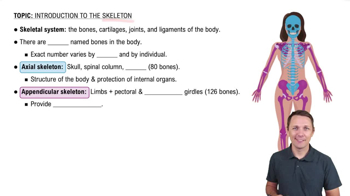
what is the axial skeleton? how many bones does it consist of?
trunk of body, 80 bones
skull, vertebral column, thoracic cage
apart of axial skeleton
what does the axial skeleton do?
structural support, protect vital organs, attachment site for muscles
number of bones skull has
22 (8 cranial, 14 facial)
bones associated with the skull (NOT THE MAIN BONES LIKE PARIETAL, ETC)
6 auditory ossicles, 1 hyoid bone
thoracic cage consists of
sternum and 24 ribs
vertebral column consists of
24 vertebrae, sacrum, coccyx
cranium (brain case) function
encases and protects brain
facial bones function
forms structure of face
bones that make up cranium
pair of parietal, temporal. single frontal, occiptial sphenoid, and ethmoid bones
sutures (definition)
immobile joints that join bones together
parietal bones (what do they form?)
form most of upper lateral side of skull
temporal bones (form?)
lower lateral side of skull
what do the temporal bones include that serves as a muscle attachment site
mastoid process
frontal bone (forms?)
forms forehead and floor of anterior cranial cavity
occipital bone (forms and contains..?)
forms posterior skull and base; foramen magnum (spinal cord exit)
sphenoid bone (forms? acts?)
forms part of cranial floor and acts as a cross bridge
what do the sphenoid bones unite & house
cranial and facial bones & houses sella turcica (pituitary gland)
ethmoid bone (forms?)
anterior cranial floor, roof of nasal cavity, medial orbit wall
what do the ethmoid bones include
cribriform plate (olfactory nerves), perpendicular plate (nasal septum), and crista galli (brain membrane attachment)
major sutures of skull
coronal, sagittal, lambdoid, squamous
coronal suture "function"
attaches frontal bone to parietal bones
sagittal "function"
attaches right and left parietal bones
lambdoid "function"
attaches occipital bone to parietal and temporal bones
squamous "function"
attaches temporal bone to parietal bone
facial skeleton consists of ? ( bones names)
paired maxillary, palatine, zygomatic, nasal, lacrimal, inferior nasal conchae, unpaired vomer and mandible
maxillae (form?)
upper jaw, hard palate, medial floor of orbit, lateral base of nose
palatine bones (form)
posterior portion of hard palate
zygomatic bones form
cheekbones; lateral wall and margin of orbit
nasal bones (forms?)
form bridge of nose
lacrimal bones form
anterior, medial wall of orbit
inferior nasal conchae (what are they)
thin, curved plates projecting into nasal cavity
vomer (forms?)
forms posterior-inferior part of nasal septum
mandible (form + move?)
forms lower jaw; ONLY moveable skull bone
what do foramina and processes serve in the skull?
passageway for nerves, blood vessels, attachment site for muscle
foramen magnum (what is it)
large opening for spinal cord
optic canal (what does it do)
passageway for optic nerve
mandibular fossa (what does it connect to?)
articulates with madnible (temporomandibular joint)
mental foramen (what is it)
passageway for nerves from the chin and lips
what anchors the teeth? (socket)
alveolar process
vertebral columns functions
provides support, protects spinal cord, allows flexibility and movement
cervical vertebrae (C1-C7)
located in neck
C1 (name, function)
atlas, supports skull
C2 (name, function)
axis, allow head movement
thoracic vertebrae (T1-T12)
located in upper back & articulate w/ ribs
lumbar vertebrae (L1-L5) (characteristic aswell)
located in lowerback, largest and bear most weight
sacrum (how is formed, part of?)
formed by fusion of 5 vertebrae; part of pelvis
coccyx
formed by fusion of 3-5 vertebrae; tailbone
what does each vertebra consist of
vertebral body that is weight-bearing, vertebral arch, vertebral foramen, and processes
intevertebral disc
fibrocartilage discs between vertebrae that absorbs shock
transverse & spinous processes
muscle attachment sites
articular processes
forms joints between vertebrae
thoracic cage functions
protects vital organs and supports upper body
what does the thoracic body consist of
sternum,12 pair of ribs, costal caerilages, and thoracic vertebrae
what makes up the sternum
manubrium (superior), body (middle), and xiphoid process (inferior)
ribs (what are the bones like, articulate w?)
elongate, curved bones; posteriorly articulate with thoracic vertebrae
true ribs (what numbers?)
1-7; directly connect to sternum via costal cartilage
false ribs (numbers)
8-10; indirectly connect to sternum via cartilage of rib 7
floating ribs (numbers)
11-12; doesn't attach to sternum