Skip to main content
Anatomy & Physiology
나의 코스
배우기
시험 준비
AI 튜터
학습 가이드
교과서적 해결책
플래시카드
탐험해 보세요
앱을 사용해 보세요
나의 코스
배우기
시험 준비
AI 튜터
학습 가이드
교과서적 해결책
플래시카드
탐험해 보세요
앱을 사용해 보세요
뒤로
chapter 9
카드를 뒤집기 위해 탭할 수 있습니다.
Smooth muscle characteristics
카드를 뒤집기 위해 탭할 수 있습니다.
👆
Smooth muscle characteristics
Not striated
and
involuntary
muscle type.
진행 상황 추적
컨트롤 버튼이 '내비게이션' 모드로 변경되었습니다.
1/29
추천 영상
VideoThumbView.guidedCourse
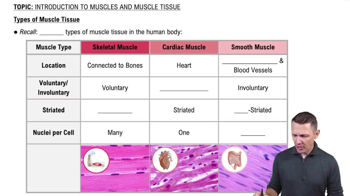
6:31
Types of Muscle Tissue
18705
views
494
rank
1
comments
VideoThumbView.guidedCourse
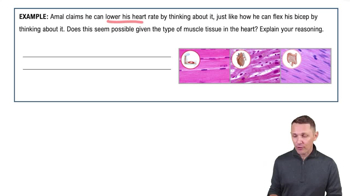
2:00
Introduction to Muscles and Muscle Tissue Example 1
16633
views
323
rank
VideoThumbView.guidedCourse
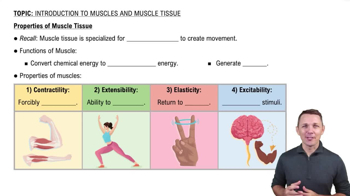
4:36
Properties of Muscle Tissue
25601
views
741
rank
2
comments
이 집합의 용어 (29)
하이드의 정의
Smooth muscle characteristics
Not striated
and
involuntary
muscle type.
Purpose of shivering and sitting upright
Shivering produces
heat
; sitting upright maintains
posture
.
Connective tissue layers in muscle
Epimysium
: surrounds whole muscle;
Perimysium
: surrounds fascicles;
Endomysium
: surrounds individual muscle fibers.
What is one muscle fiber?
A
long, multinucleated cell
formed by fused myoblasts;
myosatellite cells
repair damaged fibers.
Muscle cell membrane, cytoplasm, and ER names
Sarcolemma
: membrane;
Sarcoplasm
: cytoplasm;
Sarcoplasmic reticulum
: specialized ER.
Effect of ruptured tendon and aponeurosis definition
Ruptured tendon means
force cannot reach bone
, so no movement;
Aponeurosis
is a broad, sheetlike tendon.
Role of T tubules, terminal cisternae, triad, and SR
T tubules carry action potentials inward; terminal cisternae store
Ca²⁺
; triad = 1 T tubule + 2 terminal cisternae; SR stores/releases
Ca²⁺
.
Proteins in thin and thick filaments
Thin:
actin, troponin, tropomyosin
; thick:
myosin
. Tropomyosin blocks sites; troponin binds
Ca²⁺
.
Sarcomere changes during contraction
I band, H zone, and Z-to-Z distance
shorten;
A band
length stays constant; overlap between filaments increases.
Resting ion concentrations and pump function
Na⁺ high outside, K⁺ high inside; pump moves 3 Na⁺ out and 2 K⁺ in; Na⁺ enters during depolarization, K⁺ exits during repolarization.
Sequence of events at the neuromuscular junction (NMJ)
Order: D, G, B, F, A, E, C (specific steps of NMJ signaling).
How does the NMJ signal end?
AChE breaks down acetylcholine
, closing receptors and allowing muscle fiber relaxation.
Excitation–contraction (E–C) coupling steps
Action potential → T tubules → SR releases
Ca²⁺
→ Ca²⁺ binds troponin → tropomyosin moves → binding sites exposed.
ATP roles in muscle contraction
ATP detaches myosin heads, hydrolysis re-cocks them, and powers
Ca²⁺ pumping
back into SR.
Effect if Ca²⁺ can't bind troponin or ACh receptors are blocked
No cross-bridge formation → no contraction; blocked receptors cause weakness or paralysis.
Why is ATP needed for muscle relaxation?
ATP powers SR
Ca²⁺ pumps
and Na⁺/K⁺ pumps; removing Ca²⁺ lets tropomyosin cover actin sites again.
Phases of a muscle twitch
Latent
(no tension),
contraction
(tension rises),
relaxation
(tension falls).
Why does calcium matter in wave summation and tetanus?
Residual
Ca²⁺
from previous stimuli allows tension to build with repeated stimulation.
What is a motor unit?
One motor neuron plus all the muscle fibers it controls; smaller units allow finer control.
Two ways to increase muscle tension
Increase stimulation frequency and recruit more motor units; small units recruited first.
Length–tension relationship in muscle
Optimal filament overlap produces maximal tension; overstretched or over-shortened sarcomeres reduce force.
Types of muscle contraction during a bicep curl
Concentric
: lifting (shortening);
eccentric
: lowering (lengthening while active);
isometric
: holding (no length change).
Why is lowering a weight not muscle relaxation?
Muscle remains active to resist gravity; this is an
isometric contraction
.
Why use phosphocreatine at sprint start?
Stored ATP lasts ~2 seconds; phosphocreatine quickly regenerates ATP until glycolysis increases.
Causes of muscle fatigue
Fatigue results from metabolites, ion imbalances, fuel depletion, and neural factors; low pH reduces Ca²⁺ binding.
Cori cycle and EPOC explained
Lactate from muscle → blood → liver → glucose → muscle; EPOC is elevated oxygen use post-exercise to restore ATP and clear lactate.
Hypertrophy vs. atrophy
Hypertrophy: muscle fibers grow with use; atrophy: fibers shrink with disuse, e.g., after casting a leg.
Diseases affecting muscle function: polio, botulism, myasthenia gravis
Polio: motor neuron damage; botulism: blocks ACh release; myasthenia gravis: autoimmune loss of ACh receptors.
Difference between tetanus and rigor mortis
Tetanus: infection causes spasms by disrupting neural inhibition; rigor mortis: no ATP after death prevents myosin detachment.
 뒤로뒤로
 6:31