What are the three main types of chemical reactions?
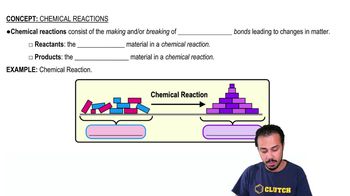
Synthesis (combination), decomposition, and exchange (displacement) reactions.
What occurs during a synthesis reaction?
Atoms or molecules combine to form a larger, more complex molecule; used in anabolic (building) processes.
What happens in a decomposition reaction?
A molecule breaks down into smaller molecules or its constituent atoms; involves catabolic (bond-breaking) reactions.
Describe an exchange reaction.
Bonds are both made and broken; involves both synthesis and decomposition processes.
What are redox reactions in living systems?
Reduction-oxidation reactions where atoms gain electrons (reduced) or lose electrons (oxidized), e.g., cellular respiration.
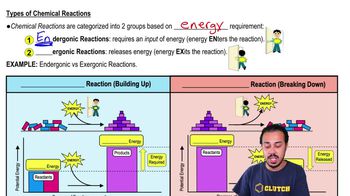
Define exergonic and endergonic reactions.
Exergonic reactions release energy; products have less potential energy than reactants. Endergonic reactions absorb energy; products have more potential energy.
What factors affect the rate of chemical reactions?
Temperature, concentration of reactants, particle size, and presence of catalysts (enzymes).
What is biochemistry?
The study of chemical composition and reactions of living matter, including organic and inorganic compounds.
What distinguishes inorganic from organic compounds?
Inorganic compounds do not contain carbon (e.g., water, salts), while organic compounds contain carbon and are usually large and covalently bonded.
List special properties of water as an inorganic compound.
High heat capacity, high heat of vaporization, polar solvent properties, reactivity, and cushioning.
What is the significance of water's high heat capacity?
Water can absorb and release large amounts of heat, preventing sudden temperature changes.
Explain water's high heat of vaporization.
Evaporation requires large amounts of heat, making it an effective cooling mechanism.
What are polar solvent properties of water?
Water dissolves and dissociates ionic substances and forms hydration layers around large charged molecules like proteins.
How does water participate in chemical reactions?
Water is necessary for hydrolysis and dehydration synthesis reactions.
What role does water play in cushioning?
Water cushions organs from physical trauma, e.g., cerebrospinal fluid protects nervous system organs.
What are the four emergent properties of water that support life?
Cohesive behavior, ability to moderate temperature, expansion upon freezing, and versatility as a solvent.
What causes cohesion in water molecules?
Hydrogen bonding causes water molecules to stay close to each other.
How does cohesion aid plants?
Cohesion helps transport water and nutrients against gravity through plant vessels.
What is adhesion in relation to water?
The clinging of water molecules to other substances, such as cell walls, helping counter gravity.
Define surface tension in water.
Surface tension measures how hard it is to break the surface of a liquid; it is related to cohesion.
 뒤로
 01:56