Skip to main content
Anatomy & Physiology
나의 코스
배우기
시험 준비
AI 튜터
학습 가이드
교과서적 해결책
플래시카드
탐험해 보세요
앱을 사용해 보세요
나의 코스
배우기
시험 준비
AI 튜터
학습 가이드
교과서적 해결책
플래시카드
탐험해 보세요
앱을 사용해 보세요
뒤로
Complement System, Cytokines, and Inflammation in Anatomy & Physiology
카드를 뒤집기 위해 탭할 수 있습니다.
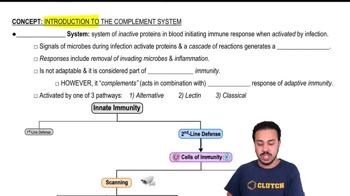
What is the complement system?
카드를 뒤집기 위해 탭할 수 있습니다.
👆
What is the complement system?
A group of plasma proteins that enhance immune responses by promoting inflammation, opsonization, and cell lysis.
진행 상황 추적
컨트롤 버튼이 '내비게이션' 모드로 변경되었습니다.
1/29
추천 영상
VideoThumbView.guidedCourse
4:16
Proteins of the Complement System
1784
views
22
rank
VideoThumbView.guidedCourse
4:25
Complement System
2235
views
34
rank
VideoThumbView.guidedCourse
3:25
Map of the Lesson on the Complement System
1690
views
15
rank
이 집합의 용어 (29)
하이드의 정의
What is the complement system?
A group of plasma proteins that enhance immune responses by promoting inflammation, opsonization, and cell lysis.
Which organ synthesizes complement proteins?
The liver synthesizes complement proteins.
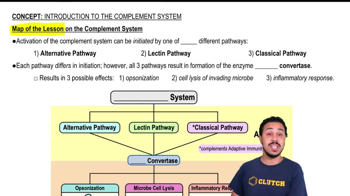
What are the three pathways of complement system activation?
The classical, lectin, and alternative pathways.
Which activated complement protein is crucial for immune response?
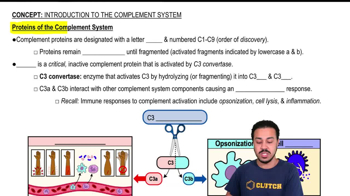
C3b is crucial as it acts as an opsonin and triggers further immune actions.
What is cell lysis in the complement system?
The destruction of a target cell by forming pores in its membrane via the Membrane Attack Complex.
What is the Membrane Attack Complex (MAC)?
A structure formed by complement proteins that creates pores in pathogen membranes, causing cell lysis.
What is the result of neutralizing a virus?
The virus is prevented from infecting host cells, stopping its replication.
Which cells are triggered to enhance inflammation by complement proteins?
Mast cells and basophils are triggered to release histamine and other mediators.
Which complement protein acts as an opsonin?
C3b acts as an opsonin, marking pathogens for phagocytosis.
What is opsonization?
The process of marking pathogens with molecules like C3b to enhance phagocytosis.
What are immune complexes?
Clusters formed when antibodies bind to antigens, which can be cleared by the immune system.
What are cytokines?
Small proteins secreted by cells that regulate immunity, inflammation, and hematopoiesis.
What is the function of tumor necrosis factor (TNF)?
TNF promotes inflammation and can induce apoptosis in infected or cancerous cells.
Which cells secrete tumor necrosis factor (TNF)?
Macrophages and T cells primarily secrete TNF.
What is septic shock?
A life-threatening condition caused by excessive cytokine release leading to widespread inflammation and organ failure.
Which cytokine is responsible for septic shock?
Tumor necrosis factor (TNF) is a key cytokine involved in septic shock.
What are interferons (IFN)?
Cytokines that interfere with viral replication and activate immune cells.
What are interleukins (IL)?
A group of cytokines that mediate communication between leukocytes during immune responses.
Which cytokines can be used to treat hepatitis B and C?
Interferons (IFNs) are used therapeutically to treat hepatitis B and C infections.
What are the two basic stages of the inflammatory response?
The vascular stage (vasodilation and increased permeability) and the cellular stage (phagocyte migration and activation).
What are the cardinal signs of inflammation?
Redness, heat, swelling, pain, and loss of function.
Which proteins/chemical mediators cause vasodilation in inflammation?
Histamine, prostaglandins, and bradykinin cause vasodilation.
What is hyperemia?
Increased blood flow to tissues, causing redness and heat during inflammation.
What is chemotaxis?
The movement of immune cells toward the site of infection or injury in response to chemical signals.
What makes up the pus seen in zits?
Dead neutrophils, bacteria, and tissue debris.
What does purulent mean?
Containing or producing pus.
What is a cytokine storm?
An excessive and uncontrolled release of cytokines causing severe inflammation and tissue damage.
What is a fever?
An elevated body temperature set by the hypothalamus in response to pyrogens.
What chemicals cause a fever to occur?
Pyrogens such as interleukin-1 (IL-1) and tumor necrosis factor (TNF) trigger fever.
 뒤로뒤로
 4:16