뒤로

Digestive System Anatomy & Physiology

컨트롤 버튼이 '내비게이션' 모드로 변경되었습니다.
1/30
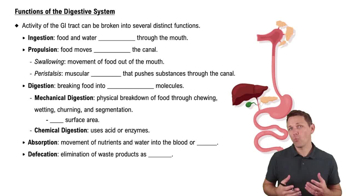
  • What are the main functions of the digestive system?

    Ingestion, mechanical processing, digestion, secretion, absorption, and excretion.
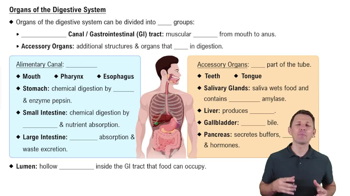
  • What is the digestive tract also called?

    The gastrointestinal tract or alimentary canal.
  • What is the peritoneum and its role in the digestive system?

    A serous membrane lining the peritoneal cavity, consisting of a mesothelium and areolar tissue, supporting and suspending digestive organs.
  • Name the four layers of the digestive tract wall.

    Mucosa, submucosa, muscularis externa, and serosa.
  • What type of epithelium lines the mucosa from stomach to rectum?

    Simple columnar epithelium.
  • What type of epithelium lines the esophagus mucosa?

    Stratified squamous epithelium.
  • Define peristalsis in the digestive system.

    Wave-like muscular contractions that move food along the digestive tract.
  • What is segmentation in digestion?

    Rhythmic contractions that mix and churn digestive contents.
  • What are the three major salivary glands?

    Parotid, sublingual, and submandibular glands.
  • What is the composition of saliva?

    99.4% water and 0.6% electrolytes, buffers, glycoproteins, antibodies, enzymes, and waste products.
  • Name the four types of teeth.

    Incisors, cuspids (canines), bicuspids (premolars), and molars.
  • What is the primary function of the esophagus?

    To carry food and liquids from the pharynx to the stomach.
  • What are the three phases of swallowing (deglutition)?

    Buccal phase (voluntary), pharyngeal phase, and esophageal phase (both involuntary).
  • Name the four regions of the stomach.

    Cardia, fundus, body, and pylorus.
  • What do parietal cells in the stomach secrete?

    Intrinsic factor and hydrochloric acid (HCl).
  • What is the role of intrinsic factor?

    Facilitates absorption of vitamin B12.
  • What enzyme do chief cells secrete in the stomach?

    Pepsinogen, which is converted to pepsin in acidic conditions.
  • What are the three phases of gastric control?

    Cephalic phase, gastric phase, and intestinal phase.
  • What are the three parts of the small intestine?

    Duodenum, jejunum, and ileum.
  • What structures increase the surface area of the small intestine for absorption?

    Circular folds, intestinal villi, and microvilli.
  • What is a lacteal?

    A lymphatic capillary within an intestinal villus that absorbs dietary lipids.
  • What is the main function of the pancreas in digestion?

    To produce and secrete pancreatic juice containing digestive enzymes and buffers.
  • Name two hormones that regulate pancreatic secretions.

    Secretin and cholecystokinin (CCK).
  • What are the three general functions of the liver?

    Metabolic regulation, hematological regulation, and bile production.
  • What is the function of bile?

    To emulsify fats, aiding in lipid digestion and absorption.
  • What is the primary function of the large intestine?

    Reabsorption of water and electrolytes and compaction of fecal material.

  • Name three vitamins produced by bacteria in the large intestine.

    Vitamin K, biotin, and vitamin B5.
  • What is the defecation reflex?

    A reflex triggered by rectal wall distension that initiates the urge to defecate.
  • How are carbohydrates digested and absorbed?

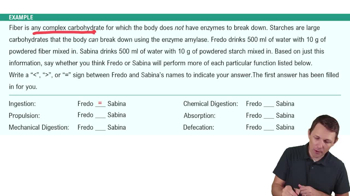
    Broken down by salivary and pancreatic amylases into disaccharides, then by brush border enzymes into monosaccharides absorbed by intestinal epithelium.
  • How are lipids digested and absorbed?

    Lipases break triglycerides into monoglycerides; bile salts emulsify fats into micelles for absorption.