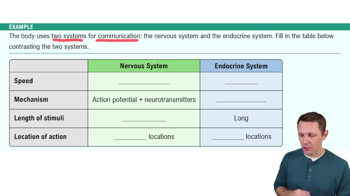
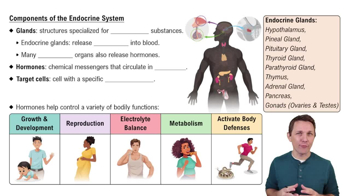
A slow-acting control system that influences metabolic activity using hormones as chemical messengers circulated in the blood to target cells.
Differences between hormonal and neural controls
Hormonal control is slower but longer-lasting, using blood-borne hormones; neural control is fast and short-lived via nerve impulses.
Hormones vs paracrines vs autocrines
Hormones act at a distance via blood; paracrines act locally on nearby cells; autocrines act on the same cell that secreted them.
Chemical classification of hormones
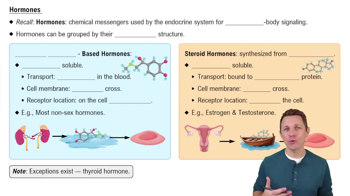
Hormones are classified by water solubility into amino acid-based, steroids, and eicosanoids.
Major effects hormones produce on target cells
Hormones can alter membrane permeability, stimulate protein synthesis, activate/inactivate enzymes, induce secretion, or stimulate mitosis.
Mechanism of water-soluble hormone action
Water-soluble hormones bind to plasma membrane receptors, activate G proteins, stimulate adenylate cyclase, increase cAMP, and activate protein kinases.
Mechanism of lipid-soluble hormone action
Lipid-soluble hormones diffuse through membranes, bind intracellular receptors, attach to DNA, and activate gene transcription for new protein synthesis.
Hormonal regulation method
Most hormone synthesis and release are controlled by negative feedback to maintain blood hormone levels within narrow ranges.
Types of endocrine gland stimuli
Hormone release is triggered by humoral (blood chemical changes), neural (nerve signals), and hormonal (other hormones) stimuli.
Hypothalamus role in endocrine system
A neuroendocrine organ that regulates hormone release from the pituitary gland via the infundibulum.
Posterior pituitary hormones
Oxytocin and ADH are produced in the hypothalamus and released by the posterior pituitary.
Anterior pituitary hormones
Includes Growth Hormone (GH), Thyroid Stimulating Hormone (TSH), Adrenocorticotropic Hormone (ACTH), FSH, LH, Prolactin, and MSH.
Growth Hormone disorders
Pituitary dwarfism (deficiency), gigantism (excess in children), and acromegaly (excess in adults).
Thyroid gland location and hormones
Located anterior neck on trachea; produces Thyroid Hormone (T4) and Calcitonin.
Thyroid hormone disorders
Myxedema (hypothyroidism), Graves’ disease (autoimmune hyperthyroidism with exophthalmos), and Hashimoto’s thyroiditis.
Calcitonin function
Inhibits osteoclast activity and stimulates bone reabsorption to lower blood calcium.
Parathyroid hormone effects
Increases osteoclast activity, intestinal calcium absorption, and kidney calcium reabsorption.
 뒤로
 7:06