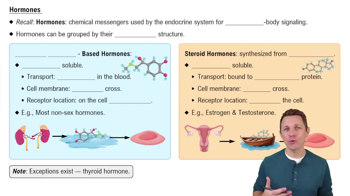
Diffuse through plasma membrane, bind intracellular receptors, hormone-receptor complex enters nucleus to regulate gene transcription.
Mechanism of water-soluble hormone action
Bind plasma membrane receptors, activate G-protein, adenylate cyclase converts ATP to cAMP, cAMP activates protein kinases triggering cell responses.
Factors affecting target cell responsiveness
Hormone concentration, receptor abundance, and influence of other hormones (permissive, synergistic, antagonistic effects).
Permissive, synergistic, and antagonistic hormone effects
Permissive: one hormone enhances another (e.g., cortisol and glucagon). Synergistic: combined effect greater (e.g., ADH and aldosterone). Antagonistic: opposing effects (e.g., PTH and calcitonin).
Role of hypothalamus in endocrine system
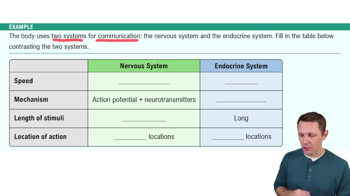
Links nervous and endocrine systems; produces releasing and inhibiting hormones controlling anterior pituitary; produces hormones stored in posterior pituitary.
Anterior pituitary hormones and functions
hGH promotes growth; TSH stimulates thyroid; FSH and LH regulate gonads; PRL promotes milk; ACTH stimulates adrenal cortex; MSH role unclear.
Posterior pituitary hormones
Stores and releases hypothalamic hormones: Oxytocin (uterine contraction, milk ejection) and ADH (water retention, blood pressure).
Thyroid gland structure and hormones
Located below larynx; follicles produce T3 and T4 increasing metabolism; parafollicular cells produce calcitonin lowering blood calcium.
Parathyroid glands and hormone function
Four small glands on thyroid; secrete PTH which increases blood calcium by stimulating osteoclasts and reducing phosphate.
Adrenal gland regions and hormones
Cortex zones: glomerulosa (mineralocorticoids like aldosterone), fasciculata (glucocorticoids like cortisol), reticularis (androgens). Medulla secretes epinephrine and norepinephrine.
Functions of ovaries and testes in endocrine system
Ovaries produce estrogens, progesterone, inhibin, relaxin; testes produce testosterone and inhibin, regulating reproduction and secondary sex characteristics.
Pineal gland and melatonin
Located in brain; secretes melatonin which regulates biological clock and promotes sleepiness, with higher secretion in darkness.
Other endocrine tissues and hormones
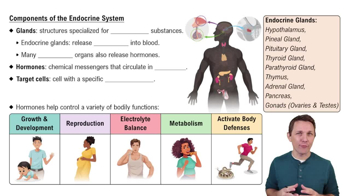
Thymus produces thymosin for T cell maturation; placenta produces estrogens and progesterone; heart produces ANP; GI tract enteroendocrine cells aid digestion.
 뒤로
 7:06