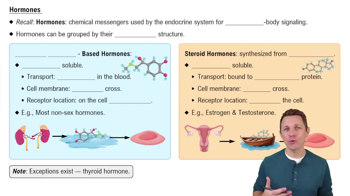
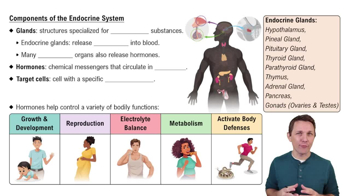
Hormones are chemical messengers secreted by endocrine organs that interact with specific target cells to maintain homeostasis, promote growth, and regulate metabolism.
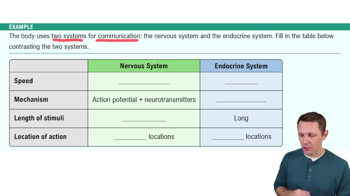
How do the endocrine and nervous systems differ in communication?
The nervous system uses neurons and neurotransmitters for rapid, short-lived effects, while the endocrine system secretes hormones into the bloodstream for slower, longer-lasting effects.
Name the three types of chemical signals in the body.
Endocrine signals (hormones traveling through blood), paracrine signals (affect nearby different cells), and autocrine signals (affect the same cell that secreted them).
What distinguishes primary from secondary endocrine organs?
Primary endocrine organs have only endocrine functions; secondary organs have both endocrine and nonendocrine functions.
What are the two main classes of hormones based on chemical structure?
How do hydrophilic hormones typically exert their effects on target cells?
They bind to plasma membrane receptors, activating G-proteins and second messenger systems like cAMP, which trigger cellular responses.
Describe the mechanism of action for hydrophobic steroid hormones.
They cross the plasma membrane, bind intracellular receptors, form hormone-receptor complexes, and alter gene transcription in the nucleus.
What is upregulation and downregulation of hormone receptors?
Upregulation increases receptor numbers in response to low hormone levels; downregulation decreases receptor numbers after prolonged high hormone exposure.
What are the main effects hormones can have on target cells?
Stimulate secretion, activate/inhibit enzymes, regulate cell division, open/close ion channels, and modulate gene expression.
Define hormone half-life and compare hydrophobic vs hydrophilic hormones.
Half-life is the time for plasma hormone concentration to reduce by half; hydrophobic hormones have longer half-lives (days to weeks) than hydrophilic hormones.
What are the three types of stimuli regulating hormone secretion?
Hormonal stimuli (hormones regulate other hormones), humoral stimuli (changes in blood ions or nutrients), and neural stimuli (nervous system signals).
What is the hypothalamic-hypophyseal portal system?
A specialized blood vessel network connecting the hypothalamus to the anterior pituitary, allowing hypothalamic hormones to regulate pituitary secretion.
Name the two neurohormones stored and released by the posterior pituitary.
Antidiuretic hormone (ADH) and oxytocin, both produced by the hypothalamus and released from the posterior pituitary.
What is the primary function of ADH (vasopressin)?
To increase water retention by kidneys via insertion of aquaporins, reducing urine output and maintaining fluid balance.
How does oxytocin support reproduction?
It stimulates uterine contractions during labor and milk ejection during breastfeeding via positive feedback.
What are tropic hormones and their role in the anterior pituitary?
Tropic hormones stimulate other endocrine glands to secrete hormones, regulating body functions and growth.
List major anterior pituitary tropic hormones and their target glands.
TSH (thyroid), ACTH (adrenal cortex), LH and FSH (gonads), and PRL (mammary glands).
What are the short-term and long-term effects of growth hormone (GH)?
Short-term: metabolic effects like fat breakdown and glucose increase; long-term: stimulates IGF production promoting bone and muscle growth.
Describe the structure and function of the thyroid gland.
Butterfly-shaped gland in the neck with follicles producing thyroid hormones (T3 and T4) that regulate metabolism and growth.
How is thyroid hormone production regulated?
By a negative feedback loop involving TRH from hypothalamus and TSH from anterior pituitary, adjusting T3 and T4 secretion.
What are the opposing roles of parathyroid hormone (PTH) and calcitonin?
PTH increases blood calcium by stimulating bone resorption and absorption; calcitonin lowers blood calcium by inhibiting osteoclasts.
What are the main zones of the adrenal cortex and their hormone products?
Zona glomerulosa (mineralocorticoids like aldosterone), zona fasciculata (glucocorticoids like cortisol), and zona reticularis (androgenic steroids).
What is the role of aldosterone in the body?
Regulates sodium and potassium levels, extracellular fluid volume, blood pressure, and acid-base balance via the renin-angiotensin-aldosterone system.
How does cortisol help the body respond to stress?
By increasing gluconeogenesis, protein breakdown, and fat release, while suppressing inflammation and regulating metabolism.
What hormones are secreted by the adrenal medulla and their effects?
Epinephrine and norepinephrine increase heart rate, dilate bronchioles, constrict some blood vessels, and prepare the body for fight-or-flight.
What are the main endocrine cell types in the pancreatic islets and their hormones?
 뒤로
 7:06