 뒤로
Endocrine System - Anatomy & Physiology
 7:06

이 집합의 용어 (28)
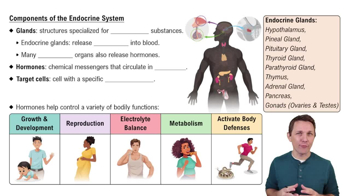
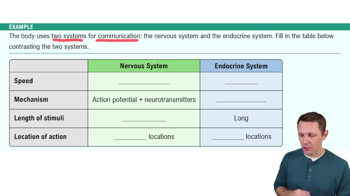
The endocrine system coordinates and integrates body cell activity by releasing hormones into the blood, influencing metabolic processes with slower but longer-lasting responses than the nervous system.
Endocrine glands are ductless and secrete hormones into the bloodstream; exocrine glands have ducts and secrete products onto body surfaces or cavities.
Pituitary, thyroid, parathyroid, adrenal, pineal glands, hypothalamus, pancreas, gonads, and additional hormone-producing tissues like adipose tissue and GI tract.
Hormones (long-distance signals in blood), autocrines (act on same cell), and paracrines (act on nearby cells); only hormones are part of the endocrine system.
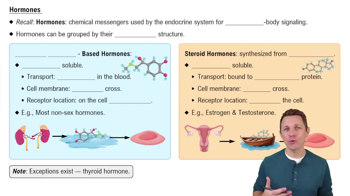
Amino acid–based hormones (peptides, proteins) and steroids (synthesized from cholesterol).
Target cells have specific receptors for hormones; response depends on hormone concentration, receptor number, and binding affinity.
Up-regulation increases receptor numbers in response to low hormone levels; down-regulation decreases receptors when hormone levels are high.
Water-soluble hormones bind membrane receptors and use second messengers; lipid-soluble hormones diffuse through membranes and affect gene transcription.
Water-soluble hormones bind receptors, activate G proteins, which stimulate adenylate cyclase to produce cAMP, triggering cellular responses.
Lipid-soluble hormones enter cells, bind intracellular receptors, hormone-receptor complex enters nucleus, binds DNA, and initiates mRNA transcription.
Hormone levels are regulated by negative feedback and triggered by hormonal, humoral, or neural stimuli.
Declining blood Ca2+ levels stimulate parathyroid hormone release, which raises Ca2+ levels and inhibits further hormone release.
Sympathetic nervous system stimulates adrenal medulla to release epinephrine and norepinephrine during fight-or-flight response.
Hypothalamus releases hormones that stimulate anterior pituitary, which then stimulates other endocrine glands; target gland hormones provide negative feedback.
Posterior pituitary (neurohypophysis) stores and releases neurohormones oxytocin and ADH; anterior pituitary (adenohypophysis) produces and secretes multiple hormones.
Stimulates uterine contractions during childbirth and milk ejection; acts via positive feedback and PIP2-calcium second messenger system.
Increases water reabsorption in kidneys, reduces urine output, regulated by osmoreceptors; high levels cause vasoconstriction (vasopressin).
Promotes growth via insulin-like growth factors (IGFs), increases protein synthesis, mobilizes fats, and converts glucose.
Stimulated by GHRH and ghrelin; inhibited by GHIH (somatostatin) and increased GH/IGF levels.
Regulate metabolic rate, energy production, growth, development, and maintain blood pressure by increasing adrenergic receptors.
Iodide trapped and oxidized, attached to thyroglobulin tyrosines forming MIT and DIT, coupled to form T3 and T4, stored in colloid, then released into blood.
Increases blood Ca2+ by stimulating bone resorption, kidney reabsorption, and intestinal absorption.
Zona glomerulosa produces mineralocorticoids (aldosterone), zona fasciculata produces glucocorticoids (cortisol), zona reticularis produces gonadocorticoids.
Stimulates Na+ reabsorption and K+ elimination by kidneys, increasing blood volume and pressure.
Maintains blood glucose, supports blood pressure, promotes gluconeogenesis, and suppresses immune and inflammatory responses.
Secretes catecholamines epinephrine (80%) and norepinephrine (20%) that increase heart rate, blood glucose, and vasoconstriction during stress.
Alpha cells produce glucagon (raises blood glucose); beta cells produce insulin (lowers blood glucose by enhancing uptake and storage).
Type 1: insulin hyposecretion; Type 2: insulin hypoactivity; symptoms include polyuria, polydipsia, and polyphagia.