뒤로

Endocrine System and Hormones - Anatomy & Physiology

컨트롤 버튼이 '내비게이션' 모드로 변경되었습니다.
1/29
  • Adrenal cortex

    The outer region of the adrenal gland that produces corticosteroids including mineralocorticoids, glucocorticoids, and gonadocorticoids.
  • Adrenal medulla

    The inner part of the adrenal gland that secretes catecholamines, chiefly epinephrine (EPI) and norepinephrine (NE).
  • Adrenocorticotropic hormone (ACTH)

    A hormone from the anterior pituitary that stimulates the adrenal cortex to release corticosteroids.
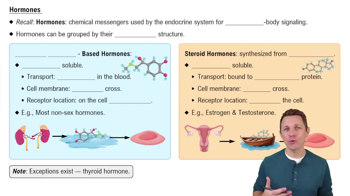
  • Amino acid based hormone

    Water-soluble, nonsteroid hormones that act via second messenger systems like cyclic AMP (cAMP).
  • Steroid/lipid-soluble hormone

    Hormones derived from cholesterol that can cross cell membranes and act on intracellular receptors.
  • Androgens

    Male sex hormones chiefly testosterone, produced mainly by the gonads and adrenal cortex.
  • Anterior pituitary lobe (adenohypophysis)

    The front lobe of the pituitary gland that secretes tropic hormones like ACTH, FSH, LH, GH, PRL, and TSH.
  • Antidiuretic hormone (ADH) / vasopressin

    A hormone from the posterior pituitary that promotes water retention by the kidneys.
  • Calcitonin (CT)

    A hormone from the thyroid gland that lowers blood calcium levels by inhibiting osteoclast activity.
  • Catecholamines

    Hormones from the adrenal medulla, mainly epinephrine (EPI) and norepinephrine (NE), involved in the fight-or-flight response.
  • Corticosteroids

    Steroid hormones from the adrenal cortex including mineralocorticoids, glucocorticoids, and gonadocorticoids.
  • Corticotropin-releasing hormone (CRH)

    A hypothalamic hormone that stimulates the anterior pituitary to release ACTH.
  • Down-regulation

    A decrease in receptor numbers on target cells in response to high hormone levels, reducing sensitivity.
  • Up-regulation

    An increase in receptor numbers on target cells in response to low hormone levels, increasing sensitivity.
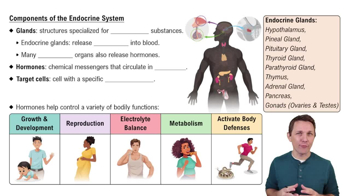
  • Endocrine glands

    Glands that secrete hormones directly into the bloodstream to regulate body functions.
  • Follicle-stimulating hormone (FSH)

    A gonadotropin from the anterior pituitary that stimulates gamete production in ovaries and testes.
  • Glucagon

    A hormone from the pancreas that raises blood glucose levels by stimulating glycogen breakdown.
  • Glucocorticoids

    Corticosteroids like cortisol that regulate metabolism and help the body respond to stress.
  • Gonadotropin-releasing hormone (GnRH)

    A hypothalamic hormone that stimulates the anterior pituitary to release FSH and LH.
  • Growth hormone (GH) / somatropin

    An anterior pituitary hormone that stimulates body growth and metabolism.
  • Human chorionic gonadotropin (hCG)

    A hormone produced by the placenta that maintains the corpus luteum during early pregnancy.
  • Insulin

    A pancreatic hormone that lowers blood glucose by promoting cellular uptake and storage.
  • Luteinizing hormone (LH)

    A gonadotropin from the anterior pituitary that triggers ovulation and stimulates testosterone production.
  • Mineralocorticoids

    Corticosteroids like aldosterone that regulate electrolyte and water balance.
  • Parathyroid hormone (PTH)

    A hormone from the parathyroid glands that raises blood calcium levels by stimulating bone resorption.
  • Posterior pituitary lobe (neurohypophysis)

    The back lobe of the pituitary gland that stores and releases ADH and oxytocin.
  • Second messenger mechanism (cAMP)

    A signaling pathway where hormones activate receptors that produce cyclic AMP to trigger cellular responses.
  • Thyroid hormone (TH)

    Hormones thyroxine (T4) and triiodothyronine (T3) that regulate metabolism and growth.
  • Thyroid-stimulating hormone (TSH)

    An anterior pituitary hormone that stimulates the thyroid gland to produce thyroid hormones.