What is the primary function of the endocrine system?
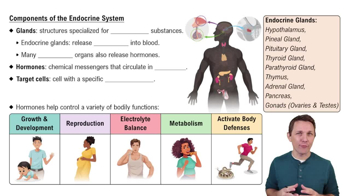
To synthesize and secrete hormones into the blood, which regulate various body functions by interacting with specific target cells.
How do hormones reach their target cells?
Hormones are secreted into interstitial fluid, enter blood capillaries, travel through veins to the heart, then arteries, and finally diffuse out of capillaries to reach target cells.
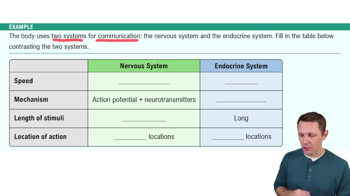
Difference between endocrine and nervous system communication?
Nervous system uses rapid nerve impulses and neurotransmitters at synapses; endocrine system uses slower hormones transported in the bloodstream to distant target cells.
What are paracrine and autocrine signals?
Paracrine signals affect nearby cells via extracellular fluid; autocrine signals affect the same cell that secreted the chemical.
What distinguishes endocrine glands from exocrine glands?
Endocrine glands are ductless and secrete hormones into interstitial fluid; exocrine glands secrete products into ducts leading to body surfaces or cavities.
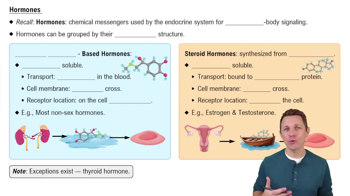
How do hydrophilic and hydrophobic hormones differ in cell entry?
Hydrophilic hormones cannot cross the plasma membrane and bind to surface receptors; hydrophobic hormones cross membranes and bind intracellular receptors.
What are the main classes of hormones?
Steroid hormones (lipid soluble), peptide hormones (short polypeptides, hydrophilic), and amine hormones (derived from amino acids, mostly hydrophilic).
Mechanism of action of steroid hormones?
Steroid hormones diffuse into target cells, bind intracellular receptors, form hormone-receptor complexes, and regulate gene transcription.
How do nonsteroid hormones typically act on target cells?
They bind to cell surface receptors and activate second messenger systems, often involving G-proteins and cAMP, amplifying the signal inside the cell.
What are the effects of hormone actions on target cells?
Stimulating secretion, activating/inhibiting enzymes, regulating cell division, opening/closing ion channels, and altering gene expression.
What are the three types of stimuli that regulate hormone secretion?
Hormonal stimuli (other hormones), humoral stimuli (blood ion or nutrient levels), and neural stimuli (nervous system signals).
Role of the hypothalamus in endocrine regulation?
It links the nervous and endocrine systems, releasing hormones that regulate the anterior pituitary gland's secretion of tropic hormones.
Difference between anterior and posterior pituitary glands?
Anterior pituitary is glandular tissue producing hormones; posterior pituitary is nervous tissue storing and releasing hypothalamic neurohormones.
Function of antidiuretic hormone (ADH)?
ADH promotes water retention by kidneys by inserting aquaporins in kidney tubule cells, reducing urine output and conserving body water.
What triggers ADH release?
Osmoreceptors in the hypothalamus detect increased blood solute concentration and stimulate ADH release to conserve water.
Role of oxytocin in the body?
Oxytocin stimulates uterine contractions during childbirth and milk ejection during nursing; it operates via positive feedback loops.
What hormones does the anterior pituitary secrete?
TSH, ACTH, prolactin, LH, FSH, growth hormone (GH), and others that regulate various endocrine glands and physiological processes.
Effects of growth hormone (GH)?
Promotes fat breakdown, gluconeogenesis, protein synthesis, cell division, bone growth, and muscle development.
What causes gigantism and acromegaly?
Gigantism results from GH hypersecretion before epiphyseal plate closure; acromegaly occurs after closure, causing tissue thickening.
Functions of thyroid hormones (T3 and T4)?
Regulate metabolic rate, promote growth and development, and synergize with the sympathetic nervous system.
How is thyroid hormone production regulated?
TSH from the anterior pituitary stimulates thyroid hormone synthesis, secretion, and thyroid gland growth.
What is the role of parathyroid hormone (PTH)?
PTH increases blood calcium by stimulating bone resorption, enhancing intestinal absorption via vitamin D activation, and reducing kidney calcium excretion.
How does calcitonin affect calcium levels?
Calcitonin inhibits osteoclast activity at high levels, reducing blood calcium and promoting bone formation.
What hormones are produced by the adrenal cortex?
Mineralocorticoids (e.g., aldosterone), glucocorticoids (e.g., cortisol), and androgenic steroids.
Main effects of aldosterone?
Regulates sodium and potassium levels, maintains extracellular fluid volume, blood pressure, and acid-base balance.
Role of cortisol in stress response?
Promotes gluconeogenesis, fat and protein breakdown, acts as an anti-inflammatory, and helps maintain homeostasis during stress.
What hormones does the adrenal medulla secrete?
Catecholamines: epinephrine and norepinephrine, which mediate the fight-or-flight response.
Functions of pancreatic hormones glucagon and insulin?
Glucagon raises blood glucose by promoting glycogen breakdown and gluconeogenesis; insulin lowers blood glucose by promoting uptake and storage.
What is the difference between type 1 and type 2 diabetes mellitus?
Type 1 is autoimmune destruction of insulin-producing cells; type 2 involves insulin resistance and impaired insulin secretion.
 뒤로
 7:06