뒤로

Exam 4 A&P 4.0

컨트롤 버튼이 '내비게이션' 모드로 변경되었습니다.
1/48
  • Ion that binds to troponin to allow contraction

    Calcium

  • Ion that enters the muscle cell during depolarization

    Sodium (Na⁺)

  • Ion that leaves the muscle cell during repolarization

    Potassium (K⁺)

  • Process where sodium enters and the inside becomes less negative

    Depolarization

  • Process where the cell returns toward its resting electrical state

    Repolarization

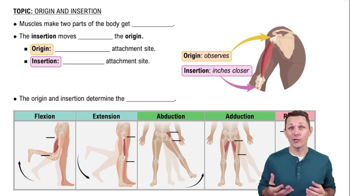
  • Movement that decreases the angle of a joint

    Flexion

  • Movement that increases the angle of a joint

    Extension

  • Circular movement of a limb

    Circumduction

  • Movement away from the body's midline

    Abduction

  • Movement toward the body's midline

    Adduction

  • Turning a bone around its axis

    Rotation

  • Turning the palm upward

    Supination

  • Turning the palm downward

    Pronation

  • Pulling the toes toward the shin

    Dorsiflexion

  • Pointing the toes downward

    Plantar flexion

  • Turning the sole of the foot inward

    Inversion

  • Turning the sole of the foot outward

    Eversion

  • Moving a body part upward

    Elevation

  • Moving a body part downward

    Depression

  • Moving a body part forward

    Protraction

  • Moving a body part backward

    Retraction

  • Moving the thumb to touch the fingertips

    Opposition

  • Joint type where flat surfaces slide past each other

    Plane (gliding) joint

  • Joint type allowing back-and-forth movement

    Hinge joint

  • Joint type allowing rotation around an axis

    Pivot joint

  • Joint type allowing movement side to side and back and forth

    Condyloid joint

  • Joint type allowing movement in two directions

    Saddle joint

  • Joint type allowing movement in almost every direction

    Ball-and-socket joint

  • Muscle's response to one stimulus

    Muscle twitch

  • Repeated stimulation increases muscle tension

    Wave summation

  • Activating more motor units to increase muscle force

    Motor recruitment

  • One motor neuron and all the muscle fibers it controls

    Motor unit

  • Low-level muscle activity while resting

    Muscle tone

  • Muscle creates tension without changing length

    Isometric contraction

  • Muscle changes length while producing movement

    Isotonic contraction

  • Slow muscle type, uses oxygen, resists fatigue

    Slow oxidative (Type I)

  • Fast muscle type, uses oxygen and glycolysis, moderate fatigue resistance

    Fast oxidative-glycolytic (Type IIa)

  • Fast and powerful muscle type but fatigues quickly

    Fast glycolytic (Type IIx)

  • Cartilage in the knee that cushions and stabilizes the joint

    Meniscus

  • Joint disease involving the breakdown of cartilage

    Osteoarthritis

  • Muscle that has a striped appearance

    Striated muscle

  • Muscle under conscious control

    Voluntary muscle

  • Muscle not under conscious control

    Involuntary muscle

  • Connects bone to bone

    Ligament

  • Connects muscle to bone

    Tendon

  • Freely movable joint containing synovial fluid

    Synovial joint

  • Covers bone ends and reduces friction

    Articular cartilage

  • Lubricates joints and reduces friction

    Synovial fluid