뒤로

Fundamentals of Endocrine Signaling and Action

컨트롤 버튼이 '내비게이션' 모드로 변경되었습니다.
1/20
  • What is the primary difference between endocrine and nervous system communication in terms of speed and duration?

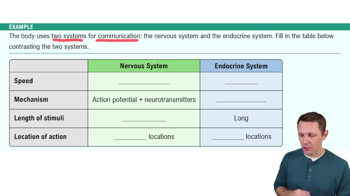
    Nervous system communication is rapid (milliseconds) and brief, targeting specific neurons, muscles, or glands. Endocrine system communication is slower (seconds to hours), sustained, and targets cells with specific hormone receptors.
  • Define the endocrine system and its main components.

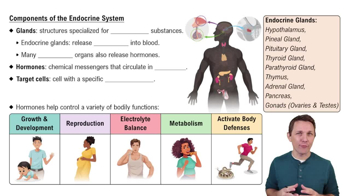
    The endocrine system consists of ductless glands that secrete hormones into the bloodstream to regulate homeostasis. Key components include endocrine glands, hormones, and target cells with specific receptors.
  • How do water-soluble and lipid-soluble hormones differ in transport and receptor location?

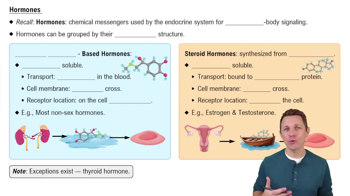
    Water-soluble hormones dissolve freely in plasma and bind to membrane receptors. Lipid-soluble hormones require carrier proteins in plasma and bind to intracellular receptors in the cytosol or nucleus.
  • What is the role of hormone receptors in endocrine signaling specificity?

    Hormone receptors bind only to hormones with matching shapes, ensuring specificity so that only target cells respond to a given hormone.
  • Describe the gene activation mechanism of lipid-soluble hormones.

    Lipid-soluble hormones diffuse across membranes, bind intracellular receptors, form a complex that binds DNA at hormone response elements, and trigger mRNA transcription for new protein synthesis.
  • Explain the second messenger system used by water-soluble hormones.

    Water-soluble hormones bind membrane receptors, activating G proteins that stimulate adenylyl cyclase to produce cAMP, which acts as a second messenger to activate kinases and phosphorylate proteins.
  • What is signal amplification in endocrine signaling?

    One hormone binding activates multiple G proteins, which activate many adenylyl cyclase enzymes, producing large amounts of cAMP, leading to phosphorylation of millions of enzymes, amplifying the cellular response.
  • Compare the half-life and stability of free versus bound hormones in plasma.

    Free hormones are active but degrade rapidly (short half-life). Bound hormones are protected by carrier proteins, degrade slowly, and serve as a reservoir to maintain hormone levels.
  • What are the three types of endocrine stimuli that regulate hormone secretion?

    Humoral stimuli respond to blood ion/nutrient changes, neural stimuli involve nerve fibers triggering secretion, and hormonal stimuli involve hormones stimulating other glands (tropic hormones).
  • Describe negative and positive feedback loops in hormone regulation.

    Negative feedback inhibits hormone release when levels are high to maintain homeostasis. Positive feedback amplifies hormone secretion to drive processes to completion, such as oxytocin during childbirth.
  • What is receptor up-regulation and down-regulation?

    Up-regulation increases receptor numbers in response to low hormone levels, enhancing sensitivity. Down-regulation decreases receptor numbers or desensitizes cells in response to high hormone levels to prevent overstimulation.
  • Define permissiveness, synergism, and antagonism in hormone interactions.

    Permissiveness: one hormone enables another's full effect. Synergism: combined hormones produce greater effect than sum. Antagonism: one hormone opposes another's action.
  • How does the nervous system override endocrine control during stress?

    During stress, the CNS triggers sympathetic nerves to stimulate adrenal medulla release of catecholamines, suppressing insulin and increasing glucose for muscle use, prioritizing survival over homeostasis.
  • What factors govern plasma hormone concentration?

    Plasma concentration depends on secretion rate, metabolic inactivation (liver), renal excretion, and plasma volume.
  • Explain the role of the hypothalamus in endocrine integration.

    The hypothalamus links neural input to endocrine control by regulating the anterior pituitary via tropic hormones through the hypophyseal portal system and sending hormones to the posterior pituitary.
  • Compare steroid and peptide hormone signaling in terms of receptor location and response speed.

    Steroid hormones are lipid-soluble, bind intracellular receptors, and have slow, long-lasting responses. Peptide hormones are water-soluble, bind membrane receptors, and have fast, transient responses via second messengers.
  • What causes receptor resistance in conditions like Type 2 Diabetes?

    Chronic high hormone levels cause receptor down-regulation or desensitization, reducing receptor density and impairing signaling, leading to resistance despite high hormone presence.
  • Outline the sequence of events in the cAMP second messenger pathway.

    1. Hormone binds membrane receptor. 2. G-protein activates and exchanges GDP for GTP. 3. Adenylyl cyclase converts ATP to cAMP. 4. cAMP activates protein kinase A. 5. Kinase phosphorylates cellular proteins.
  • Why do only free hormones exit capillaries to bind receptors?

    Only free (unbound) hormones can diffuse out of capillaries to reach and bind target cell receptors; bound hormones are inactive while attached to carrier proteins.
  • How do hormone half-lives affect their physiological effects?

    Hormones with short half-lives act quickly and are cleared rapidly, while those with long half-lives have prolonged effects, influencing the duration of their physiological actions.