 뒤로
General Chemistry for Anatomy & Physiology Pt 1
 02:13

이 집합의 용어 (19)
Matter has mass and occupies space. It exists in states solid, liquid, or gas, depending on energy.
Elements are components of matter that cannot be broken down by chemical reactions. There are over 100 elements, each with a chemical symbol.
Major elements include C, H, O, N, S, P. Trace elements include Si, Mg, etc.
An atom has a nucleus containing protons (p+) and neutrons (n0), with electrons (e-) orbiting. The number of electrons equals protons.
Atomic number is the number of protons in an atom's nucleus.
Mass number is the total number of protons and neutrons in an atom's nucleus.
Atomic mass is the mass of protons plus neutrons plus electrons, with protons and neutrons each about 1 amu, electrons much less. It is the average of all isotopes.
Isotopes are atoms of the same element with different numbers of neutrons. Some isotopes are radioactive.
Radioactive isotopes are unstable and emit radiation. They are used to treat cancer, detect cancer, and date fossils.
Elements in the periodic table are ordered by increasing atomic number.
A chemical reaction involves atoms combining or breaking apart. Two or more atoms form a molecule. Different elements combined form a compound. Electrons are involved.
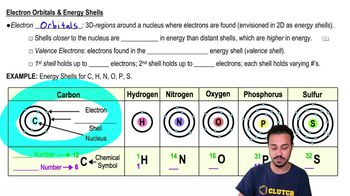
Electron energy levels are regions where electrons orbit the nucleus: K(2), L(8), M(18), N(32). Full levels are stable. Atoms combine to achieve stability.
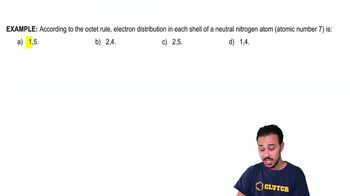
The octet rule states that beginning with the 2nd energy level, 8 electrons in the outer shell make the atom stable.
Valence is the number of extra or missing electrons in the outermost energy level (valence electrons).
Inert elements (Group VIII) have full valence shells and are non-reactive.
Energy input excites electrons to outer levels (e.g., photosynthesis). When electrons fall back, energy is released (e.g., fluorescence).
The three main chemical bonds are ionic, covalent, and hydrogen bonds.
An ionic bond forms when one element gives up electron(s) to another, producing ions (cations/anions). It is non-directional and of intermediate strength, e.g., NaCl.
A covalent bond involves sharing electrons. It is directional and the strongest bond, e.g., CH4 (single bonds), CO2 (double bonds).