Skip to main content
Anatomy & Physiology
나의 코스
배우기
시험 준비
AI 튜터
학습 가이드
교과서적 해결책
플래시카드
탐험해 보세요
앱을 사용해 보세요
나의 코스
배우기
시험 준비
AI 튜터
학습 가이드
교과서적 해결책
플래시카드
탐험해 보세요
앱을 사용해 보세요
뒤로
Genes and Cellular Function - Anatomy & Physiology
카드를 뒤집기 위해 탭할 수 있습니다.
What percentage of DNA is identical among all humans?
카드를 뒤집기 위해 탭할 수 있습니다.
👆
What percentage of DNA is identical among all humans?
99.9%
of human DNA is identical; the remaining 0.1% accounts for genetic variation.
진행 상황 추적
컨트롤 버튼이 '내비게이션' 모드로 변경되었습니다.
1/20
추천 영상
VideoThumbView.guidedCourse
05:13
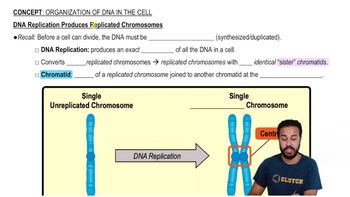
DNA Replication
17455
views
271
rank
1
comments
VideoThumbView.guidedCourse
06:51
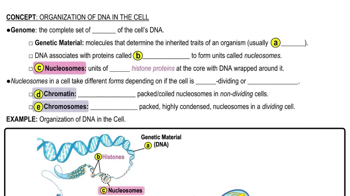
Organization of DNA in the Cell
22338
views
358
rank
이 집합의 용어 (20)
하이드의 정의
What percentage of DNA is identical among all humans?
99.9%
of human DNA is identical; the remaining 0.1% accounts for genetic variation.
What is the basic structure of DNA?
DNA is a polymer of nucleotides forming a
double helix
with complementary nitrogenous base pairs.
What is chromatin and how does it relate to chromosomes?
Chromatin
is DNA wrapped around proteins; tightly wound chromatin forms
chromosomes
.
Name the three important types of RNA and their general function.
mRNA
carries genetic code,
tRNA
brings amino acids, and
rRNA
forms the ribosome structure.
Define a gene.
A gene is a segment of DNA that contains information to synthesize one or more
proteins
.
What is a single nucleotide polymorphism (SNP)?
An SNP is a variation at a single nucleotide position in DNA, contributing to genetic diversity.
How many amino acids are used to make proteins, and how are they encoded?
Proteins are made from 20 amino acids, encoded by sequences of 3 DNA nucleotides called
codons
.
What is transcription in genetics?
Transcription is the process of copying DNA into messenger RNA (mRNA) using the enzyme
RNA polymerase
.
Describe the process of translation.
Translation is when ribosomes read mRNA codons and tRNAs bring amino acids to build a
protein
.
Summarize the central dogma of molecular biology.
DNA is transcribed into RNA, which is then translated into
proteins
.
How do mRNA vaccines work?
mRNA vaccines deliver instructions to cells to produce a
protein spike
that triggers an immune response.
What is gene regulation?
Gene regulation involves turning genes
on or off
depending on cellular needs and environmental signals.
Give examples of traits influenced by gene variations.
Traits like
eye color
,
hair color
,
height
, and
lactose tolerance
are influenced by gene differences.
What causes sickle cell anemia at the genetic level?
A mutation causing a single amino acid substitution in the beta-globin protein leads to
sickle-shaped red blood cells
.
Describe the mutation and effect in cystic fibrosis.
A deletion of three nucleotides causes absence of an amino acid in the CFTR protein, leading to
thick mucus buildup
.
What are common causes of mutations?
Mutations can be spontaneous from DNA replication errors or induced by chemicals, radiation, and UV light.
What is epigenetics?
Epigenetics studies changes in gene expression caused by environmental factors without altering the DNA sequence.
How do methylation and acetylation affect DNA accessibility?
Methylation tightens DNA packaging making genes
inactive
, while acetylation loosens it making genes
active
.
What was learned from the Dutch hunger winter about epigenetics?
Malnutrition during pregnancy caused epigenetic changes that increased health risks in offspring and subsequent generations.
How does a skin cell know to perform skin-specific functions and not stomach functions?
Gene regulation turns on skin-specific genes and turns off stomach-specific genes, defining cell identity.
 뒤로뒤로
 05:13