Skip to main content
Anatomy & Physiology
나의 코스
배우기
시험 준비
AI 튜터
학습 가이드
교과서적 해결책
플래시카드
탐험해 보세요
앱을 사용해 보세요
나의 코스
배우기
시험 준비
AI 튜터
학습 가이드
교과서적 해결책
플래시카드
탐험해 보세요
앱을 사용해 보세요
뒤로
Hypothalamus and Pituitary Gland Functions
카드를 뒤집기 위해 탭할 수 있습니다.
Where is the hypothalamus located?
카드를 뒤집기 위해 탭할 수 있습니다.
👆
Where is the hypothalamus located?
The hypothalamus is located in the brain below the thalamus and above the pituitary gland.
진행 상황 추적
컨트롤 버튼이 '내비게이션' 모드로 변경되었습니다.
1/20
추천 영상
VideoThumbView.guidedCourse
7:10
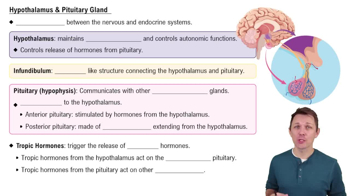
Hypothalamus & Pituitary Gland
9413
views
225
rank
1
comments
VideoThumbView.guidedCourse
3:02
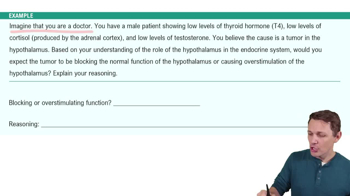
The Hypothalamus and Pituitary Gland Example 2
5716
views
109
rank
VideoThumbView.guidedCourse
10:02
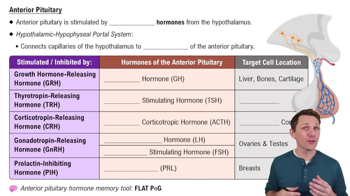
Anterior Pituitary
7491
views
175
rank
1
comments
이 집합의 용어 (20)
하이드의 정의
Where is the hypothalamus located?
The hypothalamus is located in the brain below the thalamus and above the pituitary gland.
What tissue makes up the anterior pituitary?
The anterior pituitary is made of glandular epithelial tissue.
What tissue makes up the posterior pituitary?
The posterior pituitary is made of neural tissue.
Does the anterior pituitary make its own hormones?
Yes, the anterior pituitary synthesizes and secretes its own hormones.
Does the posterior pituitary make its own hormones?
No, the posterior pituitary stores and releases hormones made by the hypothalamus.
What venous system allows hypothalamic hormones to reach the anterior pituitary?
The hypophyseal portal venous system transports hormones from the hypothalamus to the anterior pituitary.
What tract allows hormones to leave the hypothalamus to be stored in the posterior pituitary?
The hypothalamo-hypophyseal tract carries hormones to the posterior pituitary for storage.
Which two hormones are synthesized in the hypothalamus and secreted by the posterior pituitary?
Antidiuretic hormone (ADH) and oxytocin are synthesized in the hypothalamus and secreted by the posterior pituitary.
What is the primary function of ADH?
ADH regulates water retention by increasing water reabsorption in the kidneys.
What is oxytocin responsible for?
Oxytocin stimulates uterine contractions during labor and milk ejection during breastfeeding.
What effect would an ADH inhibitor have?
An ADH inhibitor would decrease water reabsorption, leading to increased urine output and potential dehydration.
What is diabetes insipidus?
Diabetes insipidus is a condition caused by insufficient ADH activity, resulting in excessive urination and thirst.
What protein does ADH insert into nephron plasma membranes?
ADH inserts aquaporin-2 water channels into the nephron's collecting duct membranes.
How do osmoreceptors respond to high solute concentration?
High solute concentration stimulates osmoreceptors to increase ADH secretion.
Is the milk let-down reflex a positive or negative feedback loop?
The milk let-down reflex is a positive feedback loop.
What are the three tiers in the negative feedback loop involving the anterior pituitary?
The three tiers are: hypothalamus, anterior pituitary, and target endocrine gland.
Does the negative feedback loop inhibit one or multiple tiers?
It inhibits multiple tiers, including the hypothalamus and anterior pituitary.
What are the short-term effects of growth hormone (GH)?
Short-term effects include increased blood glucose and fatty acid levels.
What are the long-term effects of growth hormone (GH)?
Long-term effects include stimulation of growth in bones and muscles.
What are the three types of GH disorders?
The three types are gigantism (excess GH before puberty), acromegaly (excess GH after puberty), and dwarfism (GH deficiency).
 뒤로뒤로
 7:10