뒤로

Immune System - Anatomy & Physiology

컨트롤 버튼이 '내비게이션' 모드로 변경되었습니다.
1/31
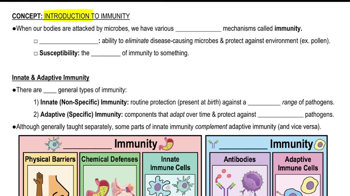
  • What are the three lines of defense in the immune system?

    First line: Surface barriers (skin, mucosa).
    Second line: Innate internal defenses (inflammation, phagocytes, NK cells).
    Third line: Adaptive defense system (lymphocytes, antibodies).
  • What are the main components of the first line of defense?

    Keratinized epidermis and protective chemicals such as acid, enzymes, mucin, and defensins.
  • Name two types of phagocytes and their characteristics.

    Neutrophils: Abundant, die fighting.
    Macrophages: Voracious, derived from monocytes.
  • List the steps of phagocytosis.

    1. Phagocyte binds particle.
    2. Particle enclosed in phagosome.
    3. Phagosome fuses with lysosome forming phagolysosome.
  • What is opsonization?

    Pathogens are coated with opsonins (complement proteins or antibodies) to enhance phagocytosis.
  • What role do Natural Killer (NK) cells play in immunity?

    NK cells kill cancer and virus-infected cells by inducing apoptosis.
  • What are the cardinal signs of inflammation?

    Redness, heat, swelling, and pain.
  • Describe the stages of inflammation.

    Chemical release (histamine), vasodilation, increased permeability, phagocyte mobilization (leukocytosis, margination, diapedesis, chemotaxis).
  • What is pus composed of?

    A mixture of dead neutrophils, tissue cells, and pathogens.
  • Name two types of antimicrobial proteins involved in innate immunity.

    Interferons (IFNs) and complement proteins.
  • What is the purpose of fever in immune response?

    A systemic response to infection that increases body temperature to inhibit pathogen growth.
  • What are the key features of adaptive immunity?

    Specificity, systemic action, and memory to target and eliminate pathogens and abnormal cells.
  • Differentiate between humoral and cellular immunity.

    Humoral immunity is antibody-mediated by B cells.
    Cellular immunity involves T cells acting directly or indirectly against target cells.
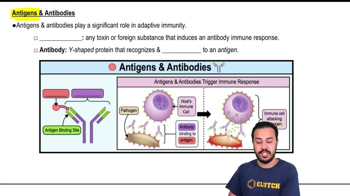
  • Define antigens.

    Substances that provoke an immune response and are not normally found in the body.
  • What are haptens?

    Incomplete antigens; small molecules that become immunogenic when combined with proteins.
  • What are antigenic determinants?

    Specific parts of an antigen that antibodies bind to.
  • What are self-antigens?

    MHC proteins that display self or foreign peptides to the immune system.
  • Which cells provide humoral immunity and which provide cellular immunity?

    B cells provide humoral immunity.
    T cells provide cellular immunity.
  • What is the role of antigen-presenting cells (APCs)?

    Dendritic cells, macrophages, and B cells present antigens to T cells to initiate adaptive immunity.
  • Where do B and T cells originate and mature?

    Both originate in red bone marrow.
    B cells mature in bone marrow; T cells mature in the thymus.
  • What is positive selection in T cell education?

    Ensures T cells recognize self MHC proteins.
  • What is negative selection in T cell education?

    Eliminates T cells that react to self antigens to prevent autoimmunity.
  • Describe the primary and secondary humoral immune responses.

    Primary: Lag period 3-6 days, peak antibody in 10 days.
    Secondary: Faster and stronger due to memory cells.
  • What is the difference between active and passive immunity?

    Active immunity involves B cells producing antibodies after antigen exposure.
    Passive immunity involves receiving ready-made antibodies.
  • What does the acronym PLAN stand for in antibody mechanisms?

    Precipitation, Lysis (via complement), Agglutination, Neutralization.
  • What are the main types of T cells and their functions?

    CD4 (helper and regulatory) and CD8 (cytotoxic) T cells.
  • What is required for T cell activation?

    Two-step process: antigen binding and co-stimulation.
  • What role do cytokines play in immunity?

    Chemical messengers that regulate immune responses.
  • What is the function of helper T cells?

    Activate B and T cells, secrete cytokines, and amplify innate defenses.
  • What is the role of cytotoxic T cells?

    Directly attack and kill infected or abnormal cells.
  • What do regulatory T cells do?

    Dampen immune response and prevent autoimmunity.