Skip to main content
Anatomy & Physiology
나의 코스
배우기
시험 준비
AI 튜터
학습 가이드
교과서적 해결책
플래시카드
탐험해 보세요
앱을 사용해 보세요
나의 코스
배우기
시험 준비
AI 튜터
학습 가이드
교과서적 해결책
플래시카드
탐험해 보세요
앱을 사용해 보세요
뒤로
Integumentary System - Anatomy & Physiology
카드를 뒤집기 위해 탭할 수 있습니다.
What are the main components of the integumentary system?
카드를 뒤집기 위해 탭할 수 있습니다.
👆
What are the main components of the integumentary system?
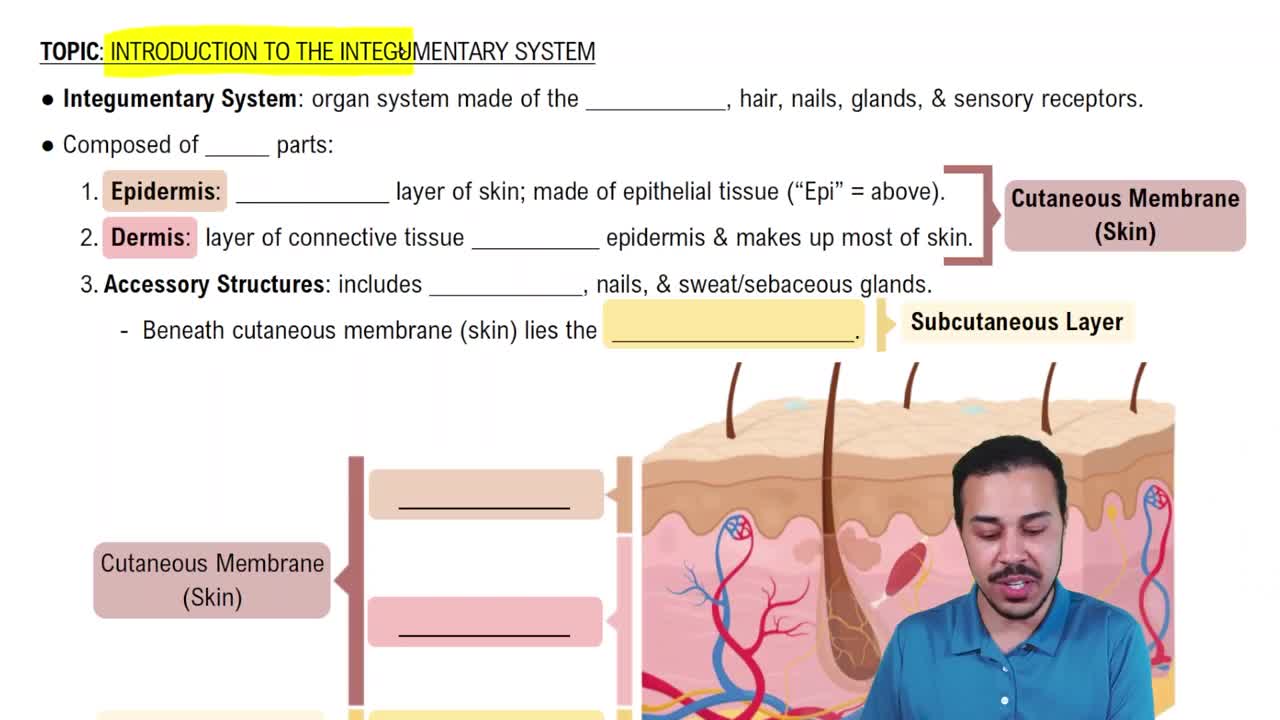
The integumentary system includes
skin, hair, nails, sweat glands, oil glands, and mammary glands
.
진행 상황 추적
컨트롤 버튼이 '내비게이션' 모드로 변경되었습니다.
1/25
추천 영상
VideoThumbView.guidedCourse
06:54
Introduction to the Integumentary System
24079
views
820
rank
3
comments
VideoThumbView.guidedCourse
03:40
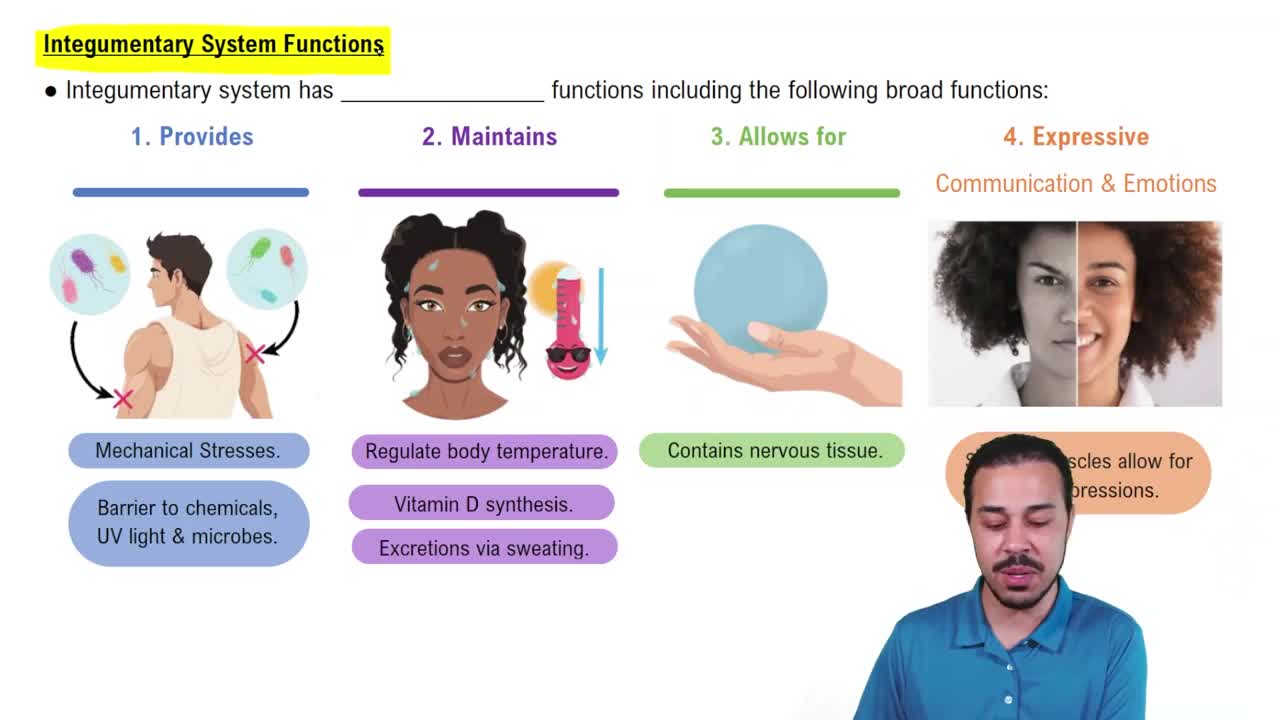
Integumentary System Functions
15633
views
394
rank
1
comments
VideoThumbView.guidedCourse
02:47
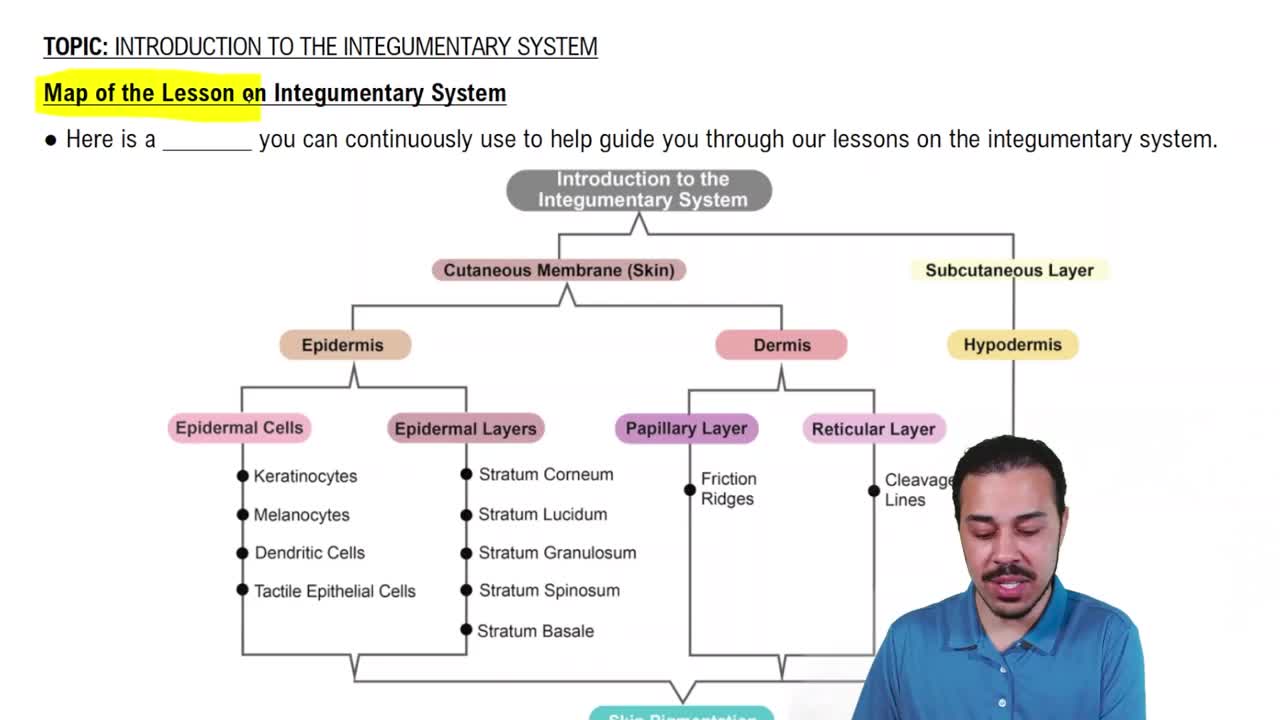
Map of the Lesson on Integumentary System
13780
views
649
rank
6
comments
이 집합의 용어 (25)
하이드의 정의
What are the main components of the integumentary system?
The integumentary system includes
skin, hair, nails, sweat glands, oil glands, and mammary glands
.
What are the primary functions of the integumentary system?
Physical protection, regulation of body temperature, excretion, nutrition (vitamin D synthesis), sensation, and immune defense
.
What are the two main layers of the skin?
The skin consists of the
epidermis
(stratified squamous epithelium) and the
dermis
(underlying connective tissue).
What lies beneath the dermis?
The
subcutaneous layer
(hypodermis), composed mainly of loose connective tissue and fat.
Name the four main cell types found in the epidermis.
Keratinocytes, melanocytes, Merkel cells, and Langerhans cells
.
What is the role of keratinocytes?
They are the most abundant epidermal cells and produce
keratin
, a protective protein.
What is the function of melanocytes?
Melanocytes produce
melanin pigment
which protects against UV radiation.
What are Merkel cells responsible for?
Merkel cells function as
sensory receptors
for touch.
What role do Langerhans cells play in the skin?
They act as
fixed macrophages
involved in immune defense.
List the five layers of the epidermis from deepest to most superficial.
Stratum germinativum (basale), stratum spinosum, stratum granulosum, stratum lucidum (only in thick skin), and stratum corneum
.
What is the characteristic of the stratum germinativum?
It is the
innermost basal layer
attached to the basal lamina, containing stem cells, melanocytes, and Merkel cells.
Describe the stratum spinosum.
Keratinocytes are bound by
desmosomes
, and Langerhans cells and melanocytes are often present.
What happens in the stratum granulosum?
Keratinocytes produce
keratohyalin and keratin
, and cells become thinner and flatter.
Where is the stratum lucidum found and what is its appearance?
Found only in
thick skin
, it appears as a
glassy layer
.
What are the features of the stratum corneum?
It consists of multiple layers of
flattened, dead keratinocytes
, is water-resistant but not waterproof.
What are epidermal ridges and their function?
Epidermal ridges are
projections of the epidermis
that increase surface area for attachment and enhance grip.
What are the two layers of the dermis?
The
papillary layer
(nourishes and supports epidermis) and the
reticular layer
(provides strength and elasticity).
What structures are found in the papillary layer of the dermis?
Contains
capillary loops, sensory neurons, and loose connective tissue
.
What is the function of the reticular layer of the dermis?
It restricts spread of pathogens, stores lipids, attaches skin to deeper tissues, and contains sensory receptors.
What are the main accessory structures of the integumentary system?
Hair follicles, hair, exocrine glands (sweat and sebaceous glands), and nails
.
What is the hair follicle and its function?
The hair follicle is the
organ that produces hair
, a nonliving keratinized structure.
Describe the hair growth cycle phases.
Includes
active growth phase (2-5 years), regression, resting phase, and reactivation
.
What are the types of sweat glands?
Eccrine (merocrine) glands
produce watery sweat for thermoregulation, and
apocrine glands
produce a thicker secretion in specific areas.
What is the function of sebaceous glands?
They secrete
sebum
to lubricate and protect the skin and hair.
What changes occur in the integumentary system with aging?
Includes
thinner epidermis, fewer melanocytes, reduced sweat gland activity, decreased blood supply, and thinner dermis
.
 뒤로뒤로
 06:54