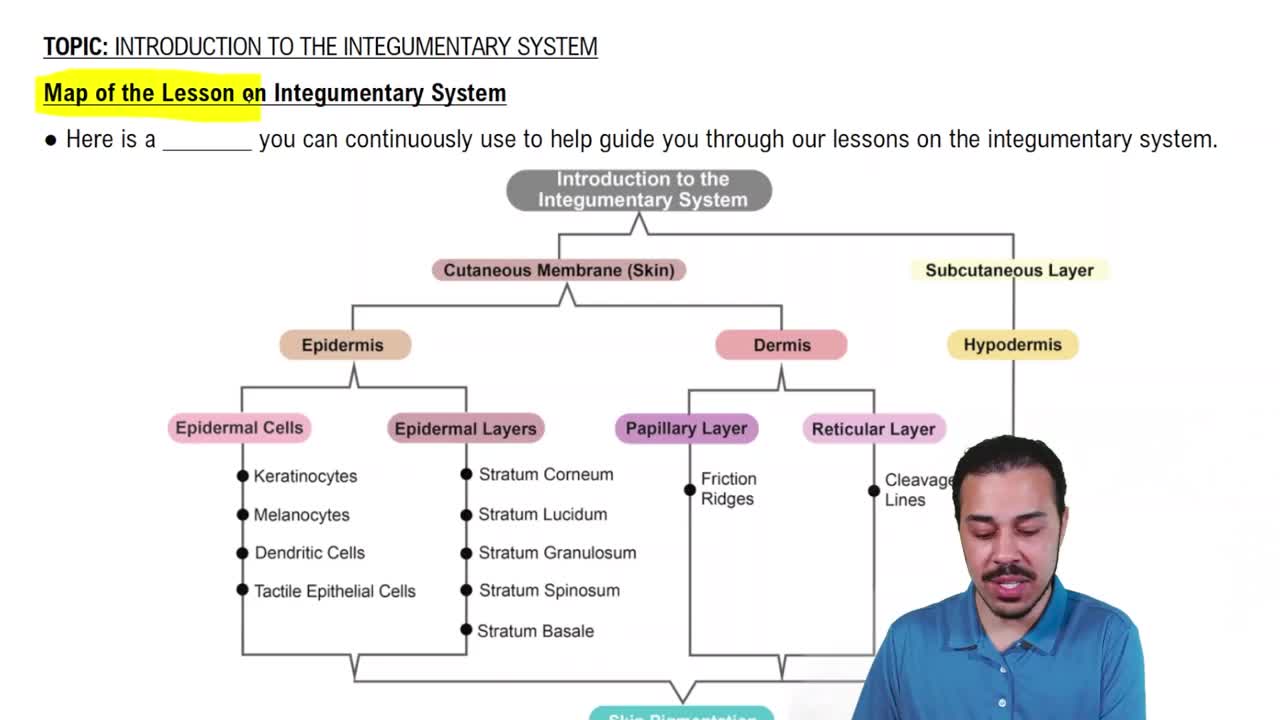
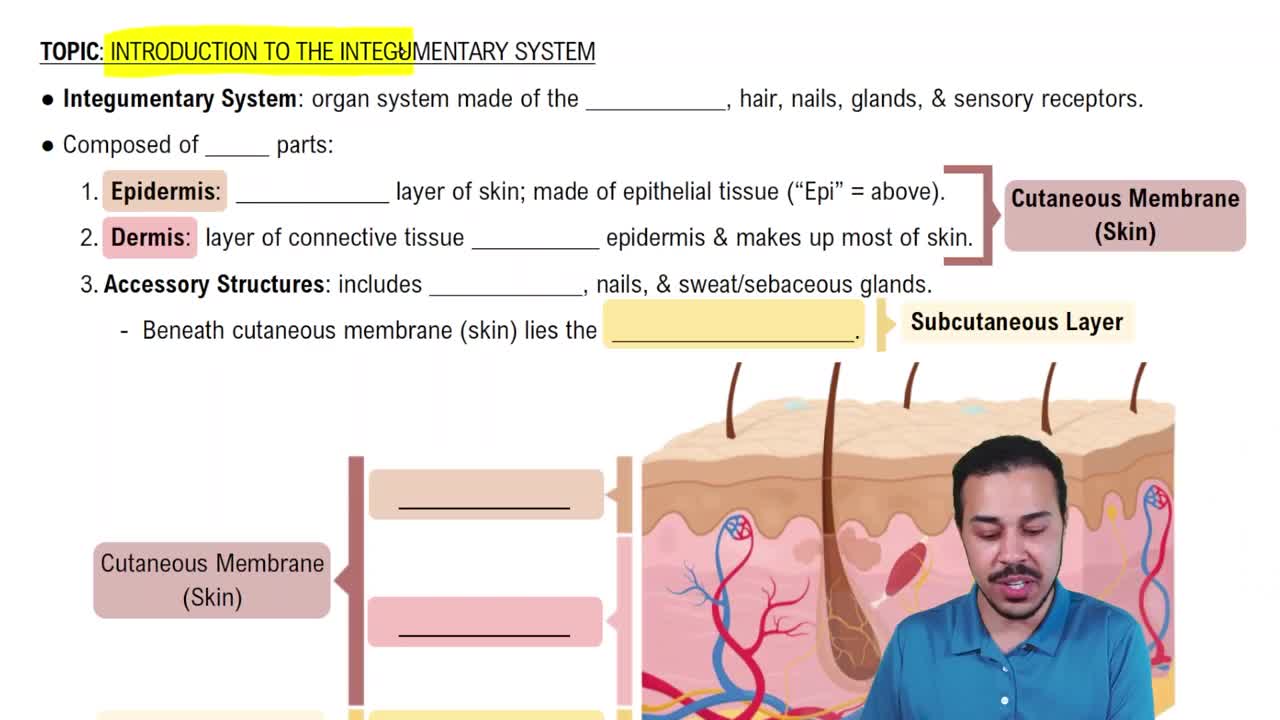
The skin consists of the epidermis, a keratinized stratified squamous epithelium, and the dermis, made of loose and dense irregular connective tissue.
What is the hypodermis and its function?
The hypodermis is a layer deep to the dermis made of loose connective and adipose tissue; it anchors the skin to deeper structures like muscle and bone.
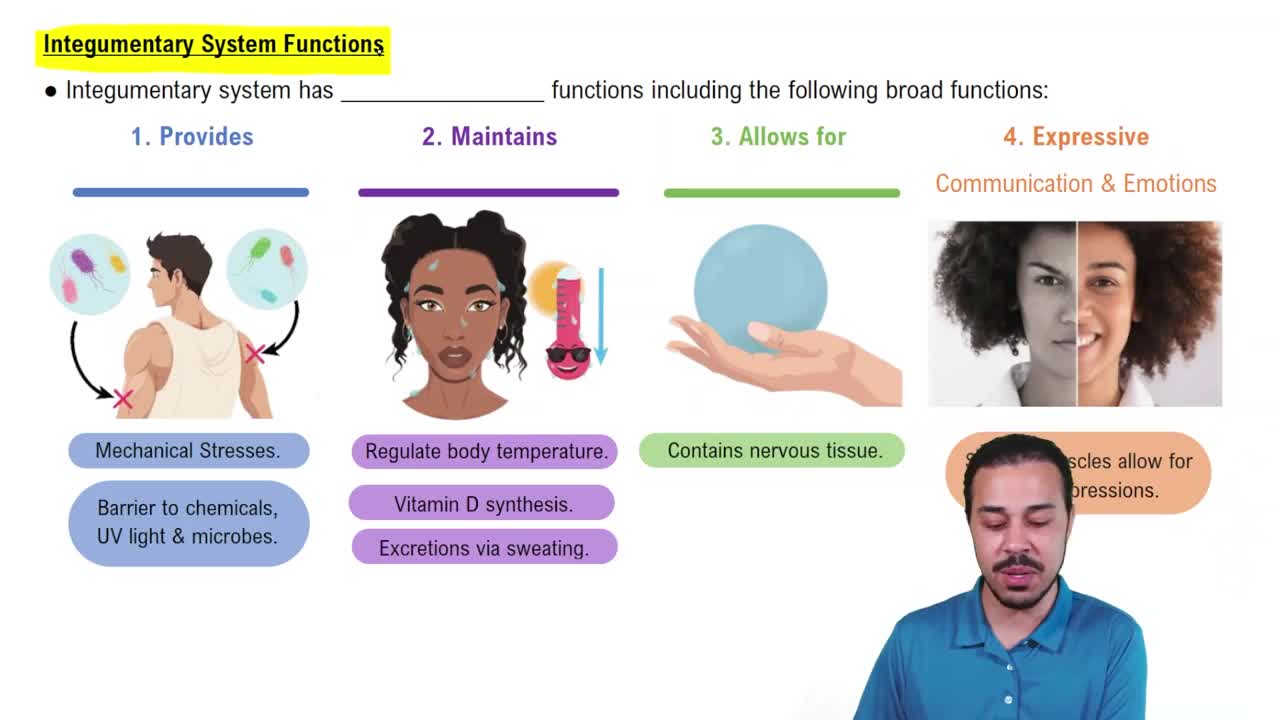
List the primary functions of the integumentary system.
Functions include protection, sensation, thermoregulation, excretion, and vitamin D synthesis.
How does the skin protect against pathogens and mechanical trauma?
The keratinized stratified squamous epithelium forms a continuous barrier, and glands create an acidic pH that inhibits pathogen growth.
Describe the process of thermoregulation when body temperature rises.
Thermoreceptors detect heat, the hypothalamus triggers sweating and cutaneous vasodilation, increasing heat loss until normal temperature is restored.
What happens during thermoregulation when body temperature drops?
Thermoreceptors detect cold, hypothalamus causes vasoconstriction to reduce blood flow and heat loss, conserving body heat until temperature normalizes.
What is the role of vitamin D synthesis in the skin?
Cells in the epidermis convert inactive cholecalciferol to active calcitriol, essential for calcium absorption needed for nerve function, muscle contraction, and bone health.
Name the five layers of the epidermis from deep to superficial.
Stratum basale, stratum spinosum, stratum granulosum, stratum lucidum (only in thick skin), and stratum corneum.
What are keratinocytes and their key features?
Keratinocytes make up 95% of the epidermis, produce keratin for strength, and are connected by desmosomes to resist mechanical trauma.
What is the function of the stratum granulosum?
Cells contain granules with keratin bundles or lipid substances that waterproof the skin, maintaining fluid and electrolyte homeostasis.
What distinguishes thick skin from thin skin?
Thick skin has all five epidermal layers including a thick stratum corneum and no hair follicles; thin skin lacks the stratum lucidum and has hair follicles.
What are the two layers of the dermis and their characteristics?
The papillary layer is superficial, made of loose connective tissue with capillaries and tactile corpuscles; the reticular layer is deeper, dense irregular connective tissue with collagen and elastic fibers.
What is the function of dermal papillae?
Dermal papillae increase surface area for oxygen and nutrient diffusion to the avascular epidermis and contain tactile (Meissner) corpuscles for light touch sensation.
How do collagen and elastic fibers function in the reticular dermis?
Collagen bundles strengthen the dermis and protect deeper tissues; elastic fibers allow the skin to return to its original shape after stretching.
What causes skin pigmentation and what is melanin's primary function?
Melanin, produced by melanocytes in the stratum basale, protects keratinocyte DNA from UV radiation-induced mutations.
How does UV radiation affect melanin production?
UV causes immediate melanin oxidation darkening existing pigment and delayed increased melanin synthesis within 72 hours to protect skin.
What are the accessory structures of the integumentary system?
Hair, nails, sweat glands, and sebaceous glands derived from epithelium that assist skin functions.
Describe the structure and function of hair.
Hair consists of a shaft and root made of keratinized epithelial cells; it protects areas like eyes and scalp and has sensory neurons for environmental detection.
What is the arrector pili muscle and its function?
A small smooth muscle attached to hair follicles; contraction causes hair to stand (piloerection), producing 'goosebumps'.
What are the types of sweat glands and their functions?
Eccrine glands regulate temperature by secreting watery sweat; apocrine glands produce protein-rich sweat in specific areas; ceruminous glands produce ear wax; mammary glands produce milk.
What is sebum and its role?
Sebum is an oily secretion from sebaceous glands that coats hair, provides a hydrophobic barrier, and inhibits bacterial growth.
What is the rule of nines in burn assessment?
A method dividing the body into 11 areas of 9% each to estimate burn extent and guide treatment.
Differentiate between first, second, and third-degree burns.
First-degree burns affect only the epidermis; second-degree burns affect epidermis and part/all of dermis with blistering; third-degree burns extend through epidermis, dermis, hypodermis, and possibly deeper tissues.
 뒤로
 06:54