What are the two main parts of the integumentary system?
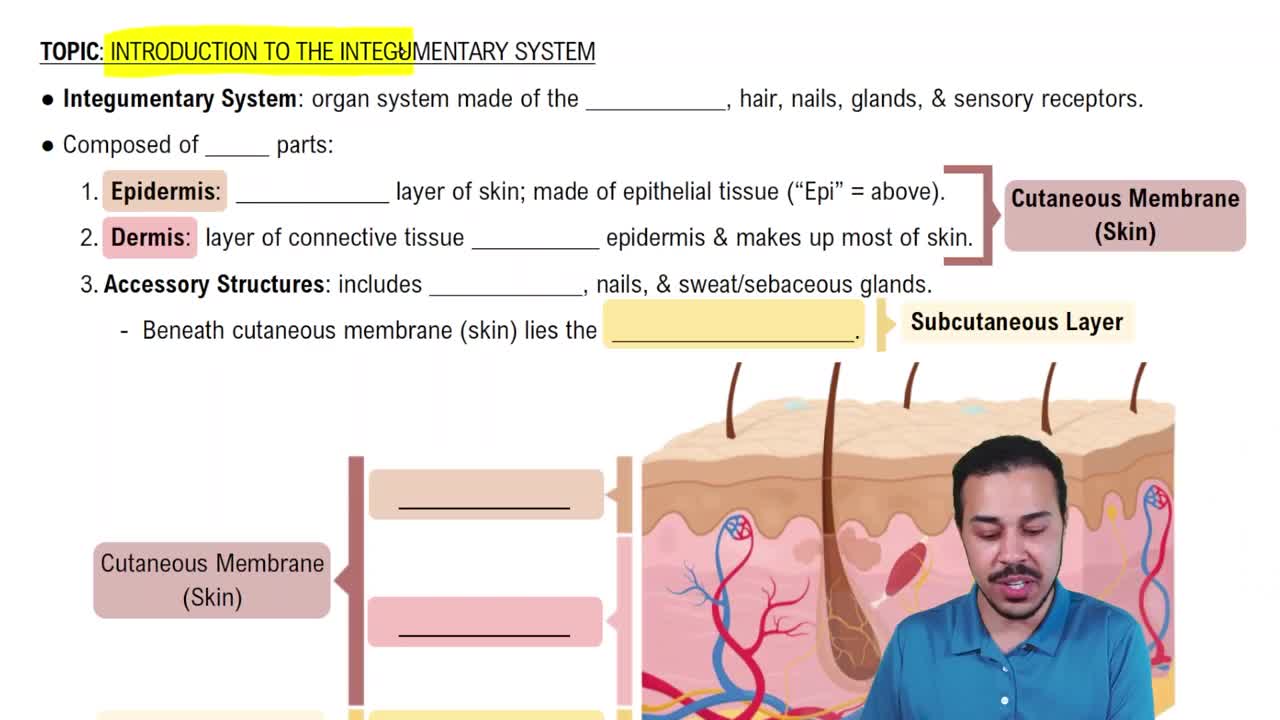
The integumentary system consists of the cutaneous membrane (skin) and accessory structures such as hair, nails, and exocrine glands.
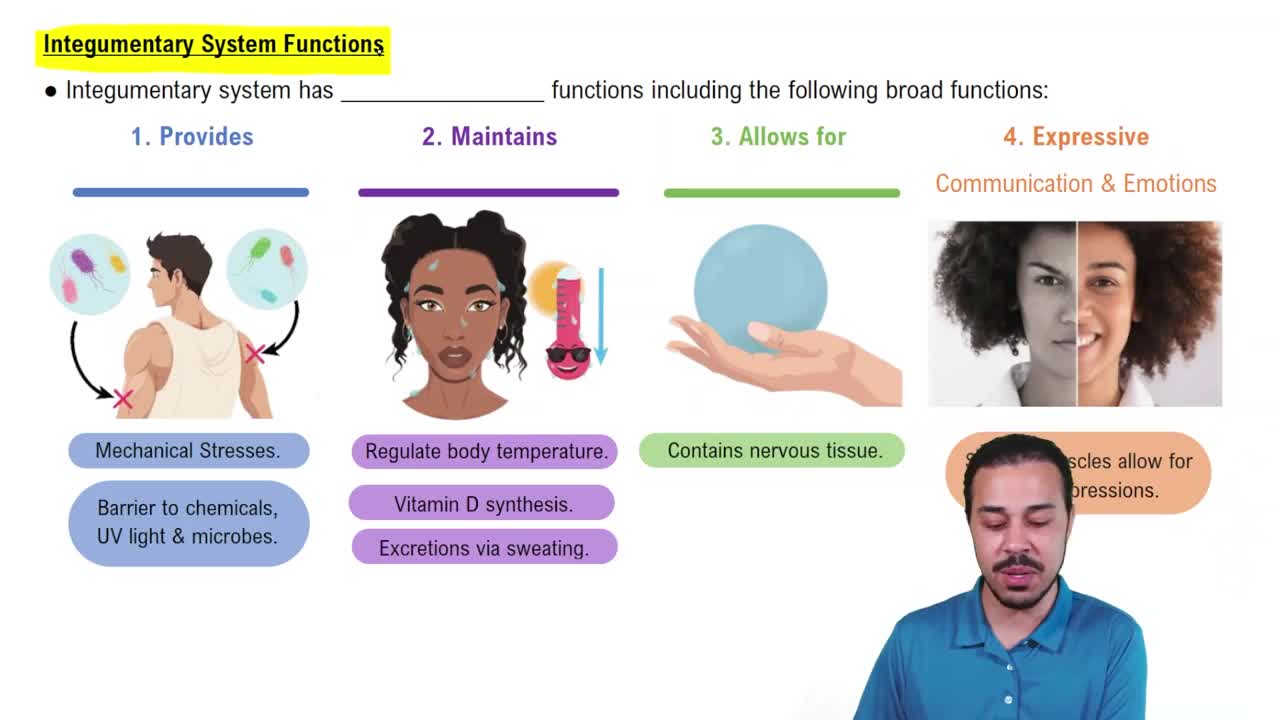
What are the primary functions of the integumentary system?
Protection from environmental hazards, water loss prevention, immune response coordination, sensory reception, vitamin D3 synthesis, excretion, and thermoregulation.
What are the three layers of the cutaneous membrane?
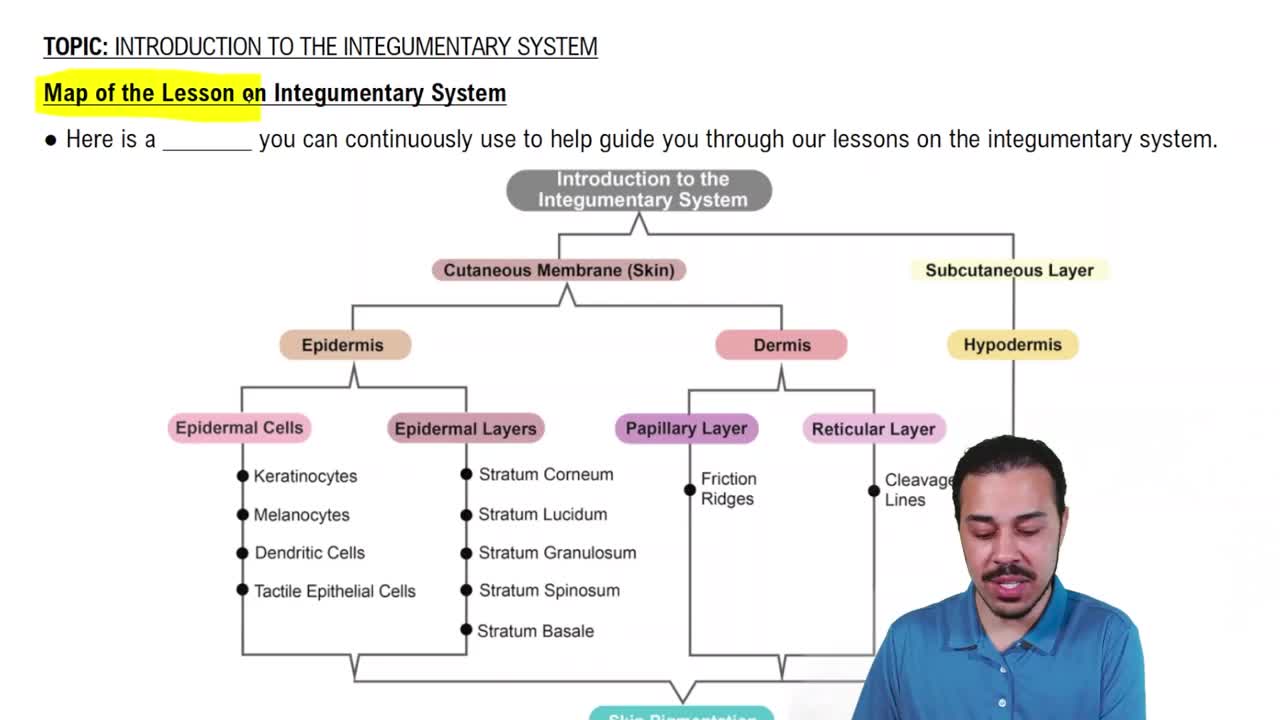
The cutaneous membrane is composed of the epidermis (outer layer), dermis (middle layer), and the hypodermis (subcutaneous layer).
What type of tissue makes up the epidermis?
The epidermis is made of keratinized stratified squamous epithelium.
What are the layers of the epidermis from deepest to most superficial?
Stratum basale, stratum spinosum, stratum granulosum, stratum lucidum (only in thick skin), and stratum corneum.
What is the function of the stratum basale?
It is the deepest epidermal layer where stem cells divide to produce new keratinocytes and contains melanocytes and Merkel cells for pigment and touch sensation.
What cells produce melanin and where are they located?
Melanocytes produce melanin and are located in the stratum basale of the epidermis.
What is the role of keratin in the skin?
Keratin is a tough, fibrous protein that protects skin by making it water-repellent and resistant to abrasion.
What distinguishes thick skin from thin skin?
Thick skin has an additional layer called the stratum lucidum and is found on palms and soles; thin skin lacks this layer and covers most of the body.
What is the function of the dermis?
The dermis supports and nourishes the epidermis, contains sensory receptors, blood vessels, and anchors accessory structures like hair follicles and glands.
What are the two layers of the dermis?
The papillary layer (loose connective tissue with capillaries and sensory neurons) and the reticular layer (dense irregular connective tissue with collagen and elastic fibers).
What fibers provide strength and elasticity to the dermis?
Collagen fibers provide strength and resiliency, while elastic fibers allow stretching and recoil.
What are cleavage lines and why are they important?
Cleavage lines are patterns of collagen and elastic fibers in the dermis that resist force; surgical incisions parallel to these lines heal better with less scarring.
What are the two types of sweat glands and their functions?
Apocrine glands secrete into hair follicles and produce odorous sweat at puberty; merocrine (eccrine) glands secrete watery sweat directly onto skin for thermoregulation.
What is the function of sebaceous glands?
Sebaceous glands produce sebum, an oily secretion that lubricates hair and skin and inhibits bacterial growth.
What causes dandruff in the scalp?
Excessive shedding of cells from the stratum corneum of the scalp epidermis causes dandruff.
How does melanin protect the skin?
Melanin absorbs ultraviolet (UV) radiation, protecting skin cells from DNA damage and reducing the risk of skin cancer.
What is albinism?
An inherited condition where melanocytes are present but unable to produce melanin, resulting in very pale skin and hair.
What is the role of vitamin D3 produced in the skin?
Vitamin D3 is converted by the liver and kidneys into calcitriol, essential for calcium and phosphorus absorption and bone health.
What are the stages of skin repair after injury?
Inflammation phase (bleeding and mast cell activation), migration phase (epithelial cell migration and macrophage cleanup), proliferation phase (fibroblast activity and collagen production), and scarring phase (scar tissue formation).
What distinguishes first, second, and third degree burns?
First degree affects only epidermis; second degree affects epidermis and part of dermis with blistering; third degree destroys epidermis, dermis, and extends into hypodermis, often requiring grafts.
 뒤로
 06:54