뒤로

Integumentary System and Skin Pathology

컨트롤 버튼이 '내비게이션' 모드로 변경되었습니다.
1/20
  • Primary functions of the integumentary system

    • Aids in body heat loss or heat retention
    • Aids in excretion of urea and uric acid
    • Synthesizes vitamin D
  • How does the integumentary system aid in heat loss?

    By activating sweat glands and allowing blood to flush into skin capillary beds so heat can radiate from the skin surface.
  • How does the integumentary system aid in heat retention?

    By not allowing blood to flush into skin capillary beds, conserving body heat.
  • How is vitamin D synthesized in the skin?

    Modified cholesterol molecules in skin are converted to vitamin D by sunlight exposure.
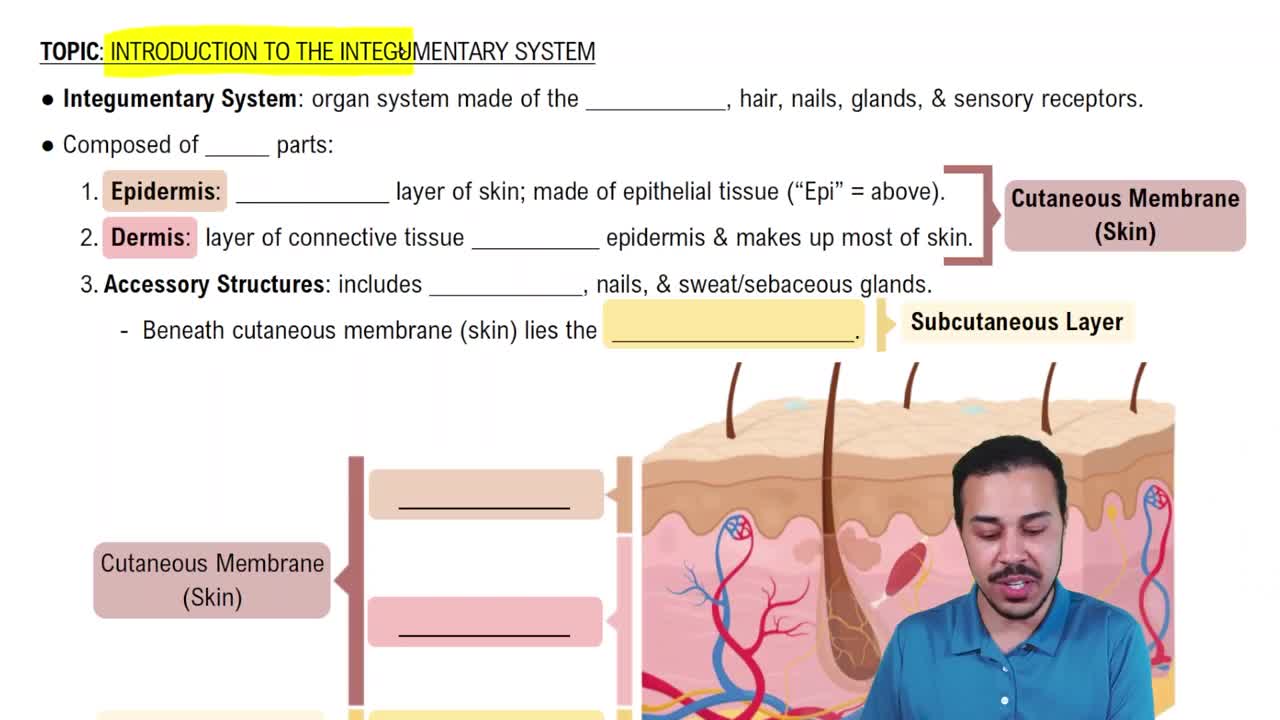
  • Layers of the skin from outermost to innermost

    • Epidermis
    • Dermis
    • Hypodermis (subcutaneous layer)
  • What type of tissue primarily composes the epidermis?

    Stratified squamous epithelial tissue.
  • Role of keratinocytes in the epidermis

    Produce keratin, a protein that strengthens the skin and makes it waterproof.
  • Function of melanocytes

    Produce melanin pigment that protects against UV radiation.
  • What is the dermis composed of?

    Dense irregular connective tissue containing collagen and elastin fibers, blood vessels, nerves, hair follicles, and glands.
  • Function of sweat glands

    Produce sweat to help regulate body temperature and excrete waste products.
  • Function of sebaceous glands

    Secrete sebum (oil) to lubricate and waterproof the skin and hair.
  • What causes a sunburn?

    Excessive UV radiation causing skin inflammation and damage.
  • Characteristics of first-degree burns

    Affect only the epidermis, causing redness and pain without blistering.
  • Characteristics of second-degree burns

    Affect epidermis and upper dermis, causing redness, pain, swelling, and blistering.
  • Characteristics of third-degree burns

    Destroy the entire thickness of the skin; burned area appears gray-white or blackened and is painless due to nerve damage.
  • What is basal cell carcinoma?

    A common skin cancer originating in the basal cells of the epidermis, usually appearing as a shiny bump.
  • What is squamous cell carcinoma?

    A skin cancer arising from keratinocytes in the stratum spinosum, often appearing as scaly, red patches.
  • What is melanoma?

    A dangerous skin cancer originating from melanocytes, characterized by uncontrolled growth and potential to metastasize.
  • How does uncontrolled mitosis relate to cancer?

    Rapid, uncontrolled cell division leads to tumor formation and cancer progression.
  • Why is early detection important in skin cancer?

    Early detection improves treatment success and reduces the risk of metastasis.