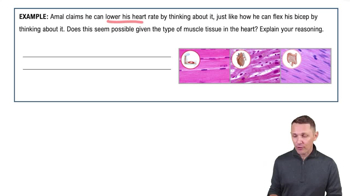
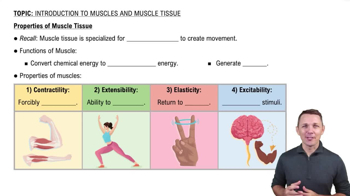
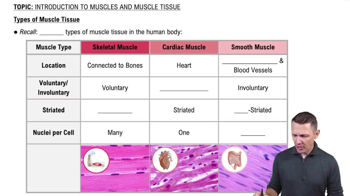
Skeletal muscle attaches to the skeleton or connective tissue and is under voluntary control. Its primary functions are shape and movement.
What are the main components of a skeletal muscle cell?
Skeletal muscle cells are long cylindrical muscle fibers with a membrane called sarcolemma and cytoplasm called sarcoplasm. They are multinucleated with nuclei arranged peripherally.
What are myofibrils and their role in skeletal muscle?
Myofibrils are rod-shaped bundles of myofilaments inside muscle fibers, responsible for contraction. They create the muscle's striped appearance with alternating light (I) and dark (A) bands.
What proteins compose the myofilaments in skeletal muscle?
Myofilaments are made of contractile proteins: thick filaments contain myosin, and thin filaments contain actin.
Describe the banding pattern of myofibrils.
Myofibrils have alternating light I bands and dark A bands. The A band contains a lighter H zone bisected by the M line, and the I band has a midline Z disc.
What is a sarcomere?
A sarcomere is the smallest contractile unit of a muscle fiber, spanning from one Z disc to the next, containing an A band with half an I band on each side.
What is the function of the transverse tubule (T tubule)?
The T tubule is an indentation of the sarcolemma at the A-I band junction that conducts impulses deep into the muscle fiber to trigger Ca2+ release.
What structures form a triad in skeletal muscle?
A triad consists of two terminal cisterns of the sarcoplasmic reticulum flanking one T tubule.
What connective tissue layers surround skeletal muscle fibers and muscles?
Endomysium surrounds each muscle fiber, perimysium surrounds fascicles (bundles of fibers), and epimysium surrounds the entire muscle.
What is a fascicle in skeletal muscle?
A fascicle is a bundle of muscle fibers surrounded by perimysium.
How do muscles attach to bones?
Muscles attach directly when epimysium fuses to bone periosteum or cartilage perichondrium, or indirectly via tendons or aponeuroses.
Define origin and insertion in muscle attachment.
Origin is the muscle attachment to the immovable or less movable bone; insertion is the attachment to the movable bone.
What is the neuromuscular junction?
The neuromuscular junction is the synapse between a motor neuron axon terminal and a muscle fiber where nerve impulses trigger muscle contraction.
What is the synaptic cleft?
The synaptic cleft is the small fluid-filled gap between the motor neuron axon terminal and the muscle fiber membrane.
What neurotransmitter is released at the neuromuscular junction?
Acetylcholine (ACh) is released from the axon terminal, diffuses across the synaptic cleft, and binds to receptors on the sarcolemma.
How does acetylcholine trigger muscle contraction?
ACh binding opens ion channels on the sarcolemma, causing an action potential that leads to muscle fiber contraction.
What is a motor unit?
A motor unit consists of one motor neuron and all the muscle fibers it stimulates.
Why are skeletal muscle cells multinucleated?
They are multinucleated because they form from the fusion of many myoblasts, allowing for peripheral nuclei placement due to myofibril arrangement.
What is the role of the sarcoplasmic reticulum in muscle cells?
The sarcoplasmic reticulum stores and releases Ca2+ ions essential for muscle contraction.
What is the function of tendons in muscle anatomy?
Tendons connect muscle to bone, providing durability and conserving space by spanning bony projections.
 뒤로
 6:31