뒤로

Lecture Exam 2: Anatomy & Physiology: Autonomic Nervous System and Nerve Structure
컨트롤 버튼이 '내비게이션' 모드로 변경되었습니다.
1/16
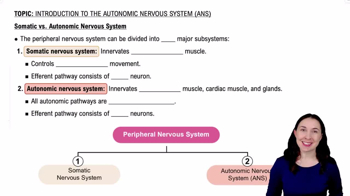
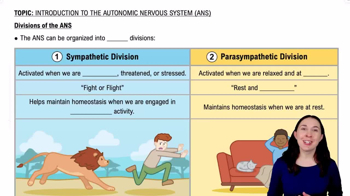
  • Two divisions of the autonomic nervous system

    Sympathetic and Parasympathetic divisions.

  • Bundles of axons in the CNS vs PNS

    Tracts are bundles of axons in the CNS; nerves are bundles of axons in the PNS.

  • Outermost layer of connective tissue holding motor and sensory axons together

    Epineurium

  • Division of ANS known as the 'fight or flight' system

    Sympathetic division

  • Location of parasympathetic postganglionic cell bodies

    In ganglia near or within the target organ

  • Preganglionic neurotransmitter for both sympathetic and parasympathetic divisions

    Acetylcholine (ACh)

  • Definition of referred pain

    Referred pain is pain originating in an organ but perceived as cutaneous pain.

  • Definition of reflexes

    Reflexes are programmed, automatic responses to stimuli, usually protective.

  • Two major types of adrenergic receptors

    Alpha (α) and Beta (β) receptors

  • Two major types of cholinergic receptors

    Muscarinic and Nicotinic receptors

  • Importance of the phrenic nerve and its plexus

    The phrenic nerve controls the diaphragm and is part of the cervical plexus.

  • Connective tissue layer surrounding small groups of bundled axons within a nerve

    Perineurium

  • Connective tissue sheath surrounding each individual axon within a fascicle

    Endoneurium

  • Three cranial nerves containing only sensory axons

    Olfactory (I) - smell, Optic (II) - vision, Vestibulocochlear (VIII) - hearing and balance

  • Five cranial nerves primarily motor with proprioceptive sensory axons

    Oculomotor (III), Trochlear (IV), Abducens (VI), Accessory (XI), Hypoglossal (XII)

  • Four cranial nerves containing both sensory and motor axons

    Trigeminal (V), Facial (VII), Glossopharyngeal (IX), Vagus (X)