뒤로

Lecture Exam 2: Anatomy & Physiology: Nervous System and Action Potentials

컨트롤 버튼이 '내비게이션' 모드로 변경되었습니다.
1/20
  • What triggers an action potential in a neuron?

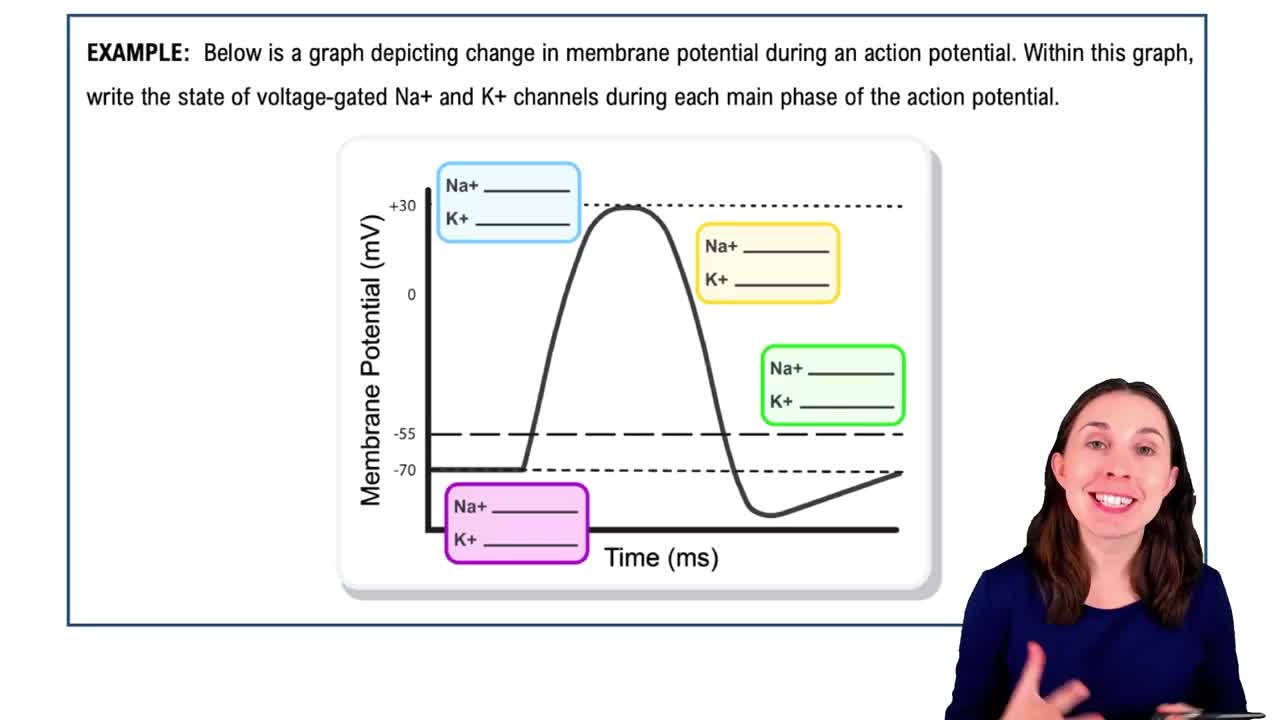
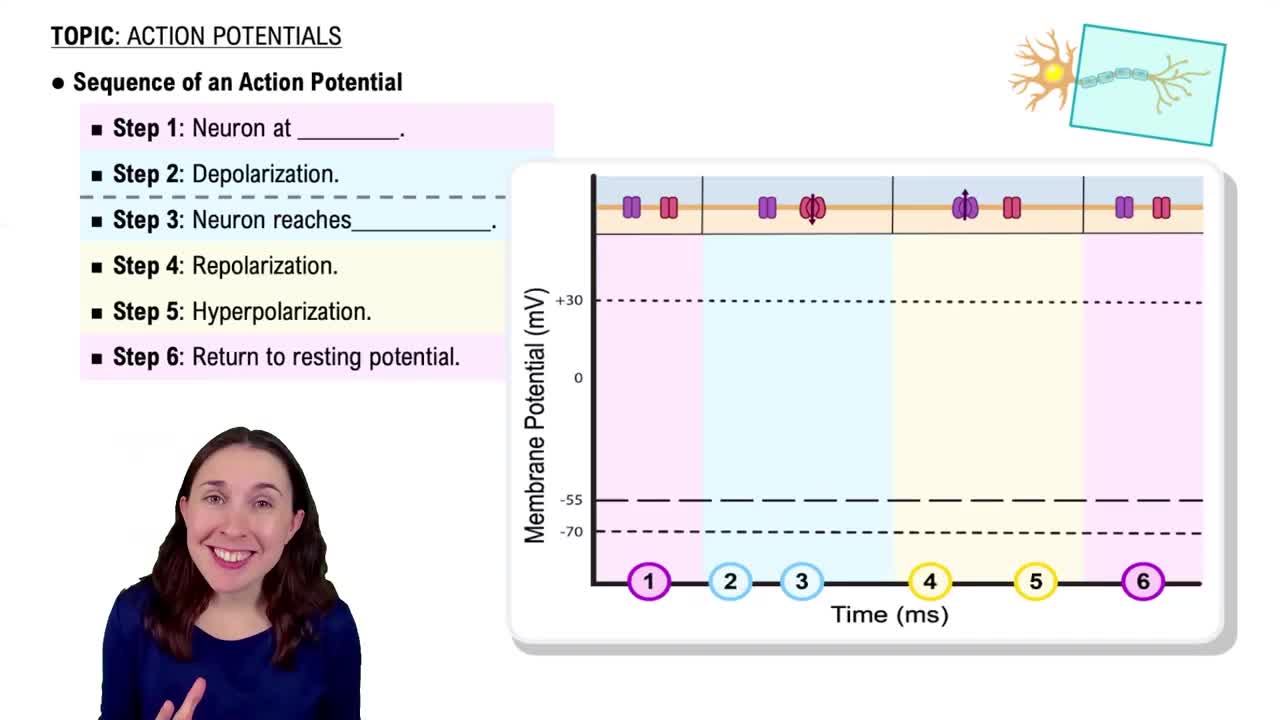
    A local potential depolarizes the membrane of the trigger zone to threshold, initiating an action potential.
  • What happens when voltage-gated Na+ channels open during an action potential?

    Na+ ions enter the axoplasm, causing rapid depolarization of the membrane potential.
  • What occurs during repolarization of an action potential?

    Voltage-gated K+ channels open, allowing K+ to exit the cell, returning the membrane potential toward resting state.
  • What is hyperpolarization in the context of action potentials?

    The axon membrane becomes more negative than the resting potential due to K+ channels remaining open briefly after repolarization.
  • What are the three connective tissue layers surrounding a nerve?

    Epineurium (outermost), Perineurium (surrounds fascicles), and Endoneurium (surrounds individual axons).
  • Where is the primary motor cortex located and what is its function?

    Located in the precentral gyrus of the frontal lobe; it plans and initiates voluntary movements.
  • What are the three types of cerebral white matter fibers?

    • Commissural fibers: connect hemispheres
    • Projection fibers: connect cortex with other brain areas and spinal cord
    • Association fibers: connect areas within the same hemisphere
  • List the meninges from superficial to deep.

    Dura mater (tough outer layer), Arachnoid mater (web-like middle layer), Pia mater (delicate layer in contact with brain).
  • What is the function of the sacral plexus and its largest nerve?

    Innervates pelvis, gluteal region, and lower extremity; includes the sciatic nerve, the largest nerve in the body.
  • Describe the Golgi tendon reflex.

    A polysynaptic reflex that protects muscles and tendons by causing muscle relaxation when tension is too high.
  • What are the three regions of spinal gray matter and their functions?

    • Anterior horn: somatic motor neurons
    • Posterior horn: sensory neurons
    • Lateral horn: autonomic motor neurons (T1-L2)
  • What are nociceptors?

    Sensory receptors that depolarize in response to painful stimuli; generally exteroceptors and slowly adapting.
  • What produces cerebrospinal fluid (CSF) in the brain?

    Choroid plexuses, networks of blood vessels, and ependymal cells produce CSF.
  • Name the three types of neurons involved in voluntary muscle contraction.

    • Upper motor neurons: from cerebral cortex
    • Interneurons: relay signals
    • Lower motor neurons: in spinal cord, innervate muscles
  • How do preganglionic axons differ between sympathetic and parasympathetic nervous systems?

    Sympathetic preganglionic axons are short; parasympathetic preganglionic axons are long.
  • During repolarization, which ion channels open and what is their effect?

    Voltage-gated K+ channels open, allowing K+ to exit the cell, making the membrane potential more negative.
  • List three effects of the parasympathetic nervous system on target cells.

    Stimulates digestion, slows heart rate, and promotes 'rest and digest' functions.
  • Name the three sensory cranial nerves and their functions.

    • Olfactory (I): smell
    • Optic (II): vision
    • Vestibulocochlear (VIII): hearing and balance
  • Which cranial nerves control eye movement?

    • Oculomotor (III)
    • Trochlear (IV)
    • Abducens (VI)
  • Which neuroglial cell myelinates axons in the CNS?

    Oligodendrocytes myelinate axons in the central nervous system.